
Buy a 12V 320Ah LiFePO4 Battery: How to Assess Capacity, BMS and Bluetooth
A 12V 320Ah LiFePO4 battery is designed for users who want to power electrical devices over extended periods in an RV, on a boat, while camping or in an off-grid solar system. The calculated capacity of 320 Ah may initially seem clear-cut. However, several other specifications are essential for making the right purchase decision: usable energy, discharge current, protection features, installation dimensions and expandability.
Common Pitfalls When Buying a 12V 320Ah LiFePO4 Battery
1. Confusing Rated Capacity with Usable Energy
The specification “320 Ah” describes the amount of electrical charge at a given voltage. For practical purposes, the watt-hour rating is more informative:
12 V × 320 Ah = 3,840 Wh based on a simplified calculation. The HumsiENK battery is listed in the product description with 4,096 Wh or 4.09 kWh. Differences may result from the nominal voltage used as the basis for calculation.
If you plan to operate a cooler, inverter, lighting or chargers, you should therefore look beyond the Ah rating. What matters is how much energy is actually available and which devices will be connected at the same time.
2. A High BMS Rating Does Not Automatically Mean Every Device Is Compatible
The integrated battery management system, or BMS, monitors charging, discharging, current and temperature, among other parameters. According to the product description, the HumsiENK 12V 320Ah LiFePO4 battery features an integrated 250A BMS.
This rating defines the system’s intended protection and operating range. It does not replace checking the inverter, charger or cables. A high-output inverter can draw very substantial currents at 12 V. Cable gauge, fuses, connectors and the charging profile must therefore be matched to the entire system.
3. Bluetooth Is Often Undervalued as a Convenience Feature
A Bluetooth battery can display data such as voltage, state of charge and temperature via an app. This makes monitoring easier in an RV or when a solar battery is installed in a utility compartment. However, Bluetooth does not replace professional installation and does not necessarily provide remote control of every battery function.
Before purchasing, check whether the app is compatible with your smartphone, which data it displays and whether the Bluetooth connection will reach the planned installation location.
Technical Parameters You Should Compare
Capacity and Energy Requirements
Before buying, create a simple list of your daily energy consumption:
- Refrigerator or compressor cooler
- Lighting
- Water pump
- Router and entertainment electronics
- Chargers for smartphones, cameras or e-bikes
- Inverter for 230-volt appliances
Add up the watt-hours used per day and include a safety margin. For high daily consumption, a 4,096Wh LiFePO4 battery solution may be a sensible choice. If your energy requirements are lower, a smaller RV battery may be sufficient.
Continuous Current, Peak Load and BMS Protection
Pay attention to the following specifications:
- Maximum continuous discharge current
- Permitted charging current
- Overcurrent protection
- Short-circuit protection
- Overvoltage and undervoltage protection
- Overheating and low-temperature protection
According to the product description, the HumsiENK battery’s 250A BMS protects against overcharging, deep discharge, overcurrent, short circuits and high and low temperatures. These specifications should be checked against the technical data of your chargers and connected devices before purchase.
Cycle Life and Depth of Discharge
The cycle count is meaningful only when considered together with the specified depth of discharge, known as DOD. For the HumsiENK battery, the supplier states up to 6,000 cycles at 80% DOD. This is a manufacturer specification and does not guarantee a particular service life in individual use.
Storage conditions, ambient temperature, charging methods and frequent deep discharges also affect the actual service life. A lithium iron phosphate battery should be operated with a suitable LiFePO4 charging profile.
Installation, Ingress Protection and Expandability
Before placing your order, check:
- The dimensions and weight capacity of the battery compartment
- The position and type of the terminals
- Ventilation and access to the battery
- Protection against moisture and splash water
- Whether series or parallel connections are supported
The HumsiENK battery is described as having IP65 protection and, according to the supplier, supports expansion up to 4S4P. A series connection increases system voltage, while a parallel connection increases capacity. Batteries, chargers, cables, fuses and inverters must all be suitable for the selected configuration. On boats and yachts, particular attention should also be paid to professional installation and protection against moisture.
Which Solution Suits Your Usage Profile?
The following recommendations categorise the available products according to their intended use. The cooling appliances are devices that can be combined with a suitable 12-volt power supply.
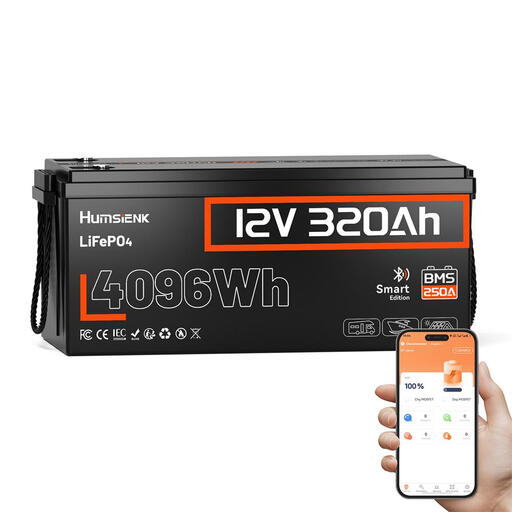
HumsiENK 12V 320Ah LiFePO4 Battery, 4096Wh, 250A BMS, Bluetooth, for RV, Marine, Off-Grid
Why this product suits the profile: With 320 Ah, Bluetooth monitoring and a 12-volt design, this battery offers a clearly specified foundation for RVs, camping and smaller off-grid systems.
The product description provides more than just the capacity: it also specifies the energy content, BMS functions and app data. This makes it possible to assess key comparison points before purchase.
4,096 Wh according to the supplier, an integrated 250A BMS and Bluetooth 5.0; expansion up to 4S4P is specified.
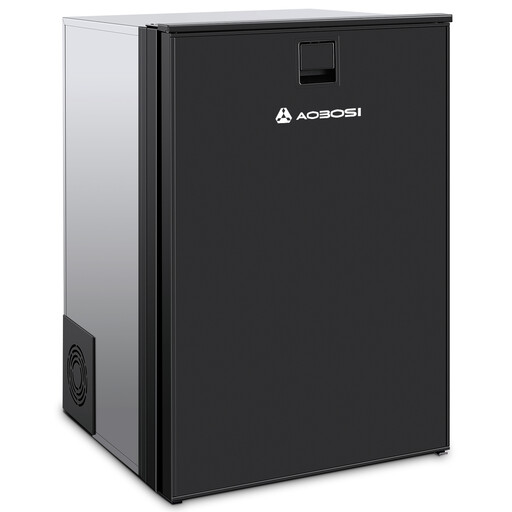
AAOBOSI 110L Dual Zone Compressor Refrigerator
Why this product suits the profile: For RV and boat owners with high refrigeration needs, the combination of a suitably sized solar battery and a larger compressor refrigerator is particularly relevant.
The stated capacity helps you plan your actual cooling requirements instead of selecting a battery solely by its advertised Ah rating.
110-litre capacity and dual-zone compressor design according to the product name.
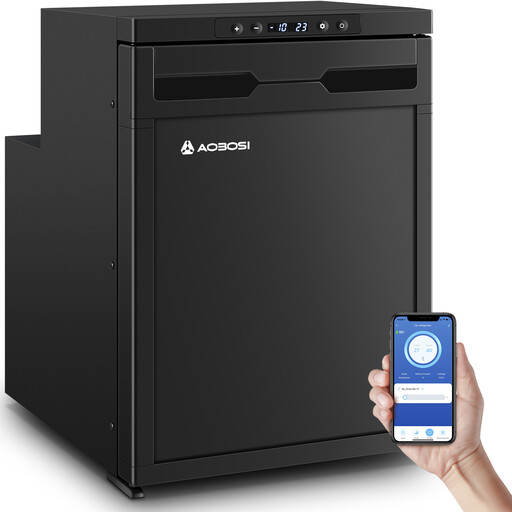
AAOBOSI 45L RV Refrigerator Freezer with App Control
Why this product suits the profile: The more compact 45-litre solution is ideal for users who want to limit energy consumption in a camper, SUV or boat while still having access to mobile refrigeration.
The smaller capacity makes it easier to create a realistic balance between the cooling appliance, battery size and daily recharging capacity.
45-litre capacity, 12/24-volt compressor operation and app control according to the product name.
Looking for more options?
We have compiled a complete, regularly updated list of products that fully meet these strict selection criteria and the safety regulations applicable in the EU.
Installation and Operation in Germany
A 12V camping battery should be mounted on a solid, dry surface protected from mechanical damage. Use suitable fuses positioned as close as possible to the battery connection. The cables must be rated for the maximum current and cable length.
Charging via shore power, solar panels or an alternator requires a suitable charger or DC-DC charger, respectively. Check the manufacturer’s specifications for charging voltage and operating temperature range. Charging LiFePO4 batteries may be restricted at low temperatures; the BMS’s specific protection functions should be confirmed before installation.
For an expandable LiFePO4 battery, use only combinations approved by the manufacturer. Different battery types, significantly different states of charge or incompatible systems can result in malfunctions. Work on permanently installed 12-volt and 230-volt systems should be carried out by a qualified professional if you lack the necessary experience.
FAQ About the 12V 320Ah LiFePO4 Battery
How long will a 12V 320Ah LiFePO4 battery last?
That depends on your energy consumption. A 100-watt device theoretically requires around 100 Wh per hour of operation. With a stated energy capacity of 4,096 Wh, you can make a rough estimate of the available runtime. Inverter losses, temperature, state of charge and the desired reserve will reduce the amount of energy that can be used in practice.
Can the battery directly replace a lead-acid battery?
Not without checking compatibility. The voltage, charging method, dimensions, connections, fuses and BMS must be suitable for the vehicle or solar system. In particular, the charger and any existing DC-DC charger should support an appropriate LiFePO4 charging profile.
Is Bluetooth necessary for a solar or RV battery?
Bluetooth is not essential, but it makes it easier to monitor voltage, temperature and state of charge. This feature can be particularly useful when the battery is installed in a hard-to-access location. Before purchasing, check the range, app functions and privacy information provided for the relevant system.