
Choosing a 12V LiFePO4 Battery: How to Compare Capacity, BMS and Application
A 12V LiFePO4 battery can be a practical alternative to lead-acid batteries in motorhomes, boats, solar systems and off-grid setups. However, the stated capacity alone is not the deciding factor. Unsuitable dimensions, an inadequate BMS or a lack of low-temperature protection can significantly limit everyday use.
This buying guide shows you which specifications really matter and which typical marketing pitfalls you should check before purchasing a 12V lithium battery.
Typical Buying Pitfalls with a 12V LiFePO4 Battery
1. Amp-hours are considered without the energy content
The specification of 100 Ah, 200 Ah or 300 Ah describes the capacity initially. For practical assessment, the energy content in watt-hours is also important:
Energy content = Voltage × Capacity
A 12V battery with 100 Ah corresponds mathematically to approximately 1,280 Wh, while a 12V battery with 300 Ah reaches around 3,840 Wh. The actual usable value depends on factors including depth of discharge, temperature, inverter and connected devices.
2. A high discharge current doesn't tell you everything about everyday suitability
A 200A or 250A BMS can be interesting for powerful consumers. However, this does not automatically mean that every connected device can be operated continuously at this power level. The inverter, cable cross-section, fuses and connectors must also be compatible with the system.
Therefore, check:
- Continuous discharge current and short-term peak current
- Power consumption of the inverter
- Fusing and cable cross-section
- Compatibility with charger, alternator or solar charge controller
3. Low-temperature protection is confused with general temperature tolerance
LiFePO4 cells should not be charged at low temperatures without a suitable protection function. A battery with low-temperature protection can interrupt the charging process under critical conditions. Pay attention to whether the protection actually affects charging and what limit values the supplier specifies.
Specifications such as IP65 or IP67 should also not be taken as a free pass for every installation situation. The housing must be correctly installed and protected from permanent submersion, mechanical damage and incorrectly routed connections.
The Most Important Technical Parameters at a Glance
Choosing the right capacity for your consumption
For occasional camping with lights, USB devices and small consumers, a LiFePO4 battery 100Ah may be sufficient. With a compressor fridge, heating, television or inverter, the demand increases. A LiFePO4 battery 200Ah offers approximately 2,560 Wh, while a 300Ah variant offers around 3,840 Wh.
For longer periods without mains hook-up, larger solutions may also be considered, such as a LiFePO4 battery 320Ah or a LiFePO4 battery 640Ah. The latter is more suitable for large motorhomes, extensive solar systems, boats or stationary 12V energy storage.
Compare BMS functions carefully
A battery with BMS refers to an integrated battery management system. Depending on the model, it monitors, among other things:
- Overcharging and deep discharge
- Overcurrent and short circuit
- Cell balancing
- Overtemperature
- Low temperature during charging
A Bluetooth battery can additionally display values such as voltage, state of charge or temperature via an app. This makes monitoring easier, but does not replace a suitable fuse or professional installation.
Dimensions, weight and expandability
Before purchasing, you should measure the available installation space. Particularly in motorhomes and boats, the housing height, connection position and mounting are crucial. Some models support series or parallel connection. In this case, the batteries must match in terms of voltage, state of charge and model specifications.
An upgrade to 24V or 48V is only sensible if the inverter, chargers and consumers are designed for it. The manufacturer's specifications for the maximum configuration should be strictly observed.
Our Selection by User Profile
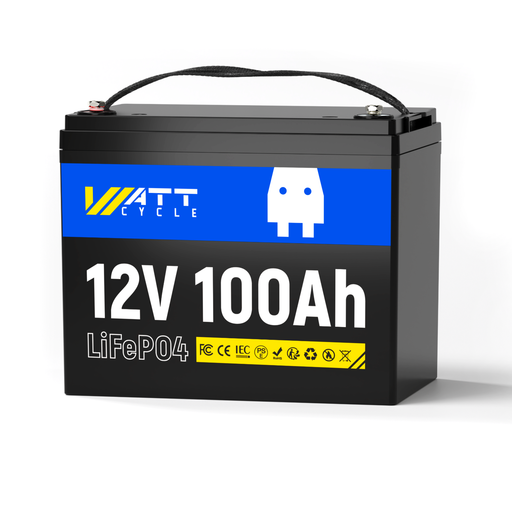
WattCycle 12V 100Ah LiFePO4 Battery, Deep-Cycle, for RV, Solar, Marine, Off-Grid
Why this product suits the profile: The 100Ah capacity and stated Group-24 format are suitable for users looking for a compact deep-cycle battery for motorhomes, boats, solar systems or smaller off-grid applications.
The product specifications state 1,280 Wh, a 100A BMS and an expandable 4S4P configuration. This makes it easier to assess capacity and protection functions before purchase.
An ABS housing, 23 lb weight, 1,280 Wh energy content and support for series and parallel connection are specified.
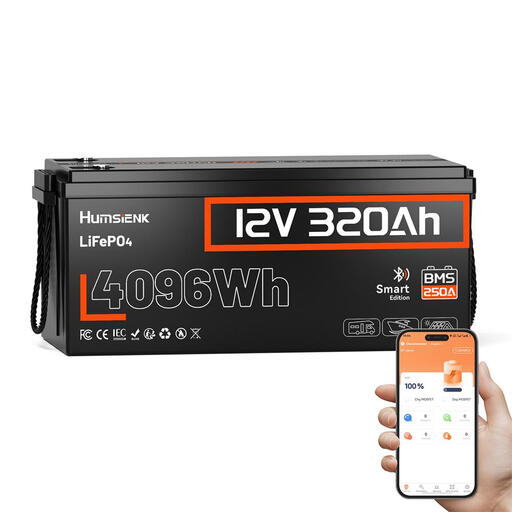
HumsiENK 12V 320Ah LiFePO4 Battery, 4096Wh, 250A BMS, Bluetooth, for RV, Marine, Off-Grid
Why this product suits the profile: The combination of 4,096 Wh, 250A BMS and Bluetooth monitoring is aimed at users with higher energy requirements in motorhomes, marine or off-grid systems.
Capacity, BMS current and monitoring function are clearly specified. Additionally, IP65 protection and a possible 4S4P expansion are mentioned.
Bluetooth 5.0, 4,096 Wh energy content, 250A BMS and specifications of up to 6,000 cycles at 80 % depth of discharge according to the manufacturer's description.
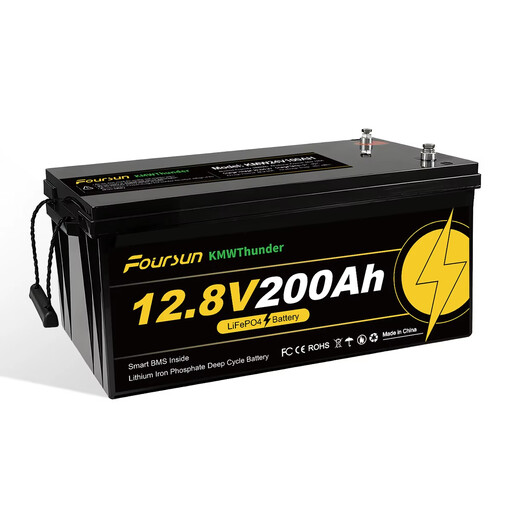
Foursun 12V 200Ah LiFePO4 Battery, Low-Temperature BMS Protection, 4500+ Cycles, for RV, Solar
Why this product suits the profile: For motorhomes, solar batteries and seasonally used vehicles, the stated low-temperature protection during charging is an important selection criterion.
The description specifies concrete charging and discharging current values as well as temperature-related BMS protection. These specifications should be checked against your existing charger.
2,560 Wh, IP67 housing protection, up to 4S4P expandability and more than 4,500 cycles are specified according to the product description.
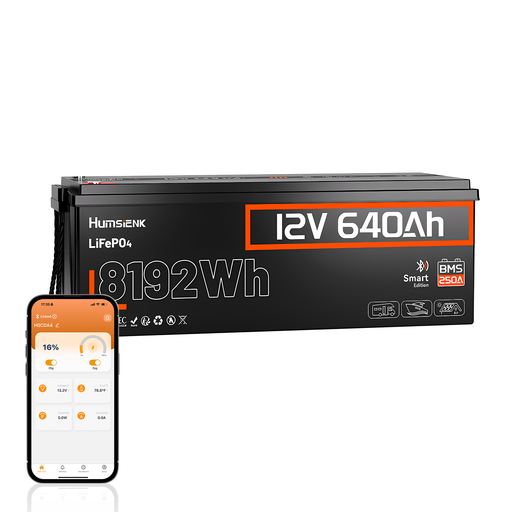
HumsiENK 12V 640Ah LiFePO4 Battery, 8.19kWh, 250A BMS, Bluetooth, Low-Temperature Protection
Why this product suits the profile: With 640 Ah and 8.19 kWh, this model is aimed at large motorhomes, stationary solar batteries, marine applications and off-grid installations with high energy requirements.
The high capacity is described with concrete dimensions, weight, 250A BMS and Bluetooth function. Before purchasing, the installation location and inverter power must be checked.
8.19 kWh, 250A BMS, Bluetooth monitoring, low-temperature cut-off and support for a 4S4P configuration are specified.
Looking for more options?
We have compiled a complete, regularly updated list of products that fully meet these strict selection criteria and the safety regulations applicable in the EU.
FAQ about the 12V LiFePO4 Battery
How long does a 12V LiFePO4 battery last?
The lifespan depends on cell quality, charging profile, temperature, depth of discharge and usage. Manufacturers specify, for example, more than 4,500 or up to 6,000 cycles under certain conditions for the models listed. These values are not a guarantee for every installation. A suitable charging characteristic and protection against deep discharge can support long-term use.
Can a LiFePO4 battery be charged in winter?
That depends on the specific model. At temperatures around or below freezing, charging should only take place if the manufacturer expressly permits it or a suitable low-temperature protection is present. Check the charging limits of the BMS and the specifications of the charger.
What capacity is sensible for a motorhome?
For short stays and moderate consumers, a LiFePO4 battery 100Ah may be sufficient. With a fridge, heating, inverter and longer periods without mains hook-up, 200 Ah or 300 Ah are often more suitable. Your individual daily consumption, solar charging power and available installation space should be calculated before making a decision.