
12V LiFePO4 Battery Buyer’s Guide and Recommendations
As a Joybuy Product Recommendation Officer, I analyse the market to provide you with clear and objective information for your purchasing decisions. This guide is designed to help you find the right 12V LiFePO4 battery for your needs, whether it's for an RV, a boat, or an off-grid solar system. We will focus on technical features and practical use cases to give you a solid foundation for your choice.
The search for a reliable deep-cycle battery can be complex. Conventional lead-acid batteries are heavy, have a limited lifespan, and can often only be discharged to about 50% without sustaining damage. A lithium iron phosphate (LiFePO4) battery offers a modern alternative with higher energy density, lower weight, and a significantly longer service life.
What to Look for When Buying a LiFePO4 Battery
Choosing the right battery depends on your specific energy needs and operating conditions. The following three criteria are crucial for making an informed decision.
1. Correctly Determining Capacity (Ah) and Energy (Wh)
A battery's capacity is specified in ampere-hours (Ah) and describes how much current it can deliver over a specific period. For example, a 100Ah battery can supply 10 amps for 10 hours. However, the more important figure for total energy storage is watt-hours (Wh), which is calculated by multiplying the nominal voltage (approx. 12.8V for LiFePO4) by the capacity (Ah).
- For weekend trips in a camper: A capacity of 100Ah (approx. 1280 Wh) is often sufficient for lighting, a water pump, and charging mobile devices.
- For extended off-grid use in an RV or on a boat: Models with 200Ah (approx. 2560 Wh) or 300Ah (approx. 3840 Wh) provide enough reserve power for a refrigerator, inverter, and other appliances.
- For off-grid solar systems: The required capacity depends on daily energy consumption and the desired autonomy time (days without sunlight).
A key advantage of LiFePO4 batteries is that they make almost their full nominal capacity available, unlike lead-acid batteries, where only 50-60% should typically be used.
2. The Function of the Battery Management System (BMS)
Every high-quality LiFePO4 battery should be equipped with a BMS. The Battery Management System is the battery's electronic control unit and performs several critical protective functions:
- Overcharge protection: Prevents cell damage from excessive charging voltage.
- Over-discharge protection: Shuts off the battery before the voltage drops to a critical level.
- Temperature monitoring: Protects against operation at excessively high or low temperatures (especially important when charging below 0°C).
- Short-circuit protection: Disconnects the circuit in the event of a short circuit.
- Cell balancing: Ensures all cells in the battery pack maintain the same state of charge, which maximises lifespan and performance.
A robust BMS is therefore not an optional extra, but a fundamental requirement for the safe and long-lasting operation of an RV house battery or a 12V solar battery.
3. Cycle Life and Longevity
A battery's lifespan is measured in charge cycles. One cycle corresponds to a full discharge followed by a full recharge. LiFePO4 batteries have an extremely high cycle life. While lead-acid batteries often only last for a few hundred cycles, lithium iron phosphate batteries can achieve several thousand.
Pay attention to the cycle count specified in conjunction with the Depth of Discharge (DoD). A specification like "4500+ cycles at 80% DoD" means the battery can be discharged to 80% and recharged more than 4,500 times before its capacity noticeably degrades. This high cycle life makes them a cost-effective long-term investment for demanding applications, such as on a boat or in continuous use.
Top LiFePO4 Battery Recommendations
Based on the criteria mentioned, we have compiled a selection of products that stand out for their technical specifications and areas of application.
HumsiENK 12V 100Ah LiFePO4 Battery
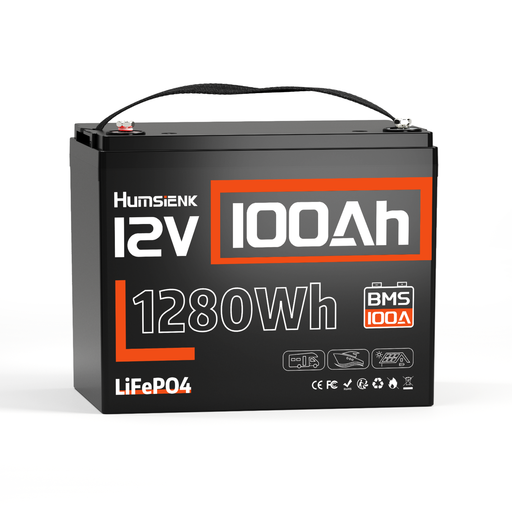
Why it stands out: This model is distinguished by an exceptionally high cycle count of over 15,000, as stated by the manufacturer, and a lifespan of up to 10 years. Its IP67 certification makes it dustproof and protects it against temporary submersion, making it ideal for use in harsh environments like on boats or in off-road applications.
Advantages:
- High cycle life: Over 15,000 cycles according to the manufacturer's specifications.
- Compact and lightweight: Weighing just 8.95 kg (19.73 lbs) and matching the BCI Group 24 dimensions, it fits easily into tight installation spaces.
- Comprehensive protection: The integrated 100A BMS provides protection against overcharging, over-discharging, short circuits, and overcurrent. Low-temperature protection is also included.
- Expandable: Up to 4 batteries can be connected in series (for 48V) and 4 in parallel (for 400Ah).
Who is it for? Ideal for users looking for a lightweight, compact, and exceptionally durable RV battery or boat battery. The high protection rating and low weight are key advantages for mobile applications.
Humsienk 12V 320Ah LiFePO4 Battery with Bluetooth
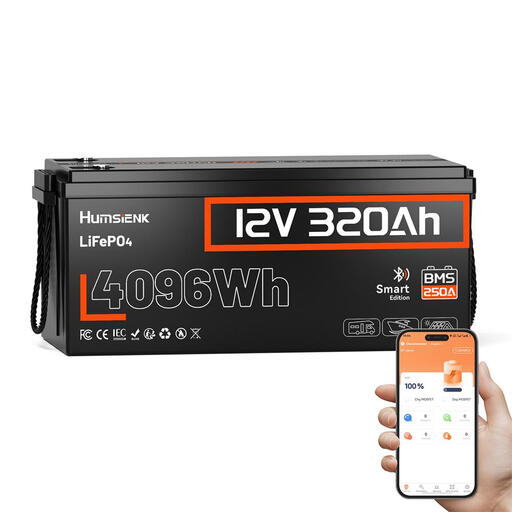
Why it stands out: With a 320Ah capacity and 4096Wh of energy, this battery offers a massive amount of energy storage. The integrated Bluetooth module allows for convenient monitoring of the state of charge, voltage, and temperature via a smartphone app. The powerful 250A BMS also supports energy-intensive consumers like large inverters.
Advantages:
- High capacity: 4096Wh of energy for extended off-grid autonomy or operating high-power devices.
- Smart monitoring: Integrated Bluetooth 5.0 for real-time monitoring via an app.
- Powerful BMS: The 250A BMS is designed for high continuous loads and peak currents.
- Durable cells: Uses EV-grade A+ cells for up to 6000 cycles at 80% DoD, according to the manufacturer.
Who is it for? Perfect for van life projects, yachts, or larger off-grid systems with high energy demands. Users who value convenience and the ability to monitor their system remotely will find this an ideal solution.
Foursun 12V 200Ah LiFePO4 Battery
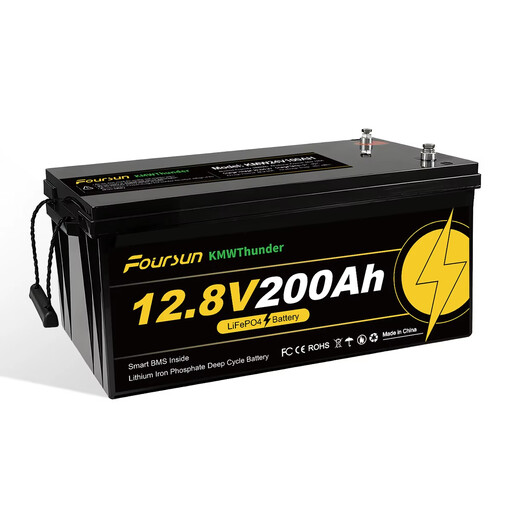
Why it stands out: This model offers a balanced capacity of 200Ah, which is ideal for many applications in RVs or for medium-sized solar systems. The BMS includes low-temperature protection, which prevents charging in freezing conditions to protect the cells. With a specified cycle count of over 4,500, it offers solid longevity.
Advantages:
- Good all-around capacity: 200Ah (2560Wh) is a great compromise between size, weight, and energy reserve.
- Low-temperature protection: The BMS protects the battery from damage when charging below 0°C.
- Flexibly expandable: Supports connecting up to 4 batteries in series and 4 in parallel (4S4P).
- Robust construction: The ABS housing with an IP67 protection rating is designed for mobile use.
Who is it for? An excellent choice for users looking to replace their lead-acid battery in an RV house battery system and who want a reliable, long-lasting solution with good capacity and essential protective features.
Looking for More Options?
If the models presented here don't exactly meet your requirements, a wide range of other battery technologies are available. Discover more innovative storage solutions in our energy storage category.
Discover more products in the Supercapacitor Battery category
Frequently Asked Questions (FAQ)
What are the main advantages of a LiFePO4 battery over a lead-acid battery?
A 12V LiFePO4 battery offers several key advantages: it is up to 70% lighter, has a 5 to 10 times longer lifespan (cycle life), can be almost completely discharged (approx. 90-100% DoD), and has an integrated BMS for enhanced operational safety. Additionally, it is maintenance-free.
Do I need a special charger for a LiFePO4 battery?
Yes, it is strongly recommended to use a charger that has a specific charging profile for LiFePO4 (or lithium). These chargers use a CC/CV (Constant Current/Constant Voltage) charging curve that is optimally matched to the cell chemistry and prevents overcharging. Many modern solar charge controllers and AC chargers offer a corresponding setting.
What does "BMS" mean for a lithium iron phosphate battery?
BMS stands for Battery Management System. It is an integrated electronic circuit that monitors and protects the battery. Its main functions include protection against overcharging, over-discharging, overcurrent, short circuits, and extreme temperatures. It also handles the balancing of individual cells, which is essential for maximising the battery's lifespan and performance.