
12V 300Ah LiFePO4 Battery: Buying Guide for Motorhomes, Solar and Boats
A 12V 300Ah LiFePO4 battery offers a high nominal storage capacity for motorhomes, boats and off-grid solar systems. At the same time, batteries in this class differ significantly in terms of BMS functions, charging specifications, dimensions and connection options. If you focus solely on the "300Ah" rating or a high number of charge cycles, you could end up buying a battery that cannot be used optimally in your existing system.
Common Buying Mistakes with a 12V 300Ah Lithium Battery
1. Confusing the Ah Rating with Actually Usable Energy
Capacity is given in amp-hours. To work out the rough amount of energy, you also need to consider the voltage:
12V × 300Ah = approximately 3,600Wh
For the Foursun battery, the product specifications state 3,840Wh. The energy that is actually available depends on factors such as depth of discharge, inverter, cabling, temperature and the BMS cut-off limits. The 300Ah rating alone therefore does not tell you how long you can run your fridge, lighting or inverter.
2. Evaluating "4,500 Charge Cycles" Without Conditions
The figure of 4,500+ charge cycles is a manufacturer's value and should not automatically be taken as a guaranteed service life. What really matters are the underlying test conditions, the state of charge, the ambient temperature and the depth of discharge. For a fair comparison, buyers should check whether the cycle count is given for a full discharge or for a shallower depth of discharge.
3. Equating Low-Temperature Protection with Full Winter Suitability
A battery with low-temperature protection can interrupt the charging process via the BMS when temperatures are unfavourable. This protects the cells from being charged in unsuitable conditions, but it does not replace a proper installation. In a motorhome or boat, the battery should be mounted in a protected, frost-free area wherever possible. Also check that your charger, solar controller and alternator are compatible with the battery's charging specifications.
Technical Parameters You Should Check Before Buying
Capacity, Voltage and Power Requirements
A 12V deep-cycle battery with 300Ah is ideal for applications with regular energy consumption. These include a compressor cool box, lighting, water pump, router or a small inverter. A simple calculation will help you work out your needs:
Power consumption in watts × operating hours = watt-hours required
With an inverter, you also need to factor in conversion losses. A 100W device running for ten hours will therefore require slightly more than 1,000Wh from the battery.
Charge and Discharge Current
According to Foursun's product specifications, the 300Ah version features:
- Standard charge current: 60A
- Maximum charge current: 200A
- Maximum discharge current: 235A
- Overcurrent protection: 250A
- Charge voltage: 14.4V ± 0.2V
- Internal resistance: maximum 30mΩ
These values must be compatible with your charger, solar controller, inverter and cable sizing. A high maximum discharge current does not automatically mean that every connected device can safely draw that current. Fuses, cable cross-section, connectors and ventilation are all part of the system design.
BMS, Casing and Mounting Space
An integrated Battery Management System (BMS) can, according to the product description, handle cell balancing, overvoltage and undervoltage protection, short-circuit protection and temperature monitoring. However, the BMS is not a substitute for a correctly designed electrical installation.
The 300Ah version is described as having dimensions of 550 × 230 × 220mm and an ABS plastic casing. Before buying, measure your battery box, the access opening and the space available for connections and fuses. The stated IP67 protection rating refers to the product specification and should not be interpreted as approval for permanent underwater use.
Recommendations by User Profile
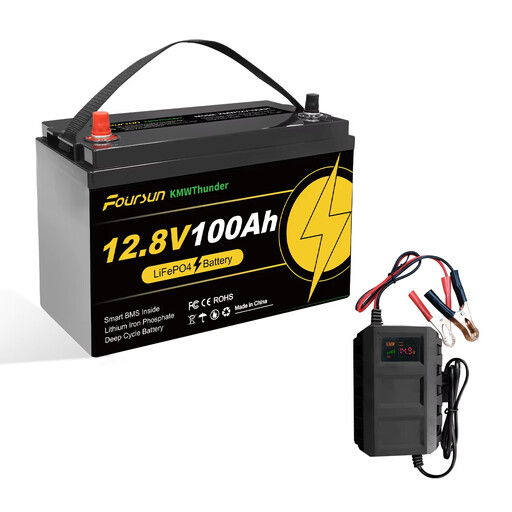
Foursun 12V 100Ah LiFePO4 Battery with Charger
Why this product suits the profile: For smaller motorhomes, weekend camping or modest solar applications, a 100Ah battery can make the switch to lithium technology simpler, without having to plan for the dimensions of a 300Ah solution.
The smaller capacity reduces the risk of buying an oversized battery. According to the product specifications, BMS protection functions and a charger are included.
12V system, 100Ah capacity and, according to the supplier, 4,500+ charge cycles.
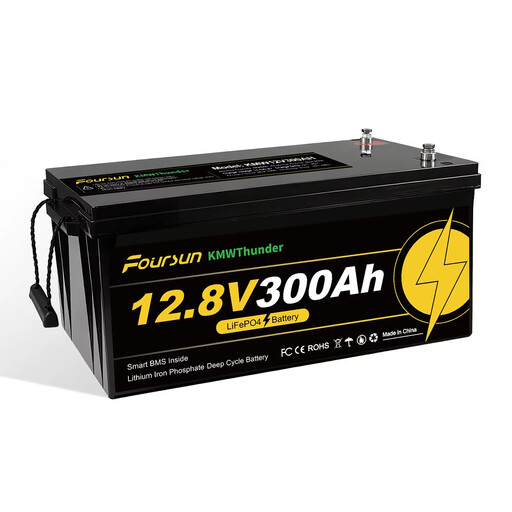
Foursun 12V 300Ah LiFePO4 Battery with Low-Temperature BMS
Why this product suits the profile: The 300Ah capacity is suitable for longer stays in a motorhome, larger appliances and a solar battery application with higher daily energy requirements.
The product specifications state specific dimensions, charge voltage, current values, IP67 and low-temperature protection. This allows you to check space requirements and system compatibility before buying.
3,840Wh according to the product specification, maximum 235A discharge current and BMS functions for multiple protection areas.
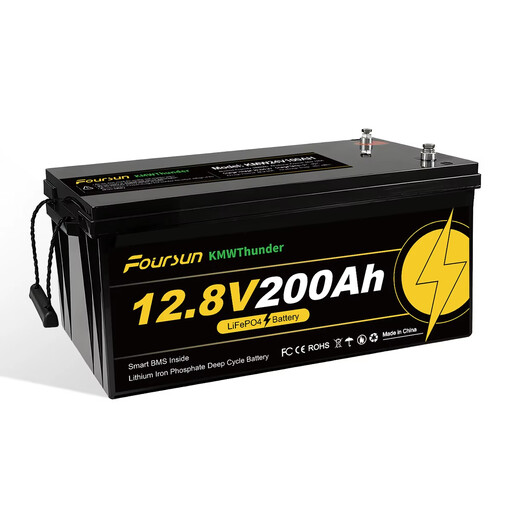
Foursun 12V 200Ah LiFePO4 Battery with Low-Temperature BMS
Why this product suits the profile: A 200Ah variant can offer a balanced capacity level for camping and boating, medium-sized solar storage or multiple electrical appliances.
The medium capacity can help you avoid unnecessary weight and space requirements compared to a larger battery. Series and parallel connections should only be made according to the instructions and with suitable cables.
2,560Wh according to the product specification, BMS protection functions and support for off-grid applications.
Installation and System Matching
Before installation, you should check the following points:
- Does the battery fit mechanically into the intended mounting location?
- Is the charger suitable for LiFePO4 and the specified charge voltage?
- Are the fuse, cable cross-section and terminal connections rated for the possible current?
- Does the inverter have a suitable undervoltage cut-off?
- Is the permissible system voltage maintained when batteries are connected in series?
- Are multiple batteries at a similar state of charge before connecting them?
A solar battery 300Ah can only work effectively if the solar controller, charging sources and load side are all matched to each other. If you are unsure, the installation should be carried out by a qualified electrician.
Looking for more options?
We have put together a complete, regularly updated list of products that fully meet these strict selection criteria and the safety regulations in force in the EU.
Frequently Asked Questions About the 12V 300Ah LiFePO4 Battery
How long does a 12V 300Ah LiFePO4 battery last?
The service life depends on charge cycles, depth of discharge, temperature, charger and storage conditions. The figure of 4,500+ charge cycles should be regarded as a manufacturer's value and does not represent a blanket guarantee for a specific number of years.
Can I charge a 12V 300Ah battery in my motorhome using the alternator?
This depends on the charging system. A suitable charge booster may be required to match the voltage and current to the LiFePO4 battery. Before installation, the alternator, charge booster, BMS and cable sizing should all be checked together.
Is a 300Ah battery suitable for a solar storage system?
Yes, a 12V 300Ah battery can be used for off-grid solar systems, provided the solar controller, charge voltage and maximum charge current are compatible. For larger household systems, a 24V or 48V system may be technically more suitable; this depends on the inverter and your daily energy requirements.