
12V 100Ah LiFePO4 Battery Buying Guide: Technical Selection Help for Motorhomes, Solar and Boats
A 12V 100Ah LiFePO4 battery is often offered as a compact alternative to lead-acid batteries. For motorhomes, boats, solar systems, camping equipment and backup power solutions, the 100 Ah capacity is generally appealing. However, the Ah rating alone does not determine whether a battery is suitable for your application.
If you only focus on a high cycle count or a low price, you may overlook important points: a lack of temperature protection, an incompatible charger, or dimensions that do not fit the intended battery compartment.
Typical pitfalls when buying a 12V 100Ah LiFePO4 battery
1. Confusing the Ah rating with usable energy
100 Ah at 12.8 V equates to roughly 1280 Wh. The actual runtime, however, depends on the load, depth of discharge, ambient temperature and system efficiency. A device drawing 100 W theoretically needs about 100 Wh per hour, plus additional losses from cables, inverters and charging electronics.
A 1280Wh battery is therefore not automatically suitable for every household appliance. Before purchasing, you should check the maximum continuous power of your inverter and the short-term starting current.
2. Mistaking a BMS for a complete safety solution
An integrated Battery Management System, or BMS, can protect against overcharging, deep discharge, overcurrent, short circuits and excessively high or low temperatures, depending on the model. However, the features vary between different models.
A battery with a 100A BMS may, for example, be suitable for certain inverters, electric motors or multiple loads. What matters is whether the continuous and peak currents of your application fall within the manufacturer's specifications. A 100 A BMS does not mean that every load should be run continuously at 100 A.
3. Not checking the charger and temperature range
A lithium iron phosphate battery requires a suitable charging profile. An existing lead-acid charger is not always compatible. For motorhomes, boats and solar systems, the charger, solar charge controller and inverter must be explicitly approved for LiFePO4 batteries.
Charging at low temperatures deserves special attention. Some models have built-in low-temperature protection, while others require a heated battery or must be disconnected from the charger in freezing conditions.
The key selection criteria at a glance
Capacity, voltage and system size
A 12V 100Ah LiFePO4 battery delivers nominally around 1280 Wh. For higher voltages or more storage capacity, some models can be connected in series or parallel. When doing so, you must use batteries of the same type, the same state of charge and, ideally, the same age.
Connecting in series increases the voltage, while connecting in parallel increases the capacity. Before installation, you must follow the manufacturer's instructions regarding the maximum permitted combinations, fuses and cable cross-sections.
Housing, installation dimensions and protection rating
Many 12V 100Ah batteries follow the Group 24 format. However, this designation does not replace checking the actual dimensions. Cable connections, handles, terminal covers and mounting frames may require additional space.
For outdoor applications, the protection rating and housing material are important. IP67 means, according to the protection classification, a defined level of protection against dust and temporary immersion under specified test conditions. It does not mean that a battery can be operated permanently underwater. On boats, the battery should also be secured against slipping, splashing water and direct heat sources.
Charge and discharge current
For a solar battery, the permissible charge current is just as important as the capacity. A model with a recommended charge current of 20 A behaves differently in practice from a battery that accepts higher currents. Also check whether the maximum discharge current matches your inverter, cool box, electric motor or portable power station.
Our selection by application profile
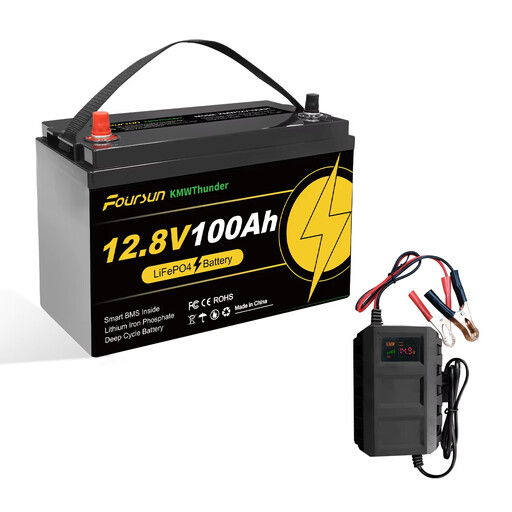
Foursun 12V 100Ah LiFePO4 Battery with Charger
Why this product fits the profile: The combination of 100 Ah capacity, charger and IP67 housing is appealing for buyers looking for a straightforward camping battery for a motorhome, garden or solar setup.
The product datasheet mentions low-temperature, overcurrent and short-circuit protection. Before installation, you should still check the charging profile and connection ratings.
1280 Wh energy according to product specifications, IP67 housing, rated for 4500+ charge cycles and supplied with a charger.
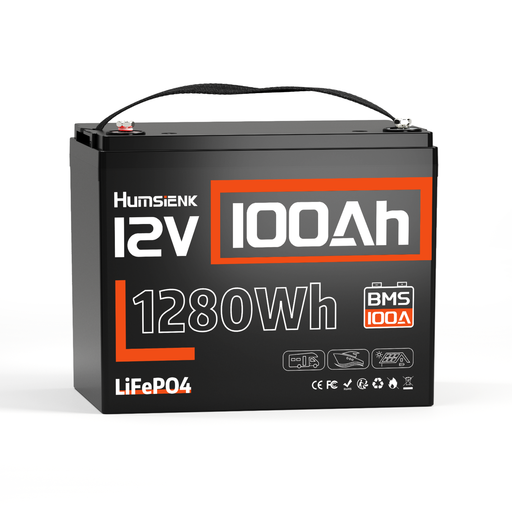
HumsiENK 12V 100Ah LiFePO4 Battery, 1280 Wh, 100A BMS
Why this product fits the profile: The Group 24 form factor and stated weight of 19.73 lb can be relevant for motorhomes, boats and tight installation spaces.
The integrated 100A BMS is designed, according to product specifications, for overcharge, deep discharge, short circuit, overcurrent and low temperatures.
Rated for 15,000+ charge cycles, IP67 protection and expandable up to 4S4P according to the manufacturer's guidelines.
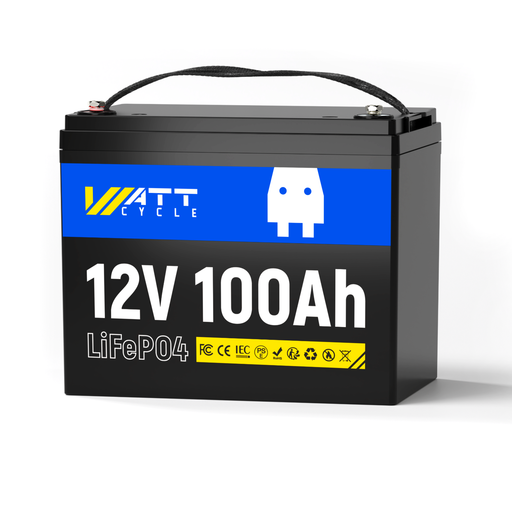
WattCycle 12V 100Ah LiFePO4 Battery, Deep-Cycle
Why this product fits the profile: Its focus on RV, marine, golf cart and off-grid energy storage appeals to users with regular charging and discharging cycles.
The datasheet mentions a reinforced ABS construction, a 100A BMS and support for a 4S4P configuration. The wiring must be appropriately sized.
Group 24 dimensions, 1280 Wh according to the supplier's specification and a designated deep-cycle design for solar, marine and vehicle applications.
When a portable power station makes more sense
A permanently installed 12V battery is best suited for systems with their own charger, solar charge controller or inverter. If, on the other hand, you want to power smartphones, laptops, a cool box or selected household appliances without wiring, you might consider a portable power station.
The DJI Power 1000 Mini, according to the product description, features a 1008 Wh LFP battery, 1000 W output power, a 400 W MPPT interface and can charge to 80 per cent in 58 minutes. At 11.5 kg, it is noticeably heavier than many individual 12V batteries, but it offers connections and charging electronics all in one device.
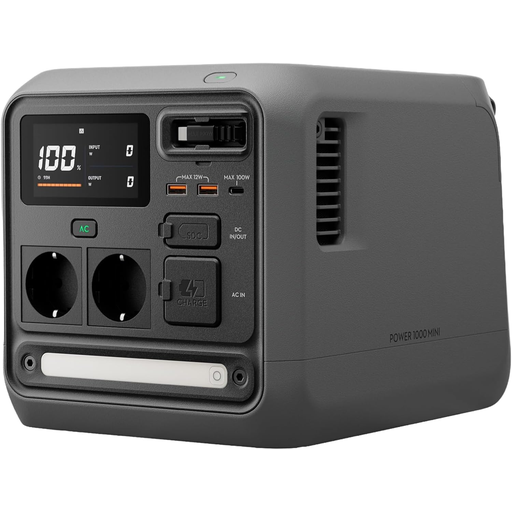
DJI Power 1000 Mini Portable Power Station
Why this product fits the profile: For camping, travel and short-term backup power, an all-in-one system with integrated outputs is more practical than a separately wired battery.
Capacity, inverter and charging functions are combined in one device. Before purchasing, you should still check whether the desired power and connection type are supported.
1008 Wh LFP capacity, 1000 W output power, 400 W solar charging and USB-C cable according to the product description.
Looking for more options?
We have compiled a complete, regularly updated list of products that fully meet these strict selection criteria and the safety regulations in force in the EU.
FAQ about the 12V 100Ah LiFePO4 battery
How long does a 12V 100Ah LiFePO4 battery last?
The lifespan depends on cell quality, charging profile, depth of discharge, temperature and storage conditions. Manufacturer claims such as 4500+, 5000+ or 15,000+ cycles should be understood under specific test and usage conditions. For a realistic assessment, you should check the warranty terms and the exact definition of a charge cycle.
Can I use a LiFePO4 battery in a motorhome?
Yes, provided the charger, solar charge controller, inverter and wiring are suitable for LiFePO4. In addition, the installation dimensions, terminal orientation, maximum currents and protection against charging at low temperatures must match your vehicle. Professional fusing near the battery is advisable.
Is a lithium battery for boats and marine use waterproof?
A stated protection rating such as IP67 describes the protection of the housing under defined conditions. It does not replace secure installation. On a boat, the battery should be kept dry, secured, ventilated according to the manufacturer's instructions and protected from salt water, condensation and mechanical stress.