
Choosing a 12V LiFePO4 battery: how to check capacity, BMS and compatibility
A 12V LiFePO4 battery is suitable for many applications: as a battery for motorhomes and campervans, boats, solar systems, camping, emergency power supplies or off-grid systems. The choice may seem straightforward at first glance, but technical specifications are not always directly comparable. A high Ah rating alone, for example, says little about whether the battery is compatible with your inverter, charger or installation space.
This buying guide explains which specifications matter before you buy and which product features you should check more closely.
Common pitfalls when buying a 12V lithium battery
1. Capacity is confused with usable energy
A specification such as 12V 100Ah corresponds to around 1,280 Wh in theory, based on a nominal voltage of approximately 12.8 V. However, the energy actually available depends on the depth of discharge, temperature, BMS settings, age and connected equipment.
An inverter also introduces conversion losses. When choosing a deep-cycle battery, you should therefore consider more than just the Ah rating:
- Nominal voltage and rated energy in Wh
- Permitted depth of discharge
- Continuous and peak discharge current
- Power consumption of the connected devices
- Charging power from the solar controller, charger or alternator
2. “Many cycles” without clear conditions
Manufacturers often state the cycle life together with a specific depth of discharge and remaining-capacity value. A figure such as “4,500 cycles” is therefore only meaningful if you know whether it was measured at, for example, 80% depth of discharge, at what temperature and down to what remaining capacity.
These figures should be regarded as manufacturer specifications. They are not a guarantee of a particular service life in your individual system.
3. The BMS is treated as a complete system solution
A battery with a BMS has an integrated battery management system. Depending on the model, this may protect against overcharging, deep discharge, overcurrent, short circuits and certain temperature conditions. However, the BMS does not replace correctly sizing the charger, using suitable cabling or ensuring professional installation.
Pay particular attention to the specifications for:
- Maximum charging and discharging current
- Deep-discharge protection and overvoltage protection
- Overtemperature and low-temperature cut-off
- Cell balancing
- Possible Bluetooth monitoring
- Series and parallel connection
The most important parameters for a 12V LiFePO4 battery
Capacity suited to your intended use
For smaller appliances, lighting, cool boxes or occasional camping trips, a 12V 100Ah LiFePO4 battery may be sufficient. For longer stays, multiple appliances or greater inverter requirements, 200 Ah or 300 Ah versions may be worth considering.
A 12V 320Ah LiFePO4 battery provides around 4.096 kWh of rated energy in theory. A 12V 640Ah LiFePO4 battery offers around 8.192 kWh. This capacity range is of interest for larger motorhomes, marine applications or off-grid systems, but requires sufficient space, appropriately sized cable cross-sections and a BMS suited to the load.
Charging and discharging current
The discharge current must be suitable for the connected devices. A high-powered inverter can draw substantial current from a 12 V battery. For example, a 1,200 W device ideally requires around 100 A; in practice, it will require more because of losses.
You should therefore check whether the BMS supports the required continuous current. Starting currents are also relevant for motors, compressors and inverters.
Temperature, casing and protection rating
LiFePO4 batteries should not be charged at low temperatures without a suitable protection function. A low-temperature cut-off can interrupt charging under critical conditions. This is particularly relevant for motorhomes, boats and outdoor installations in Germany.
The protection rating, such as IP65 or IP67, describes protection against dust and water under specified testing conditions. It does not automatically make a battery suitable for every outdoor environment. The installation location, ventilation, condensation and mechanical mounting remain important too.
Compatibility with chargers and inverters
Before buying, you should compare the charging voltage and charging profile. A charger for lead-acid batteries is not automatically suitable for a LiFePO4 battery. Also check:
- Maximum charging voltage
- Charger type and LiFePO4 profile
- Inverter voltage
- Connection cables and fuses
- Communication interfaces for larger storage systems
- Approval for series or parallel connection
For 48 V storage systems and stationary solar power storage systems, installation should be carried out by a qualified electrician.
Our selection by user profile
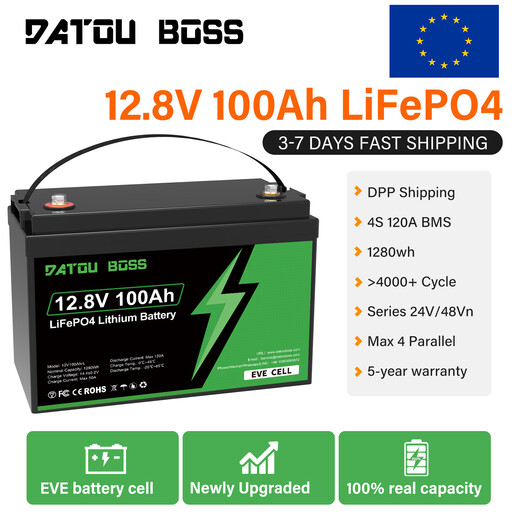
DATOUBOSS 12V 100Ah LiFePO4 Deep Cycle Battery
Why this product suits this profile: The 100 Ah class offers an accessible starting point for camping, smaller solar systems, boats or use as a replacement battery.
Calling it a deep-cycle battery focuses attention on its intended use rather than just short-term peak performance. The available product specifications should be checked against your own charger before purchase.
12 V system with 100 Ah and integrated BMS; suitable for typical mobile applications such as RVs, solar systems and boats.
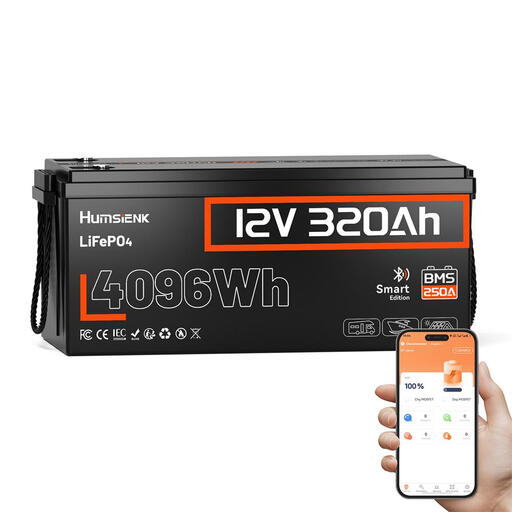
HumsiENK 12V 320Ah LiFePO4 Battery, 4096 Wh
Why this product suits this profile: The 320 Ah capacity is designed for longer stays in a motorhome, on a boat or in an off-grid system.
The product description specifies 4,096 Wh, a 250 A BMS, Bluetooth 5.0, IP65 and the option to expand to 4S4P. These details make it easier to compare the battery with your system requirements.
4.09 kWh of rated energy, Bluetooth monitoring and a 250 A BMS according to the product specifications; designed for expandable 12 V systems.
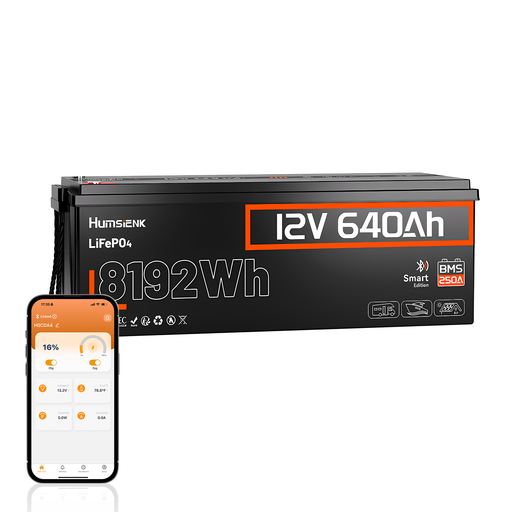
HumsiENK 12V 640Ah LiFePO4 Battery, 8.19 kWh
Why this product suits this profile: The high capacity is aimed at users with greater energy requirements, such as those with larger motorhomes, marine systems or stationary off-grid applications.
The product specifications list Bluetooth, a 250 A BMS, low-temperature cut-off and 4S4P expandability. Before buying, you must check the installation dimensions, weight, cables and inverter output.
8.19 kWh of rated energy, Bluetooth monitoring and protection features for larger 12 V energy storage systems, according to the product description.
Looking for more options?
We have put together a complete, regularly updated list of products that fully meet these strict selection criteria and the safety regulations applicable in the EU.
Frequently asked questions about 12V LiFePO4 batteries
How long does a 12V LiFePO4 battery last?
Service life depends on the number of cycles, depth of discharge, temperature, charging profile and storage conditions. Manufacturer specifications of 4,500, 6,000 or more cycles each apply under specific test conditions. Regular overloading or incorrect charging can shorten the battery’s service life.
Can a LiFePO4 battery be charged with a solar panel?
Yes, provided that a suitable solar charge controller with a LiFePO4 charging profile is used. The controller must be compatible with the battery voltage and maximum charging current. For a battery used in a solar system, you should also take the panel output, cable cross-section and fuses into account.
What does it cost to run a 12V lithium battery?
Ongoing costs mainly consist of charging energy, possible maintenance and eventual replacement. LiFePO4 batteries generally do not require regular fluid checks. For a fair cost comparison, consider the purchase price, usable capacity, expected cycle count and system accessories together.