
How to Choose a 12V 100Ah LiFePO4 Battery
The search for a reliable 12V 100Ah LiFePO4 battery for your RV, solar system, or boat can quickly become overwhelming. The market is flooded with technical specs and marketing promises that often obscure more than they clarify. As a Joybuy Product Recommendation Officer, my job is to provide you with objective guidance so you can make an informed decision and avoid common purchasing pitfalls.
Many buyers invest in a new lithium leisure battery, only to find that it doesn't deliver the expected performance or fails in cold weather. This is often due to three common misconceptions fueled by clever marketing:
- The Trap of Unrealistic Cycle Counts: Claims like "15,000 cycles" sound impressive but are often worthless without crucial context. The lifespan is directly dependent on the Depth of Discharge (DOD). A high cycle count that only applies to a very shallow 20% discharge is misleading for practical use in an RV or as a 12V solar battery.
- The "BMS Alibi": Nearly every 100Ah LiFePO4 with BMS is advertised with a Battery Management System. However, the quality and feature set vary dramatically. A basic BMS might protect against short circuits, but a critical feature for use in colder climates is often missing: protection against charging at temperatures below 0°C (32°F), which can permanently damage the battery cells.
- The Focus on Peak Current: High peak currents are relevant for jump starters, but for a deep cycle battery intended for the continuous supply of appliances like a refrigerator, lights, or an inverter, the continuous discharge current is the far more important metric.
What Really Matters: The Decisive Features of a LiFePO4 Battery
To avoid a poor investment, you should focus on the parameters that are crucial for a long-lasting and safe everyday power supply.
The Battery Management System (BMS): More Than Just a Circuit Breaker
The BMS is the brain of your 12V lithium iron phosphate battery. It is essential for safety and longevity. A high-quality BMS offers comprehensive protection:
- Over-voltage protection: Prevents cell overcharging.
- Under-voltage protection: Protects against harmful deep discharge.
- Short-circuit protection: Disconnects the circuit in the event of a short.
- Over-current protection: Protects against excessive charging and discharging currents.
- Temperature monitoring: A critical feature is low-temperature charging protection. This prevents the battery from being charged at temperatures below freezing, as this can lead to irreversible damage (lithium plating). For a camping battery that remains in the vehicle year-round, this function is indispensable.
Cycle Life and Depth of Discharge (DOD): Understanding True Lifespan
A high cycle life is a core advantage of LiFePO4 technology. However, the stated cycle count should always be considered in conjunction with the Depth of Discharge (DOD). A realistic and good specification is, for example, "4000 cycles at 80% DOD." This means you can discharge the battery to 80% of its capacity 4,000 times before its capacity noticeably degrades. In contrast, lead-acid batteries should often only be discharged to 50% to avoid drastically shortening their lifespan. A LiFePO4 battery thus offers significantly higher usable capacity.
Continuous Discharge Current: The Power for Your Appliances
While peak current is only available for a few seconds, the continuous discharge current indicates how much power the battery can deliver consistently. For a 100Ah battery, a continuous discharge current of 100A is a solid standard. This allows you to easily run an inverter that powers devices like a coffee maker, a hairdryer, or tools with a power consumption of up to 1200 watts. A continuous discharge current that is too low would cause the BMS to shut down under a higher load.
Recommendations To Match You
Here are some recommendations tailored to different user profiles and their specific requirements.
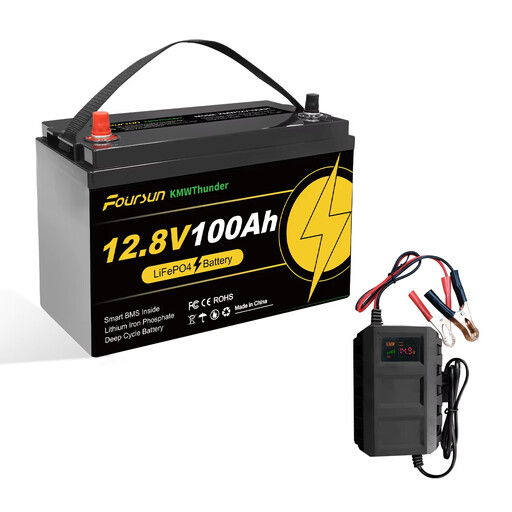
Foursun 12V 100Ah LiFePO4 Battery with Low-Temp BMS Protection
Why This Fits Their Persona: Ideal for users switching from lead-acid to lithium who need a solid, reliable entry-level setup for their RV battery or a small 12V solar battery without paying extra for premium features.
According to the manufacturer, the integrated BMS includes low-temperature protection, which bypasses the "BMS alibi" trap and qualifies the battery for year-round use.
Offers a clear and realistic lifespan rating of over 4500 cycles. The ability to connect in series and parallel (up to 4S4P) ensures future expandability.
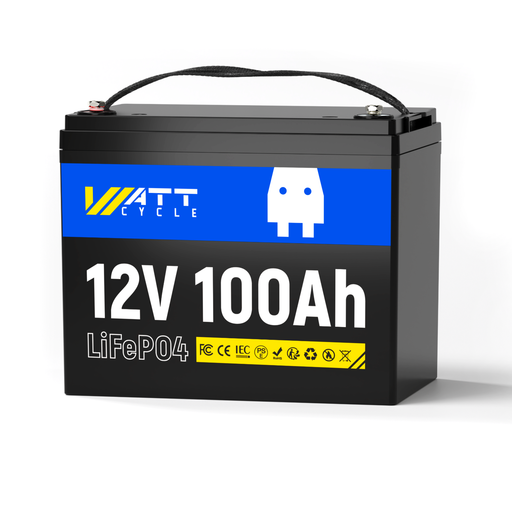
WattCycle 12V 100Ah LiFePO4 Battery, Deep-Cycle
Why This Fits Their Persona: Perfect for RV and boat owners where every inch and every pound matters. Its compact design and low weight simplify installation and optimize payload.
Focuses on relevant practical advantages: The standard BCI Group 24 case format makes it easy to replace old lead-acid batteries. The reinforced structure with an internal metal frame is designed for the stresses in vehicles and as a marine battery.
The advanced 100A BMS ensures reliable operation and allows for system expansion up to 20.48 kWh (4S4P). Its low weight of approx. 10.4 kg (23 lbs) is a significant advantage over lead-acid models (approx. 30 kg).
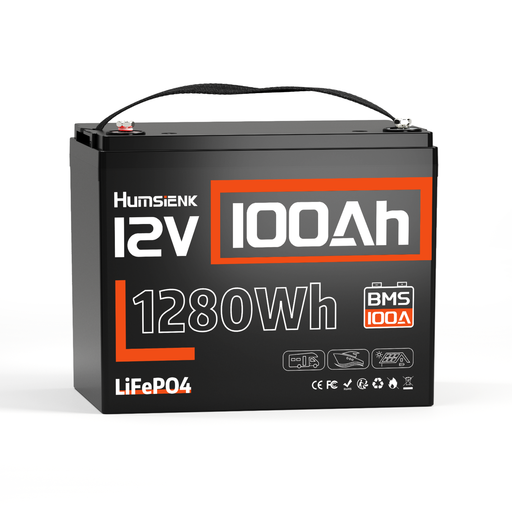
HumsiENK 12V 100Ah LiFePO4 Battery, 1280Wh, 15000+ Cycles
Why This Fits Their Persona: For off-grid enthusiasts and demanding campers who want maximum lifespan and the highest reliability for their self-sufficient power supply and are willing to invest in longevity.
It avoids the cycle trap by specifying A+ Grade cells and a lifespan of over 10 years. The intelligent 100A BMS explicitly includes low-temperature protection for safe operation from -20°C to 70°C (-4°F to 158°F).
The manufacturer-stated cycle count of over 15,000 (at shallow discharge) and the IP67 certification (dust and waterproof) underscore the focus on maximum durability. Fast charging in just 2 hours is possible.
Looking for More Options?
We have compiled a complete, up-to-date list of products that fully meet these strict selection criteria and safety regulations.
Frequently Asked Questions (FAQ)
Can I charge a LiFePO4 battery with a standard lead-acid charger?
While technically possible in some cases, it is not recommended. Lead-acid chargers have charging profiles (e.g., with desulfation phases) that are unsuitable or even harmful to LiFePO4 cells. They often fail to fully charge the battery or can confuse the BMS. For optimal performance and maximum lifespan, you should always use a dedicated LiFePO4 charger with a CC/CV (Constant Current/Constant Voltage) charging profile.
How many years does a 12V 100Ah LiFePO4 battery really last?
The lifespan heavily depends on the intensity of use (number of cycles and depth of discharge) and operating conditions. With typical use in an RV or solar system (e.g., 200 cycles per year at 80% DOD), a high-quality LiFePO4 battery can easily last 10 years or more. Models with 4,000 to 6,000 cycles at 80% DOD offer a theoretical lifespan of up to 20 years under these conditions, far exceeding that of lead-acid batteries.
Do I need to remove my LiFePO4 battery in the winter?
If your battery has integrated low-temperature charging protection, removal is not strictly necessary. This feature actively prevents the battery from being charged at temperatures below 0°C (32°F), which protects the cells. Discharging is still possible in the cold, albeit with slightly reduced capacity. If your battery does not have this protection, you should ensure it is brought to a temperature above freezing before charging, or store it in a frost-free location.