
Buy a LiFePO4 Battery 12V 100Ah: Technical Specifications, Buying Guide and Suitable Models
A LiFePO4 battery 12V 100Ah is suitable for many applications: as a solar battery 12V 100Ah, lithium battery for motorhomes, battery for boats and camping, or as an off-grid battery. However, the nominal capacity alone doesn't tell you whether a model will suit your system. What really matters includes BMS protection, charging parameters, dimensions, connection options and temperature range.
If you only focus on a high cycle count or a low price, you could end up buying a battery that doesn't work reliably with your motorhome, inverter or solar system.
Common Buying Mistakes with 12V 100Ah Lithium Batteries
1. Confusing capacity with actually usable energy
A battery with 100Ah at 12.8V theoretically provides around 1,280 Wh of energy. However, the amount of energy you can actually use depends on the depth of discharge, the battery management system, the load and the cut-off limits. Figures like "1280Wh LiFePO4 battery" should therefore always be considered alongside the nominal voltage and the permitted charge and discharge currents.
2. "Many cycles" doesn't automatically mean suitable usage
Manufacturer claims of 4,500, 5,000 or 15,000 cycles are based on specific test conditions. Depending on depth of discharge, charging speed, ambient temperature and storage, the practical lifespan can vary. A high cycle count is a useful comparison value, but it doesn't replace checking the rest of the technical data.
3. An integrated BMS doesn't solve every installation problem
A 100Ah battery with BMS can typically protect against overcharging, deep discharge, overcurrent and short circuits. However, it doesn't replace a suitable charger or correctly sized cables and fuses. Particularly with inverters that have a high start-up current, the maximum discharge and cut-off values must match the battery.
These Technical Parameters Should Be Checked Before Buying
Voltage and Energy Requirements
A 12V 100Ah lithium battery usually operates with a nominal voltage of 12.8V. At 100Ah, this gives a theoretical energy of around 1,280 Wh. A simple consumption calculation is helpful for selection:
- Determine the power consumption of your devices in watts.
- Multiply this by the daily operating time.
- Account for losses from the inverter, cables and charging electronics.
- Plan a reserve for cold temperatures and fluctuating solar yields.
A fridge, lighting and small chargers need a different battery system than an inverter for a coffee machine, induction hob or power tools.
BMS, Charge and Discharge Current
The BMS should offer at least protection functions against overcharging, deep discharge, short circuit and overcurrent. With multiple batteries, you also need to check the specifications for series and parallel connection. Some models support up to 4 batteries in series and 4 in parallel according to the product description, i.e. a 4S4P configuration. Before connecting, batteries should have the same state of charge and a comparable voltage.
Also check:
- maximum continuous discharge current and short-term peak current,
- recommended charge current,
- required charging voltage,
- compatibility with solar charge controller, mains charger and alternator,
- available connections and terminal orientation.
Dimensions, Weight and Temperature
Many 12V 100Ah models are based on BCI Group 24. However, this designation doesn't guarantee that every case will fit into every battery compartment. Measure the available space including cables, fuses and ventilation clearance.
LiFePO4 batteries are generally lighter than comparable lead-acid batteries. For winter use, it's important to check the temperature range: some BMS systems have low-temperature protection. A battery should not be charged at temperatures for which the manufacturer hasn't given approval.
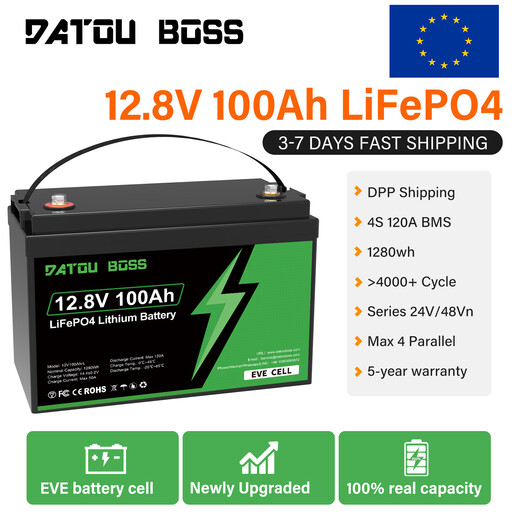
DATOUBOSS 12V 100Ah LiFePO4 Deep Cycle Battery
Why this product fits the profile: The 12V 100Ah configuration is interesting for users looking for a straightforward LiFePO4 deep-cycle battery for motorhomes, solar, boats or camping. According to the product name, EVE cells and a 100A BMS are included.
The stated BMS current rating and deep-cycle design make it easier to compare with your charger and inverter. However, you should still confirm the dimensions and charging profile before buying.
12V nominal system, 100Ah capacity, EVE cells according to the product name and 100A BMS.
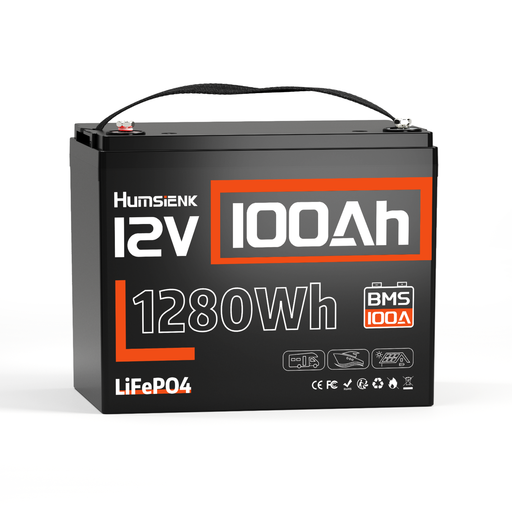
HumsiENK 12V 100Ah LiFePO4 Battery, 1280Wh, 100A BMS, Group 24
Why this product fits the profile: According to the product description, this model offers 1280Wh capacity, a Group 24 case, IP67 protection and support for series and parallel connection. This is relevant for motorhome, marine and solar applications with clearly defined installation dimensions.
The details on Group 24, 100A BMS, temperature range and IP67 provide concrete checkpoints rather than just marketing claims. Actual suitability depends on your installation location and system.
1280Wh according to product specification, 100A BMS, IP67 protection and expandable up to 4S4P as described.
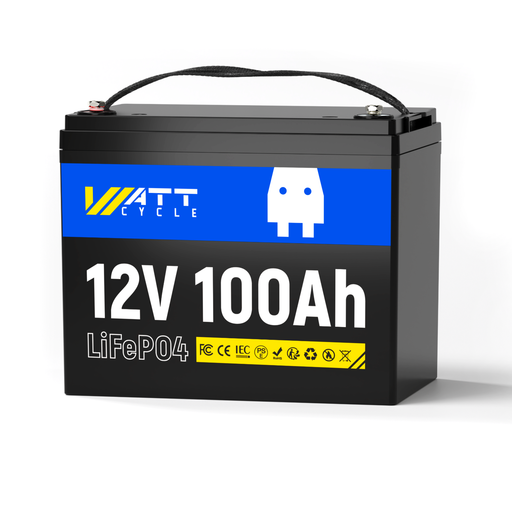
WattCycle 12V 100Ah LiFePO4 Battery, Deep-Cycle
Why this product fits the profile: According to the product description, this model is aimed at users of motorhomes, boats, off-grid systems, golf carts and home energy storage. It mentions Group 24 dimensions, 1280Wh energy, a 100A BMS and an expandable 4S4P configuration.
The description provides concrete details on the case, internal frame, cycle range and expandability. Before connecting in series, make sure your charger, inverter and battery voltage are designed for it.
ABS case with reinforced internal structure, 100A BMS and support for up to 4S4P according to product specifications.
Installation and Operation in Motorhomes, Boats and Solar Systems
For a solar battery 12V 100Ah, the charge controller should support a charging profile suitable for LiFePO4. An existing lead-acid charger isn't automatically compatible. Check the voltage values specified by the battery manufacturer and, if necessary, deactivate functions such as equalisation charging.
When installing in a motorhome or boat, the following points are also important:
- Protect the battery with a suitable fuse close to the positive terminal.
- Match the cable cross-section to the current and cable length.
- Secure the battery against slipping, shock and moisture.
- Check the polarity before connecting.
- When connecting in parallel, use identical models with a comparable age and state of charge.
- Check the charging approval at low temperatures based on the BMS specifications.
A LiFePO4 battery isn't automatically fully waterproof for every outdoor environment. An IP67 rating describes the protection level of the case under defined conditions, not suitability for permanent submersion or every marine installation.
Looking for more options?
We've put together a complete, regularly updated list of products that fully meet these strict selection criteria and the safety regulations in force in the EU.
FAQ about LiFePO4 Battery 12V 100Ah
How long does a 12V 100Ah lithium battery last?
The lifespan depends on state of charge, depth of discharge, temperature, current and storage conditions. Manufacturers quote different cycle ranges depending on the model. Figures like "15,000+ cycles" should therefore be understood as a manufacturer or product claim under specific conditions, not as a blanket guarantee for every use.
Can a LiFePO4 battery 12V 100Ah replace a lead-acid battery?
This is possible if voltage, charger, installation dimensions, BMS, cables and power requirements all match. The electrical characteristics differ from lead-acid batteries. Before replacing, you should check the technical data of your existing charging and energy system.
How much does ongoing operation cost?
The running costs mainly consist of charging losses, possible maintenance and eventual replacement. LiFePO4 batteries don't need topping up during normal operation like some lead-acid batteries do. For a fair comparison, you should consider the purchase price, usable energy, expected cycle count and warranty conditions together.