
Essential Buyer’s Guide for Mini Projectors
A spontaneous movie night on the bedroom ceiling, a large-format gaming session, or a presentation without a complicated setup – a mini projector promises flexible entertainment anywhere. But the market is flooded with devices making tempting advertising claims that often fail to deliver in practice. Before you make a purchasing decision, it's crucial to know the typical pitfalls that lead to disappointment and unnecessary expense.
As your Joybuy Product Recommendation Officer, I'll help you navigate the marketing jungle. We'll focus on the facts so you can find a device that truly fits your needs.
The 3 Most Common Traps When Buying a Mini Projector:
- Misleading Brightness Specs: Many manufacturers advertise high "lumen" numbers without specifying the measurement standard. A value of "9000 lumens" sounds impressive, but without the ANSI lumens (American National Standards Institute) designation, it's practically meaningless. The result is often a dim, washed-out image that's only visible in complete darkness.
- "Smart" Features Without a License: A projector with an Android operating system isn't automatically a full-fledged smart projector. If it lacks official licenses for streaming services like Netflix or Prime Video, these apps may not work at all or will only play in low resolution (often 480p). The promise of convenient streaming quickly turns into frustration.
- Poor Automatic Functions: A projector's portability is negated if you have to manually adjust the focus and image geometry (keystone correction) with every slight change in position. A portable projector without reliable autofocus and automatic keystone correction is impractical for everyday use.
What Really Matters: The Decisive Parameters
To avoid a bad buy, you should focus on three core technical features. These are the primary determinants of your device's image quality and user-friendliness.
1. Brightness: ANSI Lumens as the Only Reliable Value
Brightness is the most critical factor for a usable projected image. Pay exclusive attention to the value in ANSI lumens. This standardized value indicates how bright the image actually appears on the screen.
- Up to 300 ANSI Lumens: Suitable for very dark rooms, like a bedroom at night. Insufficient for use in daylight or in lit rooms.
- 500–800 ANSI Lumens: A good all-around performance for a home cinema projector experience in living rooms with controlled ambient light (e.g., closed curtains).
- Over 1000 ANSI Lumens: Provides a clear and color-rich image even with some ambient light. Ideal for flexible use, including as an outdoor projector on a summer evening.
2. Resolution: The Difference Between "Native" and "Supported"
Don't be fooled by phrases like "supports 4K." This only means the projector can process a 4K signal. The actual image sharpness is determined by the native resolution—the physical number of pixels the projector can display.
- Native 720p (1280x720): Sufficient for occasional use or as an entry-level device. Details are visible, but the image can look slightly blurry on larger screen sizes.
- Native Full HD Projector (1920x1080): The current standard for a sharp and detailed home cinema experience. Text is clear and movies look brilliant.
- Native 4K Projector (3840x2160): Offers the highest detail density, but is still rare in compact mini projectors and comes at a higher price point.
3. Connectivity and Smart Features: The Brain of the Projector
A modern mini projector should be an all-in-one solution. Look for a stable operating system with licensed apps and versatile connection options.
- Operating System: Systems like Google TV or manufacturer-specific solutions with officially licensed Netflix guarantee smooth, high-quality playback.
- Projector with Wi-Fi and Bluetooth:WiFi 6 ensures a stable and fast connection for streaming content. Bluetooth 5.0 or higher allows for easy connection of external speakers or headphones.
- Projector with Battery: For maximum flexibility, such as when camping or in the garden, an integrated battery is essential. Check the stated runtime for video playback, which realistically ranges from 1.5 to 2.5 hours.
Featured Recommendations By User
Here are some models that represent a considered choice for different use cases, based on objective criteria.
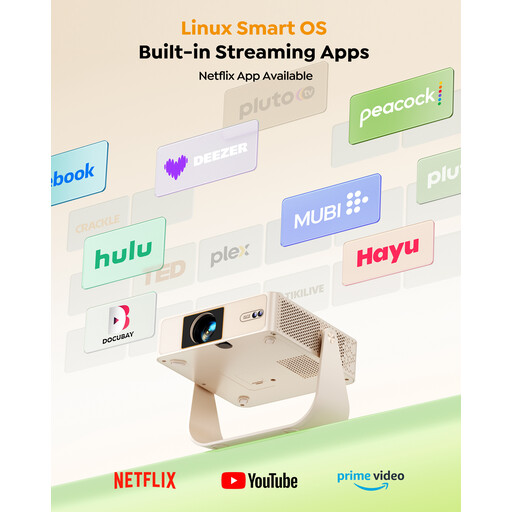
Yaber L1 Pro Portable Projector with Flexible Stand
Why This Fits Their Persona: Ideal for users looking for a simple and affordable solution for movie nights in a dark room. The 330° rotating stand makes projecting onto the ceiling or wall effortless, without needing an extra tripod.
The Linux OS features officially licensed apps for Netflix, YouTube, and Prime Video. This ensures that content can be streamed directly and in the intended quality, without compatibility issues.
Native 1080P resolution for a sharp image. The integrated stand and compact design make it ready to use right out of the box.
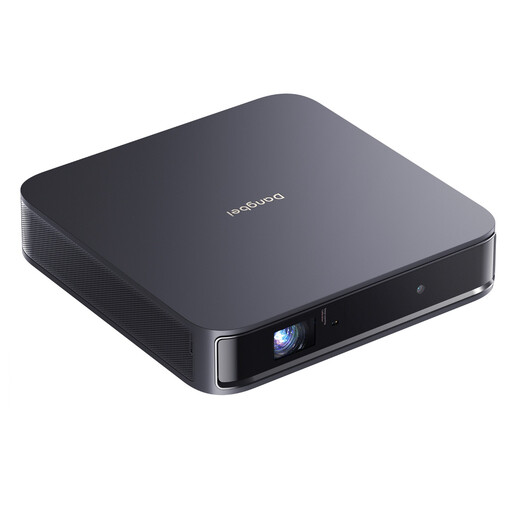
Dangbei Atom Portable Laser Projector
Why This Fits Their Persona: For users who value high image quality and brightness and are looking for a long-lasting solution. Its slim design fits into any modern living room, while its performance is sufficient for movie nights even with some ambient light.
With 1200 ISO Lumens (a value similar to the ANSI standard), it offers reliably high brightness. The Google TV operating system ensures access to all popular streaming apps in high quality, and the automatic focus and keystone correction make setup effortless.
The ALPD laser light source ensures consistently high brightness and a long lifespan of up to 30,000 hours. It supports 4K input and HDR10 for excellent image dynamics.
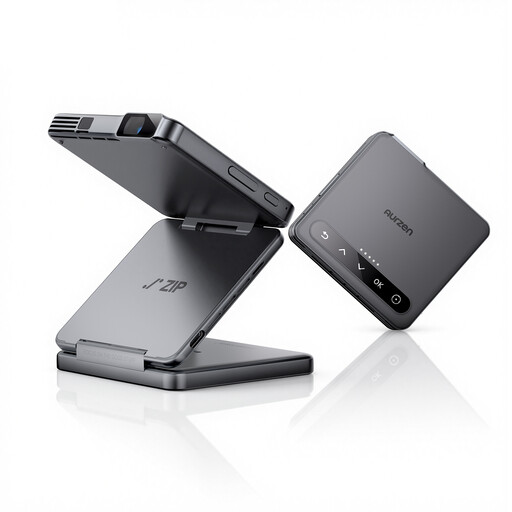
Aurzen Tri-Fold DLP Mini Projector with Battery
Why This Fits Their Persona: Perfect for anyone constantly on the go—whether for travel, spontaneous office presentations, or movie nights at a friend's house. The unique folding design makes it barely larger than a wallet and extremely portable.
It solves the problem of cumbersome setup on the move. The integrated stand and lag-free ToF autofocus ensure the image is sharp and aligned in seconds. The projector with battery offers up to 1.5 hours of playback time.
The innovative Tri-Fold design makes it one of the most compact DLP projectors on the market. Direct screen mirroring from a projector for mobile phones works even without a Wi-Fi network.
Looking for more options?
We have compiled a complete, up-to-date list of products that fully meet these strict selection criteria and UK safety regulations.
Frequently Asked Questions (FAQ)
1. How many ANSI lumens do I really need?
This depends entirely on your viewing environment. For a movie night in a completely darkened room, 200-300 ANSI lumens can be sufficient. If you also want to use the projector in a living room with some ambient light or outdoors in the evening, you should consider a model with at least 500 ANSI lumens to get a vibrant and clearly visible image.
2. Can I watch Netflix in HD on any smart projector?
No, this is a common misconception. Just because a projector has a "smart" operating system doesn't mean it has the necessary DRM (Digital Rights Management) certification for HD streaming from services like Netflix. Look for explicit statements like "Officially Licensed Netflix" or systems like Google TV, which include these licenses by default. Otherwise, you risk the app not working at all or only delivering a low standard resolution.
3. Is a projector with a battery worth it?
A projector with a battery offers maximum flexibility and is ideal for use outdoors or in places without a direct power source. However, consider the trade-off: on battery power, the brightness is often automatically reduced to save energy, and the runtime is usually limited to the length of a feature film (about 1.5 to 2.5 hours). For stationary home cinema use, the power adapter remains the more reliable option for maximum brightness and unlimited runtime.