
Hybrid Pan Buyer’s Guide: Stainless Steel Meets Non-Stick
As a Joybuy Product Recommendation Officer, I analyse the market to provide you with clear guidance in the world of cookware. Many ambitious home cooks face a choice: the durability and heat resistance of a stainless steel pan, or the convenience of a non-stick coating? A hybrid pan aims to bridge this exact gap. This article explains how they work, highlights key buying criteria, and presents a selection of pans for different needs.
What to Look for When Buying a Hybrid Pan?
Choosing the right cookware depends on your personal cooking habits and needs. Here are three objective criteria to help you make your selection.
1. Material Composition and Heat Conduction
A high-quality pan is defined by its excellent and even heat distribution. This prevents food from burning in some spots while remaining undercooked in others.
- Multi-Ply Base: Look for a multi-layered construction (often called "tri-ply" or "5-ply") where a heat-conductive core of aluminium or copper is sandwiched by durable stainless steel. This construction is crucial for rapid, even heating and makes the pan an ideal pan for induction.
- Surface Structure: The typical honeycomb pan features a laser-etched stainless steel structure that sits above the non-stick coating. This raised stainless steel grid allows for a perfect sear on meats while protecting the recessed non-stick layer from scratches.
2. Coating Type and Safety
The coating is the heart of any modern non-stick or hybrid pan. Durability and health considerations are of central importance here.
- PFOA and PFAS-Free: Look for products explicitly declared as a PFOA-free pan and free from other per- and polyfluoroalkyl substances (PFAS). Modern ceramic coatings, often reinforced with titanium or diamond particles, offer a safe, non-toxic alternative.
- Scratch Resistance: A scratch-resistant frying pan significantly increases its lifespan. The hybrid technology with its raised stainless steel structure is advantageous here, as it minimises direct contact between metal utensils and the delicate non-stick layer.
3. Versatility in Use
A good pan should do more than just fry. Its suitability for different cooktops and the oven greatly expands your culinary possibilities.
- Oven Safety: An oven-safe pan allows you to sear dishes on the stovetop and then finish them in the oven or under the broiler. Check the maximum temperature resistance, especially that of the handle. Hollow stainless steel handles stay cooler for longer on the stovetop but will also get hot in the oven.
- Cooktop Compatibility: Ensure the pan is suitable for your type of cooktop. Most modern pans are designed for all common cooktop types—including induction, gas, and ceramic. A magnetic base is a prerequisite for use on an induction hob.
Our Pan Recommendations
Based on the criteria mentioned, we have compiled a selection of products that cover different technologies and applications.
naturepan Hybrid Ceramic Frying Pan 28cm
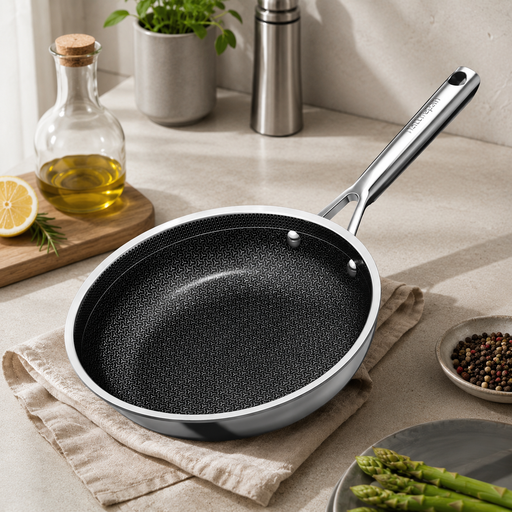
Why It Stands Out This pan represents modern hybrid technology. The 5-ply construction combines a three-layer stainless steel core with a diamond and titanium-reinforced ceramic coating. The laser-etched hexagonal surface creates a raised stainless steel grid for searing, while the recessed valleys ensure non-stick performance.
-
Pros:
- 5-ply hybrid construction for even heat distribution.
- PFAS, PFOA, and PTFE-free ceramic coating.
- Oven-safe up to 260°C, allowing for versatile cooking methods.
- The surface is 5x more scratch-resistant than standard coatings, according to the manufacturer.
- Suitable for all cooktops, including induction.
-
Who It's For: For ambitious cooks looking for a versatile coated stainless steel pan to achieve professional searing results without sacrificing the convenience of an easy-to-clean non-stick surface. Ideal for steaks, but also for more delicate foods.
PURE COOK 304 Triple-Ply Stainless Steel Frying Pan
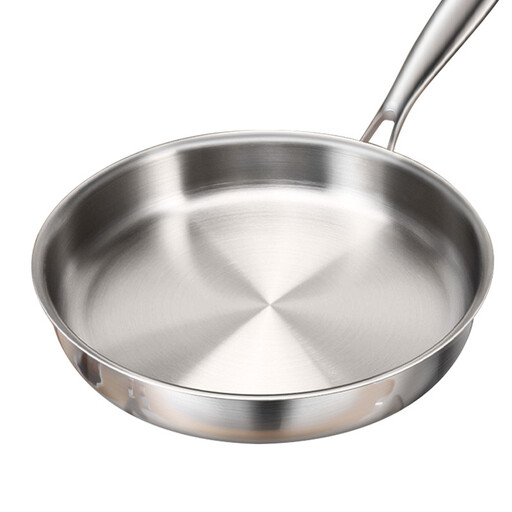
Why It Stands Out This model is a classic, uncoated stainless steel pan. Its tri-ply construction of stainless steel with an aluminium core ensures optimal heat conductivity and high dimensional stability. It is a benchmark for longevity and robustness.
-
Pros:
- Tri-ply construction prevents hot spots and warping.
- Extremely durable and resistant to scratches, acids, and corrosion.
- No coating that can wear off.
- Suitable for very high temperatures, ideal as a pan for high-heat searing.
-
Who It's For: For purists and experienced cooks who appreciate full control over the cooking process and are looking for a pan for life. Requires some practice with temperature and oil management to prevent sticking.
PURECOOK Marble Coated Frying Pan
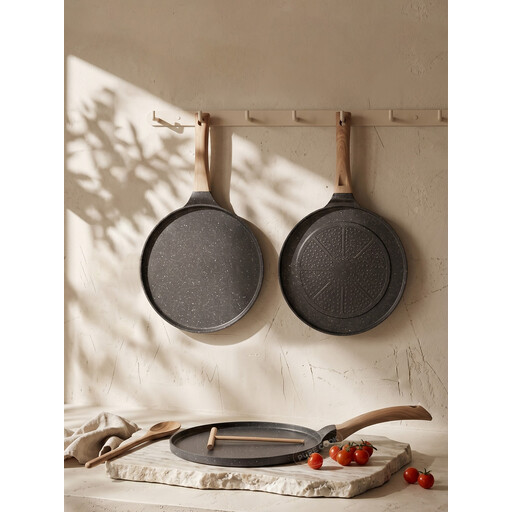
Why It Stands Out This pan features a lightweight aluminium body and a proven non-stick coating with a stone-like finish. It is designed for quick, uncomplicated cooking at low to medium heat.
-
Pros:
- Lightweight aluminium body for easy handling.
- Food-safe non-stick coating for low-oil cooking.
- Heat-insulated wooden handle for a comfortable grip.
- Heats up quickly and evenly.
-
Who It's For: For everyday use where reliable non-stick performance and easy cleaning are the main priorities. Perfect for eggs, vegetables, or pancakes, but less suited for high-heat searing.
Looking for Something Else?
While hybrid and stainless steel pans are ideal for frying and searing, very delicate foods like crêpes or classic pancakes often require a surface specially designed for them. If you want to add such a specialty tool to your collection, you can find more options for a pancake pan here.
Frequently Asked Questions (FAQ)
1. What is the main advantage of a hybrid pan over a regular non-stick pan? The main advantage lies in the combination of durability and function. The raised stainless steel structure of a honeycomb pan allows for high-heat searing, similar to a pure stainless steel pan. At the same time, this structure protects the underlying non-stick coating from abrasion from metal utensils, which can extend its lifespan compared to conventional non-stick pans.
2. Can you really use metal utensils in a hybrid pan? For many hybrid pans, the use of metal utensils is permitted according to the manufacturer. The raised stainless steel grid absorbs most of the contact, protecting the recessed non-stick layer. Nevertheless, to maximise the coating's lifespan, the use of wood or silicone utensils is often recommended.
3. Are hybrid pans like the featured 28cm ceramic pan heavier than regular pans? Yes, due to their multi-ply construction with a stainless steel core, hybrid pans are generally heavier than pure aluminium pans. However, this added weight contributes to heat retention and structural stability, which is beneficial for even cooking results.