
Buying stainless steel food storage containers: comparing materials, leak-proofing and suitable models
Anyone looking for stainless steel food storage containers for work, school, meal prep or camping will find numerous models making similar promises: leak-proof, durable, stackable and dishwasher-safe. In practice, however, the details determine how well a container performs day to day. An unsuitable lid design, insufficient capacity or inaccurate cleaning information can mean that the container is barely used after a short time.
As a Joybuy Product Recommendation Officer, I filter the relevant product features and assess them according to specific usage situations. This makes it easier to see which stainless steel food container is right for your household, commute or weekly meal planning.
Common buying and marketing pitfalls with stainless steel food storage containers
1. “Leak-proof” without a clearly defined lid design
A seal alone does not guarantee safe transport. Even pressure distribution, the type of closure and the condition of the silicone ring are also important. Lids with several clamps or clips that close all the way around are practical. Before transporting the container, buyers should check whether the lid is designed for liquid foods and whether the seal can be removed.
2. Dishwasher-safe does not always apply to every part
For many dishwasher-safe food storage containers, this claim refers only to the stainless steel body. Lids made from PP plastic, glass or silicone may require different care. For example, according to the product description, only the stainless steel body of the MAXCOOK 316 stainless steel set is dishwasher-safe; the lids and seals should be washed by hand and dried thoroughly.
3. Stainless steel is not automatically suitable for every type of heating
Metal containers must not simply be placed in a microwave. Glass lids can also be damaged by rapid temperature changes. The specific manufacturer’s instructions are therefore decisive. For containers with a stainless steel body, microwave heating should generally be ruled out unless the product page expressly and clearly permits it. Vacuum-insulated models such as a thermal lunch box must not be placed in the microwave.
The most important selection criteria
Material: 304 stainless steel or 316 stainless steel?
304 stainless steel is widely used for food containers and is often described in product specifications as a food-safe, uncoated material. It is suitable for everyday meals, refrigerator storage and transporting food.
316 stainless steel also contains molybdenum and is often associated with greater resistance to certain corrosive influences. This does not automatically mean that a container is necessary for every household, however. If you regularly store acidic foods, salty dishes or food for longer periods, you may wish to consider the 316 stainless steel specification when choosing a container.
It is important not to focus solely on the name of the material. Also check whether the specification applies to the entire container or only to the inner body. Lids, seals and closures are usually made from other materials.
Capacity and shape
For a stainless steel sandwich box or a stainless steel lunch box, flat, rectangular shapes are often practical in a bag. Single-compartment models are suitable for sandwiches, salads or a complete meal. A stainless steel bento box with two compartments, for example, keeps side dishes and the main course separate without requiring multiple containers.
Different sizes are useful for storing food and meal prep. A set with 600 ml, 1.100 ml and 2.200 ml covers small snacks, individual portions and larger meals. Deep stainless steel storage containers can hold soups or dishes with sauce, but they take up more room in a bag.
Seals, cleaning and storage
Look for:
- removable silicone rings for thorough cleaning,
- several closure clips for liquid foods,
- clear information about dishwasher use,
- stackable or nestable containers,
- a weight suited to your daily transport distance.
With stackable storage boxes, you should also check whether the lids sit flat and whether different sizes fit securely inside one another. For the refrigerator, a rectangular shape is often more space-efficient than round containers.
Our selection by user profile
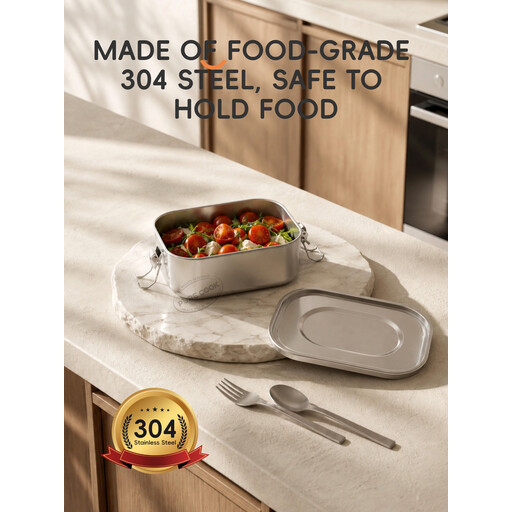
PURECOOK 304 Stainless Steel Single-Compartment Rectangular Bento Lunch Box
Why this product suits this profile: With a capacity of around 1,8 litres, the rectangular single container is suitable for work meals, packed lunches and straightforward meal-prep portions.
The product description mentions locking clips and a removable silicone seal. Even so, the closure should be tested with liquid before transporting the container.
304 stainless steel body, rectangular shape and single-compartment design for everyday use.

MAXCOOK 3 Pack 316 Stainless Steel Food Containers
Why this product suits this profile: Three sizes—600 ml, 1.100 ml and 2.200 ml—accommodate different portion sizes and regular meal prep.
The care instructions clearly distinguish between the stainless steel body and the PP lids. This makes it easier to plan cleaning correctly.
316 stainless steel and four-sided closure clips with a silicone seal, according to the product description; stackable sizes.

Maxcook 316 Stainless Steel Insulated Food Jar, 1,5 l
Why this product suits this profile: With its wide opening, the vacuum-insulated thermal lunch box is designed for soups, hot meals, commutes and outdoor activities.
The instructions specify hand washing, no microwave use and a warning against very hot contents. These points help prevent incorrect use.
1,5-litre capacity, 316 stainless steel, vacuum insulation and a wide opening.

PURECOOK 304 Stainless Steel Deep Food Storage Container Set
Why this product suits this profile: The three deep containers, measuring 1.000 ml, 1.800 ml and 3.000 ml, are suitable for organising the refrigerator, storing larger portions and keeping prepared meals.
The product information specifies silicone seals, glass lids and stackable, nestable designs. At the same time, specific instructions apply to microwave use, ovens and sudden temperature changes.
304 stainless steel, borosilicate glass lids, three sizes and a stackable design according to the product description.
Looking for more options?
We have put together a complete, regularly updated list of products that fully meet these strict selection criteria and the safety regulations applicable in the EU.
FAQ about stainless steel food storage containers
Are stainless steel food storage containers leak-proof?
It depends on the lid, seal and closure. Models with an all-round silicone seal and several clips can contain liquids more securely than lids that simply sit on top. Before first use, the container should be tested for leaks with water and the lid closed.
Can a stainless steel sandwich box go in the dishwasher?
The stainless steel body is often dishwasher-safe. However, lids, PP parts and silicone rings may have different care instructions. The manufacturer’s guidance for each individual component should therefore be followed.
How long do stainless steel food containers last?
Their service life depends on the material thickness, closure, seal and care. Stainless steel can remain usable for a long time under normal conditions. Sealing rings are wear parts and should be replaced if they become brittle, deformed or start to let liquid through.