
Slim Shoe Cabinet: A Buyer’s Guide to an Organised Hallway
By the Joybuy Product Recommendation Officer, July 29, 2026
A narrow hallway is a common reality in many homes. The challenge: where to store your shoes without blocking the walkway or creating constant clutter? A slim shoe cabinet seems like the logical solution. However, pitfalls in the selection process can quickly turn a practical purchase into a regrettable one. This guide highlights the objective criteria that matter and shows you how to find the perfect model for your needs.
Common Problems When Choosing a Slim Shoe Cabinet
Many buyers focus solely on a shallow depth, overlooking crucial design features. This often leads to three common problems:
- Unstable Construction: Particularly budget-friendly models are prone to wobbling. When fully loaded or in a household with children, such a cabinet can pose a safety hazard if not properly secured to the wall.
- Inadequate Interior Space: A cabinet may be slim on the outside, but the tip-out mechanism inside can be designed in such a way that shoes from size 43 (EU) upwards no longer fit. The result: the flaps don't close properly, or the shoes get crushed.
- Poor Material Durability: Moisture from wet shoes or high humidity in the entrance area can quickly lead to swollen edges and peeling finishes on furniture made from low-quality particleboard.
A thoughtful selection process that goes beyond a simple price comparison will prevent these frustrations.
What to Look For Before You Buy: The Core Parameters
To make an informed decision, you should evaluate three technical aspects. These determine the functionality and longevity of your space-saving shoe storage.
1. The Crucial Dimensions: Depth and Capacity
A slim shoe cabinet is typically characterised by an overall depth of less than 25 cm. Models with a depth of 17 cm to 24 cm are particularly suitable for narrow hallways. However, the external dimension isn't the only thing that matters. For a tip-out shoe cabinet, the usable internal depth of the compartments is crucial. Check the product specifications to see if the compartments are designed for your common shoe sizes. Some models offer adjustable or removable dividers to accommodate taller footwear like ankle boots.
2. Material Quality and Stability
The longevity of a shoe cabinet depends significantly on the materials used.
- MDF Boards (E1): E1 standard medium-density fibreboard is a solid choice. It is more dimensionally stable and resistant to moisture than standard particleboard.
- Anti-Tip Hardware: Due to the small footprint, anti-tip hardware—usually in the form of brackets for wall mounting—is an essential safety feature. Make sure this is included in the scope of delivery. A modern shoe cabinet or a white shoe chest made from high-quality materials with a solid back panel and a secure mounting option provides the necessary stability.
3. The Right Organisation System for Your Shoes
Depending on your needs and preferences, different systems are suitable:
- Tip-Out Shoe Cabinet: The closed front creates a tidy appearance in the hallway. Shoes are protected from dust but are less well-ventilated.
- Open Hallway Shoe Rack: Offers quick access and good ventilation for shoes. However, the look is less calm and orderly.
- Stackable Shoe Boxes: A flexible solution. Each pair is individually protected, and the system can be expanded as needed. Ideal for collectors or people who store their shoes seasonally.
Our Top Picks for Different Needs
Instead of a one-size-fits-all recommendation, we present models tailored to specific living situations and requirements.
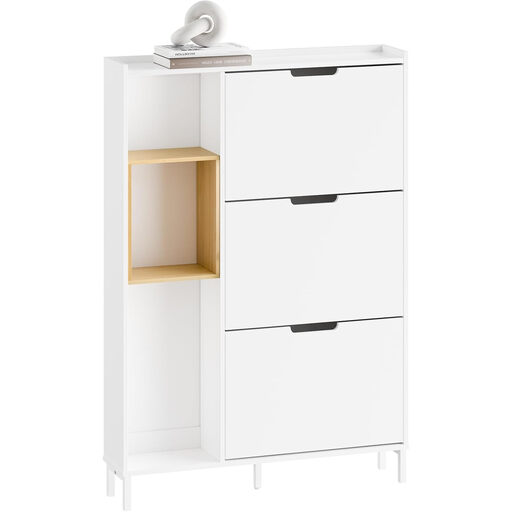
SoBuy Slim Shoe Cabinet, White, Bamboo with 3 Flaps
Why This Fits Their Persona: This person is looking for a solution that is not only functional but also blends seamlessly into a modern or Scandinavian interior design concept. The combination of a white body and bamboo accents creates a light and stylish look.
The construction of MDF (E1) and carbonised bamboo is more resistant to warping than simple particleboard. At just 19 cm deep, it is extremely space-saving without sacrificing stability.
Combines closed tip-out compartments with an open side shelf for decor or quick-access items. Offers space for up to 9 pairs of shoes.
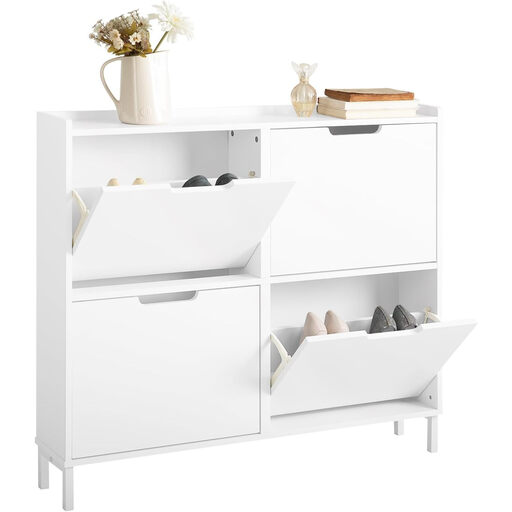
SoBuy Narrow Shoe Rack Shoe Cabinet with 4 Tip-Out Drawers
Why This Fits Their Persona: For families or shared flats where many shoes need to be stored in a small space. The focus is on maximum capacity with minimal obstruction of the walkway.
At 100 cm wide and with four tip-out compartments, this model maximises both vertical and horizontal storage space. The shallow 19 cm depth is consistently implemented. According to the manufacturer, anti-tip hardware for wall mounting is included.
High capacity for various shoe types. The closed front ensures a uniform and calm look in the hallway. The top surface is practical for keys or mail.
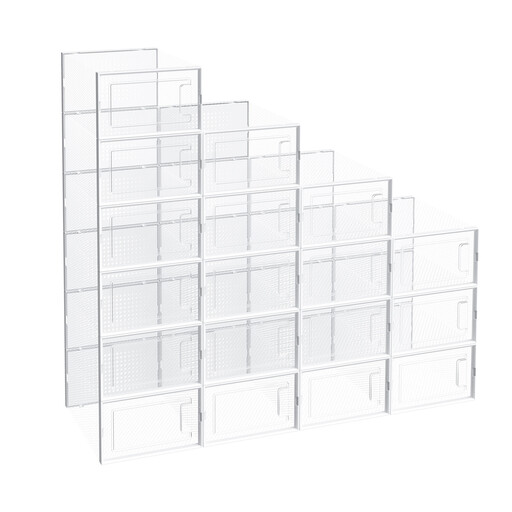
Ochama 18-Pack Stackable Shoe Storage Boxes
Why This Fits Their Persona: Ideal for people with a growing shoe collection, especially sneaker enthusiasts, or for those who need an adaptable solution that can be easily reconfigured during a move or redesign.
The problem of insufficient internal depth is avoided, as the dimensions of each box (35 x 25.2 x 19 cm) can be checked against one's own shoe size before purchase. The system is inherently stable when stacked correctly.
Modular and expandable system. The transparent front flaps allow for a quick overview and access, while protecting shoes from dust. Ventilation holes ensure air circulation.
Looking for more options?
We've compiled a full, up-to-date list of products that fully meet these strict selection criteria and UK/EU safety regulations.
Frequently Asked Questions (FAQ)
1. Will a size 45 (EU) shoe fit in a slim tip-out cabinet? This depends on the specific model. A tip-out cabinet with an external depth of 24 cm and adjustable internal dividers can often accommodate shoes up to size 44 or 45 (EU). However, it is essential to check the manufacturer's product description carefully, as the internal construction varies. If in doubt, measure the length of your largest shoes and compare it with the internal dimensions of the compartment.
2. How do you securely attach a slim shoe cabinet to the wall? Most slim shoe cabinets come with anti-tip hardware. This is usually a small metal or plastic bracket that is screwed to the top edge of the back of the cabinet and to the wall. For wall mounting, use wall plugs and screws that are appropriate for your wall type (e.g., concrete, plasterboard). The manufacturer's assembly instructions provide detailed guidance on this.
3. What is the difference between a tip-out cabinet and a shoe rack? A tip-out cabinet is a closed unit with hinged compartments where shoes are stored at an angle or vertically. It offers a clean, tidy appearance. A shoe rack is an open frame with horizontal shelves. Shoes are directly visible and accessible, which ensures good ventilation but can look visually cluttered.