
Slim Shoe Cabinet Buying Guide for Hallways
By Joybuy Product Recommendation Officer, August 30, 2026
A narrow hallway is a common feature in many apartments and houses. The challenge of storing shoes neatly without blocking valuable walkway space is familiar to many. A slim shoe cabinet seems like the obvious solution, but the market is flooded with models whose practical utility often falls short of their marketing promises.
Before you make a decision, it's important to understand the common pitfalls that can lead to purchase regret.
- Unstable Construction: Tall and narrow furniture is particularly prone to wobbling or tipping if not properly designed or secured. This poses a safety hazard, especially in households with children.
- Misleading Capacity Claims: The stated number of shoe pairs is often based on small shoe sizes or slim shoe types. Boots, hiking shoes, or shoes from size 44 and up often won't fit.
- Inflexible Compartments and Poor-Quality Mechanics: Rigid compartments with no adjustment options make it impossible to store boots or high heels. With a
tip-out shoe cabinet, weak hinges can also wear out quickly and impair functionality.
What Really Matters When Making Your Choice
To find a solution that will satisfy you in the long run, you should focus on objective and measurable criteria. Well-designed modern shoe storage not only serves its purpose but also integrates harmoniously into your living space.
1. The Crucial Dimensions: Making the Most of Depth and Height
The most important parameter for a slim shoe cabinet for a small hallway is its depth. Measure the available space precisely and plan for enough room to open doors or flaps.
- Tip-Out Cabinets: These models are especially
space-saving, often with a depth of only 17 cm to 24 cm. They are excellent for very narrow corridors, as the shoes are stored at an angle. - Cabinets with Doors: These are typically deeper (30 cm to 40 cm) but often offer more flexibility for larger shoes or boots.
- Vertical Space Utilisation: Tall, narrow cabinets use wall space efficiently. For these, make sure an anti-tip kit for wall mounting is included.
2. Material and Construction: What Defines Durability
The stability and longevity of a shoe cabinet depend directly on the materials used.
- MDF and Particleboard: These engineered woods are the standard for furniture in this segment. Look for a sufficient board thickness (at least 15 mm) and a durable coating (e.g., melamine resin) that protects against scratches and moisture. A
white shoe cabinetwith a high-quality paint or coating is less likely to yellow and is easier to clean. - Modular Systems Made of PP Panels: These interlocking systems are lightweight and flexible but often don't offer the same stability as engineered wood furniture. They are well-suited for temporary solutions or for lighter footwear.
- Hinges and Handles: Metal hinges are preferable to plastic versions, especially for a
tip-out shoe cabinetwhose flap mechanism is under constant stress.
3. Storage Types: From Tip-Out Cabinets to Shoe Chests
The type of compartments determines how practical the hallway shoe chest is in daily use.
- Adjustable Shelves: This is the most important feature for flexibility. It's the only way to adapt the interior to different shoe types—from flat sandals to tall boots.
- Closed vs. Open Compartments: A
closed shoe rackprotects shoes from dust and creates a calm, tidy appearance. Open compartments offer quick access and are great for daily-use shoes or for displaying decorative items. - Combined Solutions: Models with drawers, open shelves, and closed compartments offer the greatest utility, as they also create space for keys, scarves, or other small items.
Top Picks by Preference
Instead of recommending a single model, we present various solutions tailored to specific needs and living situations.
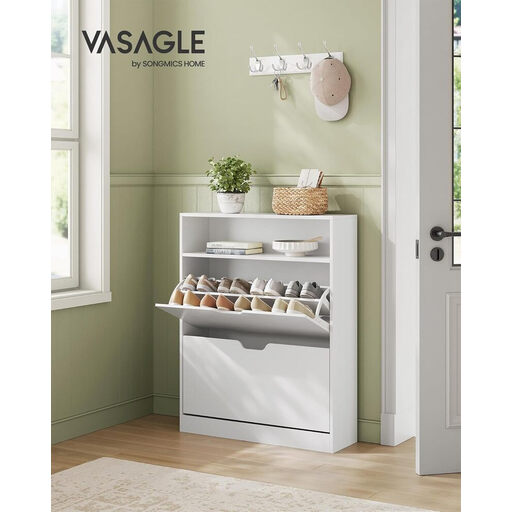
VASAGLE Shoe Cabinet with 2 Flaps
Why This Fits Their Persona: Ideal for those who need maximum shoe storage in a minimal footprint for a very narrow hallway. The classic tip-out design with a 24 cm depth is extremely space-saving.
The adjustable dividers inside the flaps counteract the problem of rigid, inflexible compartments, allowing for customisation to fit different shoe sizes.
Extremely slim depth of 24 cm. Flexible interior layout thanks to adjustable and removable dividers.
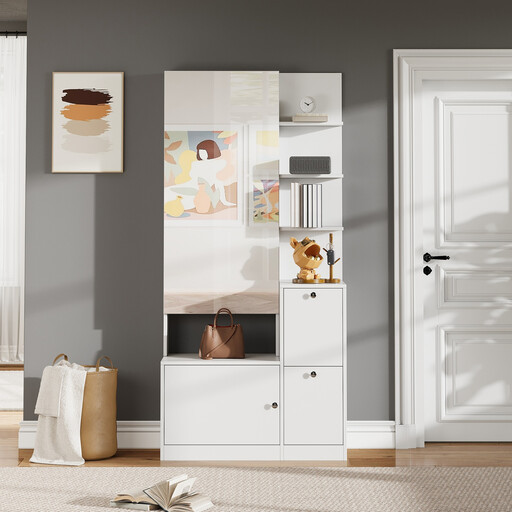
Tall Cabinet with Mirror and Shoe Storage
Why This Fits Their Persona: This all-in-one solution is designed for families who need to store not only shoes but also jackets, bags, and accessories in the entryway. The integrated mirror is also extremely practical.
Instead of being just a shoe cabinet, this unit offers clearly separated sections for different purposes. This bypasses the trap of insufficient, inflexible capacity for an entire family.
Combines a tip-out shoe cabinet, a wardrobe, open shelves, and a full-length mirror in one piece of furniture. Makes optimal use of its 180 cm vertical height.
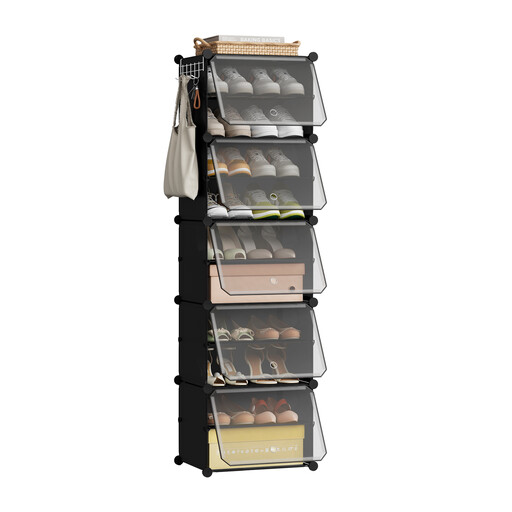
eSituro Modular Cube Shoe Cabinet
Why This Fits Their Persona: Perfect for people looking for a customisable solution that can be reconfigured to suit a move or changing needs. Ideal for sloped ceilings, alcoves, or as a room divider.
The modular system completely bypasses the trap of fixed compartments. By omitting dividers, you can create custom-sized cubes for boots or other large items.
Fully flexible DIY interlocking system. The shape (horizontal, vertical, stepped) can be freely configured. Each cube can hold up to 5 kg.
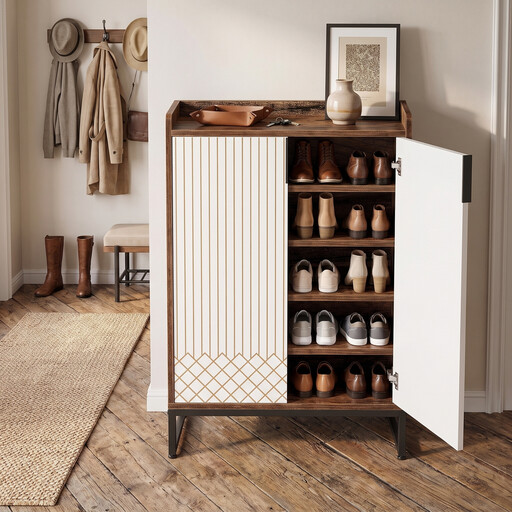
LANTINE 2-Door Shoe Cabinet
Why This Fits Their Persona: For those seeking a piece of furniture that is not only functional but also serves as a design statement. The combination of white, brown, and gold accents gives the hallway a modern, elegant touch.
This model offers high capacity for up to 25 pairs of shoes behind closed doors, avoiding the trap of misleading capacity claims while maintaining a tidy appearance.
Elegant design with a gold metal frame and diamond pattern. High, dust-protected storage capacity and a stable base thanks to the metal frame.
Looking for More Options?
We have compiled a complete, up-to-date list of products that fully meet these strict selection criteria and safety regulations.
1. Is a tip-out shoe cabinet suitable for large shoes (size 45+)?
This heavily depends on the specific model. Many standard tip-out cabinets are designed for shoe sizes up to a maximum of 43 or 44 (EU). With larger shoes, the flap may not close completely. Check the internal dimensions of the compartment in the product description or choose a model with adjustable shelves instead of a tip-out mechanism.
2. How many shoes really fit in a slim shoe cabinet?
The manufacturer's claim is a guideline, often based on slim women's shoes. As a rule of thumb, you can expect to fit about 70-80% of the stated capacity if you're storing a mix of trainers, dress shoes, and possibly children's shoes. You will need significantly more space for boots or wide hiking shoes.
3. How do I securely fasten a slim shoe cabinet to the wall?
Most tall and slim shoe cabinets come with an anti-tip kit. This is usually a small bracket or a strap that is screwed to the top of the cabinet and to the wall. Using this safety device is essential to prevent the unit from tipping over. Make sure you use the appropriate wall plugs and screws for your wall type (e.g., drywall, concrete) if they are not included.