
Induction Cookware Sets: Compare Materials, Set Contents and Storage Space
An induction cookware set should cover a range of cooking tasks, suit the size of your hob and be easy to clean day to day. For individuals, families, keen home cooks and anyone with a small kitchen or motorhome, choosing a set is about more than just price. The construction, coating, compatibility and storage space all matter.
Common misconceptions when buying induction cookware
1. “Suitable for induction” doesn’t automatically mean it’s the right fit
Induction hobs need magnetic contact between the hob and the base of the pan. Aluminium on its own isn’t enough. A suitable saucepan or frying pan will therefore usually need a magnetic stainless steel base or a specially designed multi-layer construction.
Check the base diameter too. If it’s much smaller than the cooking zone, heat may not be distributed as evenly in everyday use. When choosing a saucepan and frying pan set, check the diameters and the cooking zones you can actually use.
2. A high piece count doesn’t tell you how practical a set is
A 20-piece set may include lids, handles, kitchen utensils and protective mats as well as saucepans and frying pans. That isn’t necessarily a drawback, but it can make like-for-like comparisons harder. Check:
- How many cooking vessels are actually included?
- Are there matching lids?
- Can the pieces be stacked?
- Do removable handles need extra storage space?
- Are there sizes for single portions as well as family meals?
For a small kitchen, space-saving cookware with stackable pieces may be more practical than a larger set with lots of separate handles.
3. “Non-stick” isn’t a single type of material
Coated cookware can use different coating systems. PTFE, ceramic and other types of surfaces each have their own care instructions. Claims such as PFAS-free, PFOA-free or PTFE-free should be clearly stated in the product description. According to the manufacturers, these features are listed for the YASHE BZD-DC03SK, for example, as well as several ceramic-coated products in our selection.
Whatever the material, avoid overheating an empty pan. For coated frying pans, it’s best to use wooden, plastic or silicone utensils.
The key things to consider
Material: stainless steel, aluminium or multi-layer construction?
Stainless steel cookware is uncoated and suitable for many cooking methods. A multi-layer base with an aluminium core can improve heat distribution. However, when searing with stainless steel, you’ll usually need to get the temperature and amount of fat right to help prevent food from sticking.
Aluminium is lightweight and heats up quickly. For induction, it’s often combined with a magnetic stainless steel base. This construction is common in many non-stick frying pans and saucepan sets.
A three-layer construction, such as stainless steel-aluminium-stainless steel, combines a magnetic outer base with a heat-conducting middle layer. Even so, always check the product’s construction against the manufacturer’s specific details.
Coating and care
With coated cookware, it’s not just the material that matters; you should also check the care instructions:
- Is the product dishwasher-safe?
- Does the manufacturer recommend hand washing?
- Are metal utensils unsuitable?
- Is there a maximum temperature for the hob and oven?
- Can a removable handle stay on in the oven?
“Dishwasher-safe cookware” can make cleaning easier, but hand washing may help protect the surface and outer coating. For ceramic or non-stick frying pans, mild washing-up liquid and soft sponges are a sensible choice.
Oven safety and handles
Oven-safe cookware is versatile only if you take all the relevant components into account. A saucepan, for example, may be suitable for the oven, while its glass lid or removable handles may have a lower temperature limit.
Before you buy, check the maximum temperature, whether the cookware can be used with the lid on and how to handle hot handles. If the product has a removable handle, make sure it’s securely locked in place before lifting the pan.
Our selection by user profile
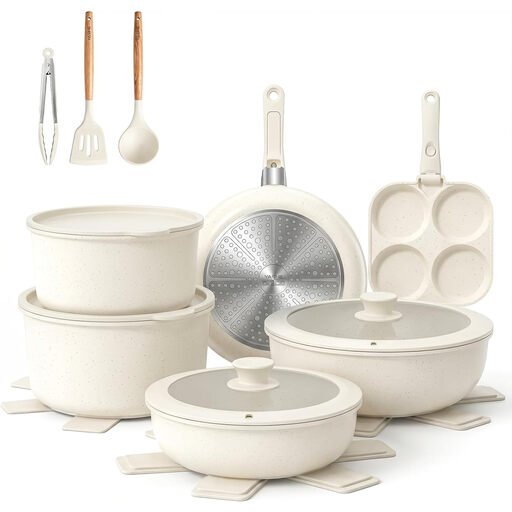
YASHE BZD-DC03SK Non-Stick Induction Cookware Set
Why it suits this profile: This 20-piece set combines two frying pans, several saucepans, lids, removable handles and protective covers. Its stackable design is made for small kitchens, motorhomes and caravans.
The product details list compatibility with induction and other types of hob. According to the manufacturer, the coating is PFOA-, PTFE- and PFAS-free. The protective covers supplied help prevent the stacked pieces from touching.
20 pieces, a stackable design and oven use up to 240 °C without the handles, according to the product details.
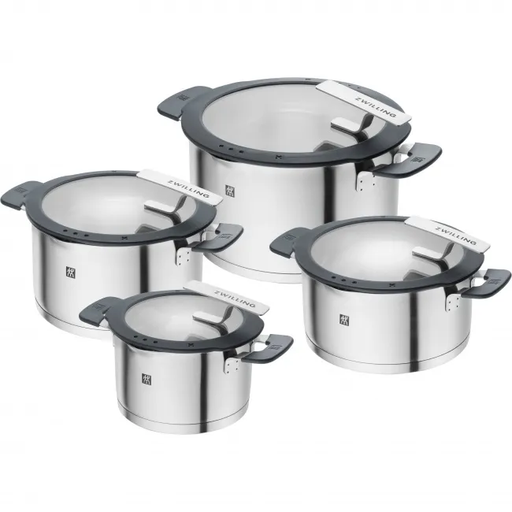
Zwilling SIMPLIFY Stainless Steel Cookware Set
Why it suits this profile: This four-piece set is for households that prefer stainless steel, clearly specified dimensions and practical details such as integrated pouring spouts.
According to the product description, the SIGMA Classic+ three-layer base is suitable for induction and other types of hob. The set uses stainless steel rather than a non-stick coating.
18/10 stainless steel, glass lids, an integrated measuring scale and dishwasher-safe according to the manufacturer; oven-safe up to 180 °C.
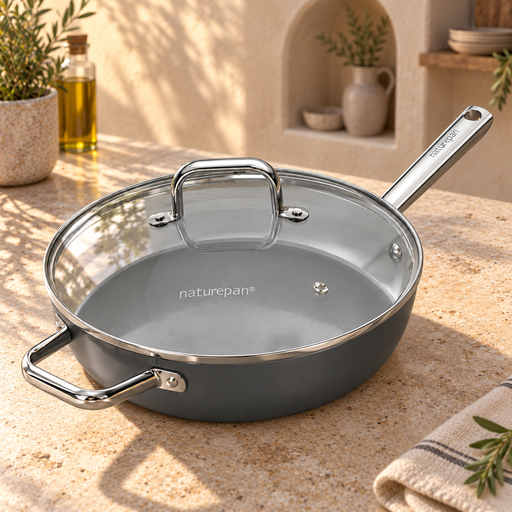
Naturepan Deep Sauté Pan with Lid
Why it suits this profile: This 28 cm sauté pan with high sides and a glass lid is ideal for braises, vegetable dishes, sauces and one-pan meals.
The product details list induction compatibility, a PFAS-, PFOA- and PTFE-free ceramic coating, and a clear maximum oven temperature.
High sides, a glass lid, compatibility with several types of hob and oven-safe up to 260 °C, according to the product details.
Looking for more options?
We’ve put together a complete, regularly updated list of products that meet these strict selection criteria and fully comply with the safety regulations in force in the EU.
Care and everyday lifespan
How long cookware lasts in practice depends on the material, temperature, cleaning method and how often it’s used. Follow these basic rules for coated frying pans:
- Don’t heat an empty pan on a high setting.
- Let hot frying pans cool before washing them.
- Don’t use abrasive cleaners or metal utensils.
- Separate stackable pieces with protective mats or tea towels.
- Check regularly that removable handles and seals are secure.
Stainless steel may develop slight discolouration or food may stick to it, but this doesn’t make the pan unusable. Stop using cookware if its coating is damaged, its handles are loose or its base is warped.
Frequently asked questions about induction cookware sets
Which saucepans work on an induction hob?
Saucepans and frying pans with a magnetic base are suitable. A simple magnet test can give you an initial indication, but the manufacturer’s details are the definitive guide to induction compatibility.
How many pieces should a cookware set contain?
For a small household, two saucepans and a frying pan in different sizes are often enough. Families may benefit from larger frying and sauté pans. The key is whether you’ll actually use the lids, handles and accessories, and whether they’re easy to store.
Is dishwasher-safe cookware always the more practical choice?
Not necessarily. A dishwasher saves time, but it can put more strain on coatings, silicone components and exterior surfaces. If the manufacturer recommends hand washing, follow that advice to help your cookware last longer.