
Buying plant pots and planters: how to choose the right size, material and drainage
Plant pots and planters should support your plants securely, drain away excess water and fit in with your home, balcony or garden. But choosing one can be tricky: product photos may show an appealing design, while important details such as internal dimensions, drainage and frost protection are easy to overlook.
Three common buying pitfalls are particularly worth looking out for:
- Missing or unsuitable drainage: A decorative planter without drainage can leave the soil permanently wet, which may harm delicate houseplants.
- Incorrect dimensions: The external measurements don’t necessarily tell you how much usable space there is inside. Thick walls or a raised base can make a large plant pot much smaller inside than you might expect.
- Material unsuited to its location: A ceramic plant pot can look right at home in your living room, but it’s vulnerable to knocks. For outdoor use, check that a plant pot is UV-resistant, moisture-resistant and stable.
What to decide before you buy
1. Consider the plant’s size and weight
Choose a planter that fits the root ball. A small plant pot with a diameter of around 14 to 18 cm is often enough for small herbs, succulents or cuttings. Larger houseplants, or plants that will continue to grow, need more internal space and a stable base.
Look for:
- Internal dimensions, not just external measurements
- Enough depth for the roots
- Weight and stability, especially for tall plants
- Space between the root ball and the rim for fresh compost
A tall, freestanding planter with a narrow base can be a space-saving choice, but it should stand on a level surface. A low centre of gravity helps keep taller plants stable.
2. Check drainage and water flow
A planter with drainage has at least one hole in the base or a separate, purpose-built water reservoir. Drainage won’t prevent every plant-care mishap, but it does make it easier for excess water to escape.
With a cachepot that has no drainage hole, you place the planted inner pot inside it. This keeps water in the outer pot, but you’ll need to check it after watering and empty it if necessary. If your pot has a drainage hole, you’ll need a suitable saucer to protect your windowsill, floor or patio.
A self-watering plant pot works differently: water is stored in a separate reservoir and delivered to the soil through a system designed for the purpose. The pot still needs to suit the plant’s needs, location and growing medium. Also check whether soil or roots could block the water flow.
3. Match the material to where you’ll use it
Ceramic, stoneware, glass and plastic are all popular choices for indoor plant pots. Ceramic and stoneware have a solid, decorative finish, but can break if knocked. Glass is best suited to small arrangements, cuttings or decorative planters, and should be placed carefully on a stable surface.
For outdoor use, these details are useful:
- UV resistance to help prevent fading in sunlight
- Moisture and weather resistance
- Sufficient weight or a secure design
- Guidance on storage during severe frosts
- A drainage hole that can be sealed or drilled through
According to the product details, the Beliani ABDERA model is made from a mixture of stone, polyresin and fibreglass. It measures 31 × 31 × 58 cm, holds 31 litres and has a pre-formed hole that can be drilled through if needed, with a stopper included. Dry storage is recommended during extreme winter conditions.
Our picks for different needs
The recommendations below are grouped by specific requirements. Before you buy, check the product details, such as dimensions, material and features, against the intended location and your plant.
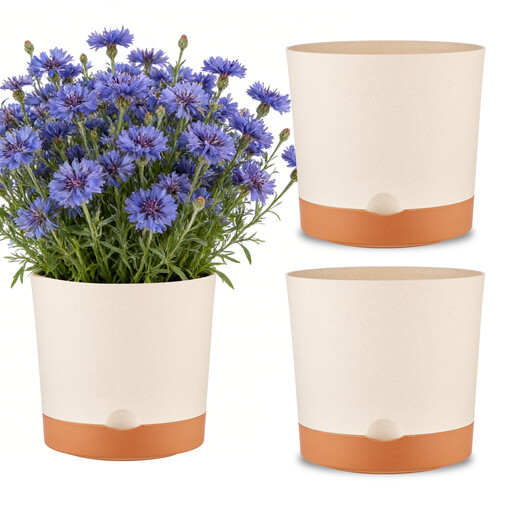
3 Self-Watering Plant Pots, 16.5cm Diameter, Beige Resin Flower Pots
Why this product suits this profile: The set includes three plant pots, each with a 16.5 cm diameter, plus matching saucers. They’re suitable for herbs, succulents and smaller houseplants on a windowsill, balcony or patio.
The built-in water reservoir and saucers make it easier to manage water than with a closed cachepot. You should still check the water supply regularly.
Three matching pots with a beige plastic finish. No assembly required.
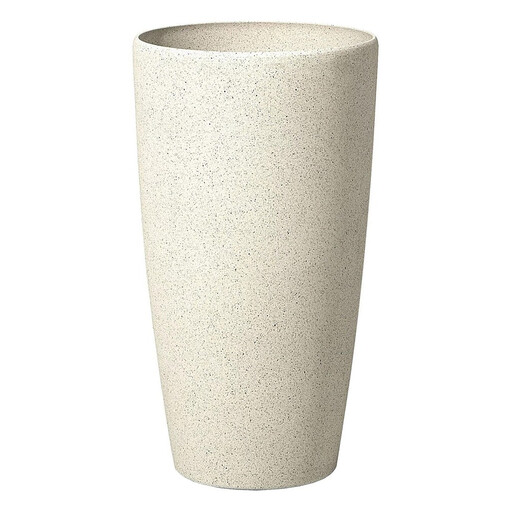
BelianiPlant Pot Stone Beige 31x31x58 cm ABDERA
Why this product suits this profile: This 58 cm-tall, round planter combines precise dimensions with a mix of stone, polyresin and fibreglass. It can be used indoors as a cachepot or outdoors.
The drainage hole is pre-formed and can be drilled through if needed, or sealed with the stopper provided. This lets you adapt the water flow to the location.
31-litre capacity, UV- and moisture-resistant properties according to the product details, and no assembly required.
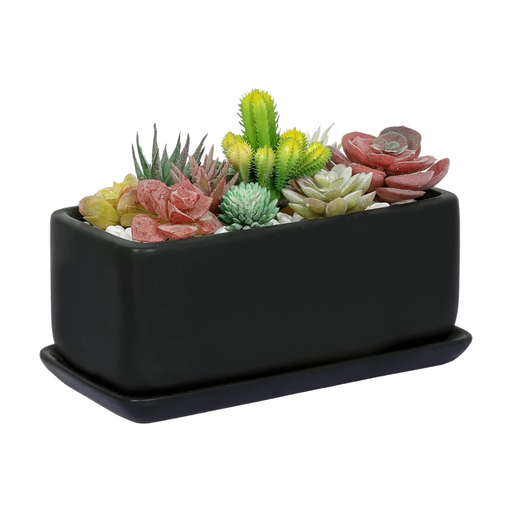
MyGift 10 Inch Matte Black Ceramic Indoor Plant Pot
Why this product suits this profile: This rectangular ceramic plant pot measures around 25 × 12 × 10 cm and is designed for windowsills, shelves or desks. Two drainage holes and a removable tray help manage water.
The two drainage holes prevent water from being trapped in a completely closed pot. You can remove and empty the drip tray after watering to protect the surface underneath.
Matte black ceramic, a rectangular shape and a removable ceramic tray.
Looking for more options?
We’ve put together a complete, regularly updated list of products that meet these strict selection criteria and fully comply with the safety regulations in force in the EU.
Practical buying and care tips
Before planting, check whether the pot is designed for direct planting or intended to be used as a cachepot. If it has a drainage hole, use a saucer or a permeable liner. Don’t let water collect on furniture or delicate windowsills.
A large plant pot for a patio or garden should stand on level ground. With taller models, stability depends on the combined weight of the plant and pot, the shape of the pot and how exposed it is to the wind. Even a planter labelled weather-resistant may need protecting or storing somewhere dry during severe frosts.
Avoid hard knocks and sudden temperature changes with ceramic and glass pots. A soft, damp cloth is usually all you need for cleaning. Abrasive cleaners can dull the surface or damage decorative finishes.
Frequently asked questions about plant pots and planters
What size plant pot should I choose for a houseplant?
The new pot should be only moderately larger than the existing root ball. A pot that’s much too large holds more moisture and can make plant care harder. So check the diameter, depth and internal dimensions of your indoor planter.
Does every plant pot need a drainage hole?
Not every cachepot needs a hole. However, a pot used for direct planting should allow excess water to drain away. For a closed pot, it makes sense to use a separate inner pot with a drainage hole, as long as you check the water in the outer pot regularly.
How does a self-watering plant pot work?
A self-watering plant pot has a water reservoir connected to the soil, allowing moisture to travel upwards as needed. This means less manual watering, but you’ll still need to check the water level, growing medium and plant’s needs.