
How to Buy a Hot Pot: A Guide to Material, Size and Hob Compatibility
A shared hot pot meal places particular demands on the pot: the broth needs to heat evenly, several people must be able to help themselves comfortably, and cleaning shouldn't be unnecessarily time-consuming. If you're looking to buy a hot pot, you shouldn't let looks, accessories or marketing claims be your only guide.
Common Pitfalls When Buying
1. Unclear Hob Compatibility Information
Not every pot works automatically on an induction hob. What matters is a multi-layer base suitable for induction, which transfers heat from the hob into the pot's base. Claims such as "suitable for all hob types" should therefore be checked against the specific product details.
For households with varying cooking options, a hot pot that works on induction, gas, electric and ceramic hobs is a practical choice. With gas hobs, you should also make sure the flame doesn't extend beyond the base of the pot.
2. Too Small or Unsuitable Capacity
A compact pot can be fine for a single portion, but often isn't enough for a family gathering. A hot pot for 3 to 6 people should offer enough surface area inside so that broth, vegetables, noodles and other ingredients aren't packed too tightly.
As a rough guide:
- 1 to 1.5 litres: for one person, small kitchens or desk use
- around 3 to 5 litres: for several people and shared meals
- from around 6 litres: for larger family gatherings or frequent use
The actual usable capacity is less than the stated total volume, as a pot shouldn't be filled to the brim.
3. Divided Pots with Too Little Space in the Partition
A divided hot pot, also known as a Yin-Yang hot pot, allows you to have two broths or flavours at the same time. However, this advantage is lost if the dividing wall isn't sturdy enough or the individual sections are very narrow. So check the diameter, depth and shape of the divider.
Key Buying Criteria in Detail
Material and Build Quality
304 stainless steel is common in many hot pots. It doesn't have a classic non-stick coating and, according to product information, is suitable for boiling, simmering and braising. A smooth interior surface can make cleaning easier. With stainless steel, white water or starch marks and rainbow-coloured discolouration can appear after heating. These marks can often be treated with a little vinegar or lemon juice.
A stainless steel hot pot should sit securely on the hob. A thick multi-layer base helps with more even heat distribution. Metallic scouring pads and harsh abrasive cleaners can damage the surface.
Lids, Handles and Operation
A hot pot with a glass lid lets you keep an eye on the broth without having to lift the lid regularly. This can be handy when bringing it to the boil and keeping it warm. The lid and handles get hot during cooking; oven gloves or pot holders are still essential.
Also look out for:
- two sufficiently wide handles for carrying,
- a stable lid rest,
- a reasonable weight,
- an easily accessible interior surface,
- clear care instructions for dishwasher use.
Classic Pot or Electric Multi-Pot?
A classic hot pot is used directly on the hob and is particularly suitable for families or groups of friends. An electric multi-pot, on the other hand, doesn't need a separate hob and is interesting for small flats, offices or occasional single portions.
With an electric model, power levels, overheat protection, boil-dry protection and a detachable power cord are relevant features. However, the wattage alone doesn't tell you how quickly the contents will actually heat up. Fill volume, pot shape and starting temperature also affect cooking time.
Our Selection by User Profile
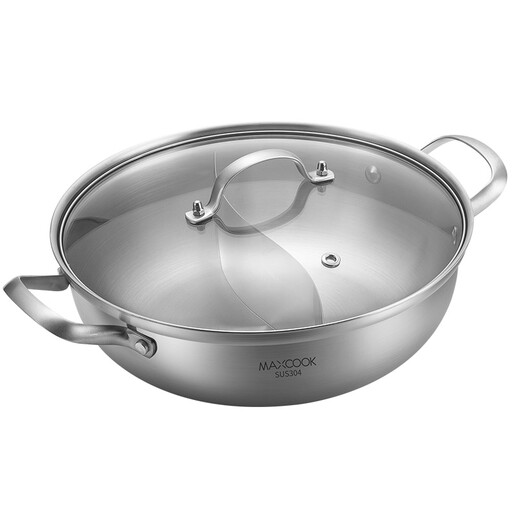
MAXCOOK 28cm Divided Hot Pot, Tri-Ply 304 Stainless-Steel Hotpot
Why this product fits the profile: The 28cm version is suitable for smaller groups and divides the broth into two sections. According to the product information, the pot is compatible with induction, gas, electric and ceramic hobs.
The hob compatibility and capacity are clearly stated. This makes it easier to match the model with your existing hob and the number of people you plan to cook for.
304 stainless steel without classic non-stick coating; divided pot for two broths; glass lid and double handles.
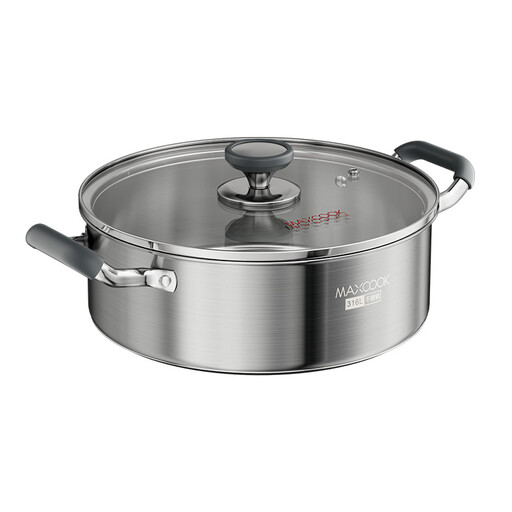
Maxcook 316L Stainless Steel Hot Pot, 6.5 l, with Glass Lid
Why this product fits the profile: The larger volume is aimed at families and frequent shared meals. According to the product description, the pot body is made from 316L stainless steel, complemented by a glass lid and silicone handles.
The details on material, volume and hob types help rule out a pot that's too small or unsuitable for your hob. The glass lid reduces the need to open it frequently during cooking.
6.5 l capacity; multi-layer base for gas, induction, electric, ceramic and halogen hobs; heat-insulating silicone handles.
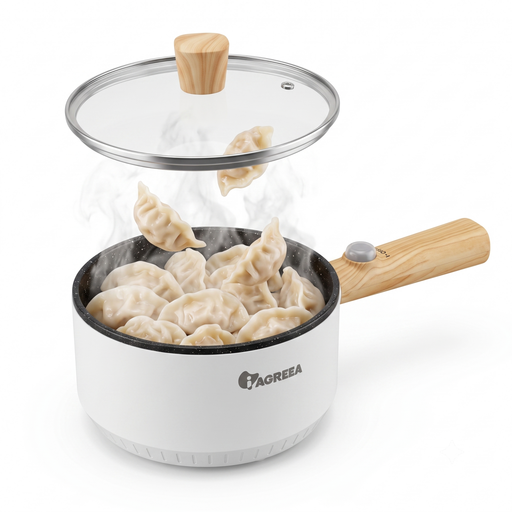
IAGREEA Electric Multi-Pot 1.2 l, 1000 W
Why this product fits the profile: The compact electric multi-pot is designed for single portions, small flats, offices or student accommodation. Two power levels support different preparations such as noodles, soup or a personal hot pot.
The small capacity makes its intended use clear. Overheat and boil-dry protection are listed as features; however, the appliance should still only be used on a stable, heat-resistant surface.
1000 W heating element; 500 W and 1000 W settings; detachable EU power cord; glass lid.
Other Suitable Sizes
For a larger group, the MAXCOOK 30 cm Divided Hot Pot with a 4.6 l capacity could be of interest. According to the product data, it has a 304 stainless steel body, a multi-layer base and compatibility with induction, gas, electric and ceramic hobs. The depth is 15.6 cm. This model is therefore suitable for users looking for an Asian hot pot with two separate broths and more space than a compact version: View the MAXCOOK 30 cm Divided Hot Pot.
Another option for 3 to 6 people is the PURECOOK Hot Pot Series with a 26 cm diameter. The product description mentions 304 stainless steel, a textured interior surface, glass lid and a reinforced multi-layer base. The pot is intended for hot pot, soups, porridge, braising, dumplings and noodles. The textured surface should be cleaned with soft sponges and without metal utensils: View the PURECOOK Hot Pot Series.
Looking for more options?
We've put together a complete, regularly updated list of products that fully meet these strict selection criteria and the safety regulations in force in the EU.
Care and Safe Use
Before first use, a stainless steel model should be cleaned with warm water and washing-up liquid. According to the product information, any manufacturing residues can be removed by briefly boiling it out and then wiping it down. For all types, the following applies:
- Do not overheat the pot when empty.
- Only touch hot handles and lids with suitable oven gloves.
- Place the pot securely on the hob.
- Avoid sudden temperature changes.
- Do not use metal utensils on non-stick or textured surfaces.
- With electrical appliances, do not immerse the housing, cable or plug in water.
FAQ About Hot Pots
Which hot pot is suitable for induction?
A model with an explicitly stated multi-layer base suitable for induction. The base diameter should also match the cooking zone. Many of the stainless steel models mentioned here are described as suitable for both induction and gas.
How big should a family hot pot be?
For three to six people, around 3 to 5 litres is often practical. With lots of ingredients or long cooking evenings, a model with 4.6 or 6.5 litres can offer more space. For a single portion, an electric multi-pot with 1.2 litres is sufficient.
Does an electric multi-pot use a lot of electricity?
The consumption depends on the wattage, running time and the setting used. A 1000 W appliance running for one hour uses 1 kWh on full power in theory. In practice, the maximum setting isn't usually used continuously. Always follow the address data and safety distances from the instruction manual before use.