
How to Choose an Upholstery Cleaner
A spilled glass of wine on the new sofa, muddy paw prints on the carpet, or the inevitable stains on car seats after a family trip—these mishaps are all too familiar. A powerful upholstery cleaner promises a quick solution. However, the market is flooded with devices whose marketing promises often fall short in practice. The result is not only poorly cleaned textiles but also wasted money.
As your Joybuy Product Recommendation Officer, I'll help you identify the crucial features and avoid common purchasing traps. This guide focuses on the technical facts that truly matter, enabling you to make an informed decision.
The 3 Most Common Pitfalls of Upholstery Cleaners
Before we dive into the key technical specifications, let's highlight the three most common issues that lead to frustration with many devices.
- The "Water Stain Trap" from Weak Suction Power: Many budget-friendly devices spray a water-and-detergent mix onto the stain, but they lack the power to pull the dirty liquid completely back out of the fabric. The result is often a large water spot that leaves unsightly rings after drying. In the worst-case scenario, the residual moisture promotes the growth of mould and unpleasant odours deep within the upholstery.
- The Unhygienic Single-Tank System: Some models use only one container for both fresh and dirty water. This means that already-extracted dirt can potentially come back into contact with the clean water. A hygienic and effective upholstery cleaning device should strictly separate clean and dirty water.
- Insufficient Reach and Lack of Flexibility: A power cord that's too short or an inflexible, short hose turns cleaning larger pieces of furniture or a car's interior into a tedious chore. If specialised attachments are also missing, cleaning corners, crevices, or delicate fabrics becomes inefficient.
What Really Matters: The Key Specifications
To avoid the problems mentioned above, you should check three core technical specifications before buying. These are the primary determinants of a device's performance and practicality.
1. Suction Power (measured in Pascals, Pa)
Suction power is the most critical factor for a true deep clean. It indicates how forcefully the device can pull the water-and-dirt mixture from the fibres. High suction power, specified in Pascals (Pa) or Kilopascals (kPa), not only ensures a more thorough cleaning but also a significantly shorter drying time.
- Pro Tip: For an effective wet vac for sofas or a mattress cleaner, a value of 12,000 Pa (12 kPa) or more is a good benchmark. Devices with lower power are often only suitable for surface-level stains on robust materials.
2. The Tank System: Size and Separation
A good device features a dual-tank system. This means there is one separate tank for clean water (often mixed with detergent) and a second, separate tank for the extracted dirty water. This principle ensures that you are always cleaning with a fresh solution and that dirt is securely contained.
- Pro Tip: Pay attention to the tank capacity. A fresh water tank with a volume of over 1 litre and a dirty water tank of a similar size reduce the need to constantly interrupt your work for refilling or emptying.
3. Reach and Accessories
User-friendliness heavily depends on freedom of movement. A portable carpet cleaner should be flexible in its application.
- Cord and Hose Length: A combined reach (cord + hose) of at least 5 metres is recommended for most household applications and for use as a car seat cleaner.
- Attachments: Check if various brush attachments are included. A wider brush is suitable for large areas like carpets, while a narrower brush is ideal for upholstery crevices, stubborn stains, or as a pet stain remover.
Picks for Your Profile
Based on the criteria above, we have compiled some options for different user groups.
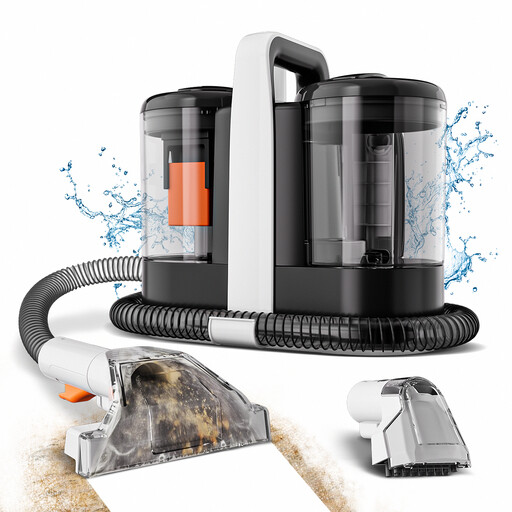
OMESER W07 Carpet Cleaner Machine, Portable Spot Cleaner
Why This Fits Their Persona: Ideal for households where stubborn stains from children or pets are a regular occurrence. The high performance and hygienic tank system are designed for frequent use to keep sofas, carpets, and mattresses clean.
With a suction power of 15 kPa, it avoids the "water stain trap." The large dual-tank system (1.5 L clean / 0.8 L dirty) bypasses the problem of unhygienic single-tank systems and constant interruptions. The long reach of the hose and cord ensures flexibility.
The 3-in-1 system (spraying, scrubbing, suction) enables a professional-grade deep clean. Two included brush heads offer versatility for different surfaces.
Compact Wet Cleaner for Upholstery
Why This Fits Their Persona: Cleaning car seats, floor mats, and boots requires an especially handy, lightweight device. The priority here is manoeuvrability in tight spaces without sacrificing a fundamental deep-cleaning function.
A good model for this purpose avoids the "reach trap" with its compact design, which allows the entire unit to be brought close to the job. It should still feature a dual-tank system to ensure hygienic cleaning.
Maximum portability and specialised, narrow nozzles for crevices and hard-to-reach areas in the car. Some models are even cordless, offering even more flexibility.
Simple Spot Cleaner for Upholstery
Why This Fits Their Persona: Anyone who only needs to remove an occasional stain from a sofa or chair doesn't need a high-performance machine. A simple, compact, and ready-to-use spot cleaner for upholstery is the right solution here.
Even with a basic model, you should look for a dual-tank system to avoid the hygiene trap. The suction power must be sufficient to remove small, fresh stains without leaving rings.
Quickly ready for small emergencies and offers space-saving storage in a cupboard. The focus is on simple handling, not on cleaning entire landscapes.
Looking for More Options?
We have compiled a complete, up-to-date list of products that meet these strict selection criteria and comply with current safety regulations.
How long does it take for a sofa to dry after cleaning with an upholstery cleaner?
The drying time depends on the device's suction power, the type of fabric, the ambient temperature, and ventilation. A device with high suction power (e.g., over 12 kPa) removes most of the water, which can lead to a drying time of typically 2 to 6 hours. With weaker suction devices, it can take 8 hours or longer. Good ventilation in the room significantly speeds up the process.
Can I use regular dish soap in an upholstery cleaning machine?
This is strongly discouraged. Household cleaners like dish soap tend to create excessive foam. This foam can get into the device's motor and damage it. Furthermore, such cleaners often leave a sticky residue in the fabric that attracts new dirt. Only use cleaning solutions that are approved by the manufacturer for use in a wet cleaner for upholstery. These are typically low-foaming and specially formulated for textile fibres.
How often should you deep-clean upholstered furniture and mattresses?
For general hygiene and to remove dust mites, a deep clean is recommended every 12 to 18 months. In households with small children, pets, or allergy sufferers, more frequent cleaning every 6 to 12 months can be beneficial to reduce allergens and deep-seated dirt. Of course, spot cleaning should always be done immediately as needed.