
Upholstery Cleaner Buyer's Guide: Essential Tips
A spilled glass of juice on the new sofa, muddy paw prints on the carpet, or the unavoidable signs of daily life on car seats—stains on upholstery and textiles are a nuisance. A high-performance upholstery cleaner promises a quick fix. But the market is crowded, and many devices don't live up to their advertising claims. As your Joybuy Product Recommendation Officer, I'll help you identify the crucial features and avoid common purchasing traps.
Many buyers invest in a device only to find it useless after a few months. The reasons are often the same and can be traced back to three common flaws:
- Insufficient Suction Power: Many budget-friendly devices spray water onto the stain but lack the power to suction it back out effectively. The result: upholstery is left soaked, drying time is extremely long, and water spots, mould, or unpleasant odours can develop.
- Inefficient Single-Tank Systems: Models with only one container for fresh and dirty water tend to redistribute already dissolved dirt back onto the surface. Instead of a deep clean, this often just shifts the problem around superficially.
- Misleading "All-in-One" Promises: Devices advertised as a universal solution for everything often turn out to be a compromise that doesn't perform any single task well. A pressure washer is not a spot cleaner for your sofa, and a compact upholstery cleaner can't clean a patio.
What Really Matters: The Decisive Parameters for an Upholstery Cleaner
To make an informed decision, you should be guided not by marketing buzzwords, but by objective technical data. Two parameters are central to the effectiveness of an upholstery or carpet cleaner.
1. Suction Power: The Key to Deep Cleaning and Fast Drying
Suction power, often specified in Pascals (Pa) or kilopascals (kPa), is the most important criterion. It determines how effectively the device can remove water and dissolved dirt from the deep fibres of upholstery, mattresses, or carpets.
- Low Suction Power (< 10 kPa): Such devices are often only suitable for superficial, fresh, and liquid stains. For deep-seated dirt or older stains, they leave too much residual moisture in the fabric.
- High Suction Power (from 12 kPa): A suction power of 12 kPa to 15 kPa is a good indicator of a high-performance device. This power ensures that not only the dirt but also a large portion of the cleaning fluid is extracted. The result is a significantly shorter drying time and a more hygienic clean, which minimises the risk of mould growth.
2. Tank System: Hygiene Through Separate Water Circuits
A good wet cleaner operates on the spray-extraction principle: clean water (often with a cleaning agent) is sprayed on and immediately suctioned up along with the dirt. The design of the tank system is crucial here.
- Single-Tank System: Fresh and dirty water are in the same container, often separated only by a simple partition. This carries the risk of cross-contamination.
- Dual-Tank System: This is the more hygienic and effective solution. One tank contains only clean water, while the dirty water is suctioned into a separate, completely isolated container. This ensures that cleaning is always done with a fresh solution and the dirt can be disposed of safely. Pay attention to the capacity of the tanks—larger tanks allow for longer, uninterrupted cleaning sessions.
Our Selection: The Right Devices for Different Needs
Instead of making a blanket recommendation, we have identified devices that meet specific user profiles and avoid the pitfalls mentioned above.
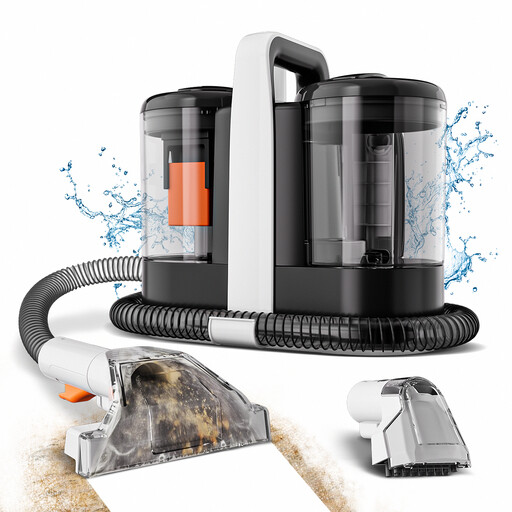
OMESER W07 Carpet Cleaner Machine, Portable Spot Cleaner
Why This Fits Their Persona: Ideal for households where stains on sofas, carpets, or mattresses are a regular occurrence. The device is designed as a specialised spot cleaner and effectively tackles typical messes caused by children or pets (e.g., as a pet stain remover).
With a suction power of 15 kPa, residual moisture is minimised, promoting fast drying. The dual-tank system (1.5 L fresh water, 0.8 L dirty water) consistently prevents cross-contamination.
The combination of a long hose (approx. 1.3 m) and power cord (approx. 3 m) offers a wide reach for cleaning car seats or large pieces of furniture. Its compact design allows for space-saving storage.
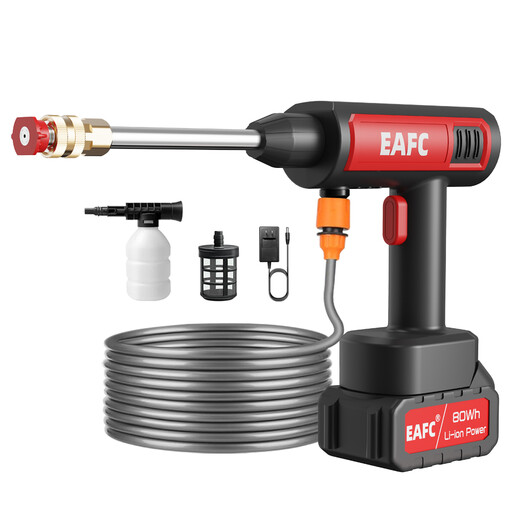
EAFC Portable Cordless High Pressure Washer
Why This Fits Their Persona: Suitable for users looking for a cordless, mobile solution for light-duty outdoor cleaning tasks. Ideal for washing the car, cleaning garden furniture, or rinsing off balcony floors where no power outlet is available.
This device is not an upholstery cleaner, thus avoiding the misleading "all-in-one" promise. It is a specialised, battery-powered high-pressure washer for mobile use and is not intended for delicate interior textiles.
Its independence from the power grid, thanks to battery operation, offers maximum flexibility. The self-priming function allows water to be drawn from a bucket or another source, enabling use anywhere.
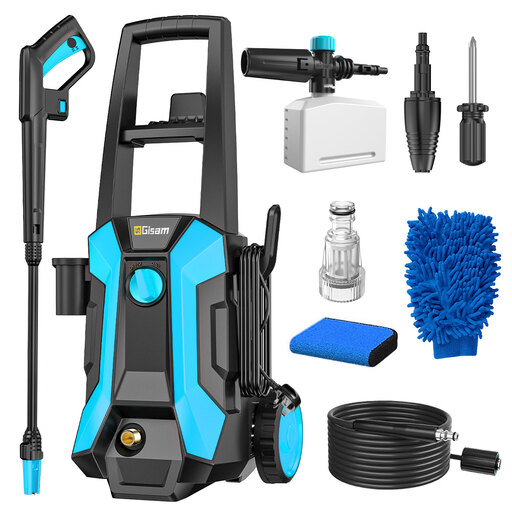
Pressure Washer, 2200W 180Bar 480L/H Electric
Why This Fits Their Persona: Designed for demanding outdoor cleaning jobs. With high pressure and water flow, this device effortlessly removes stubborn dirt from patios, fences, walkways, and facades.
This is a pure high-pressure washer, not an upholstery cleaner. It is clearly positioned for powerful outdoor cleaning and does not attempt to be an unsuitable compromise for interior upholstery cleaning.
The high pressure of 180 Bar and a water flow rate of 480 L/h ensure high cleaning efficiency. The integrated hose reel and the 8-metre-long hose provide tidiness and a long reach.
Looking for more options?
For specific cleaning tasks, especially in the automotive sector, we have curated a selection of products that meet strict selection criteria.
1. Can I use regular tap water in an upholstery cleaner?
Yes, regular tap water can be used in most devices. For enhanced cleaning performance and for stubborn stains, manufacturers often recommend adding a special cleaning agent suitable for spray-extraction machines. Be sure to use low-foaming cleaners to avoid impairing the device's function.
2. What is the difference between an upholstery cleaner and a wet/dry vac?
An upholstery cleaner (also called a carpet washer or spray-extraction device) actively works with water: it sprays a cleaning solution into the fabric and, in the same step, suctions it back up along with the dissolved dirt. It is designed for the deep cleaning of textiles. A wet/dry vac, on the other hand, is primarily a vacuum cleaner that can also suck up liquids. However, it does not perform an active cleaning with water and is therefore more suitable for vacuuming up spills than for stain removal.
3. How often should you clean upholstered furniture or mattresses?
For general hygiene, a deep clean of frequently used upholstered furniture, mattresses, or car seats is recommended once or twice a year. However, stains should always be treated as quickly as possible, as they can set into the fabric over time and become more difficult to remove. A compact spot cleaner is the ideal tool for this.