
Wallbox Dynamic Load Balancing: Recommendations and Buying Guide
By Joybuy Product Recommendation Officer, 17 July 2026
Purchasing an electric vehicle is a significant step towards modern mobility. But with the vehicle comes the question of the optimal home charging solution. Anyone who has charged their EV while the washing machine, stove, and other large appliances are running knows the concern: Can the home's electrical connection handle the load? An overload can, at best, trip the main circuit breaker; at worst, it poses risks to your home's electrical system.
This is precisely where a wallbox with dynamic load balancing comes in. This intelligent technology ensures your vehicle is charged safely and efficiently without exceeding your electrical grid's capacity. This article serves as a guide to help you understand how it works and find a home charging station that suits your needs.
Selection Criteria for Your Home Charging Station
Before choosing a model, several technical and practical aspects should be considered. These criteria will help you make an informed decision.
Charging Power: 11 kW or 22 kW?
The charging power, measured in kilowatts (kW), determines how quickly your vehicle's battery is charged.
- An 11 kW wallbox is sufficient for most private use cases. It can fully charge a standard electric car overnight and, in Germany, only requires notification to the grid operator.
- A 22 kW wallbox offers twice the charging power, reducing charging time accordingly. However, it requires approval, and not every home connection is designed for this output. Additionally, your vehicle's onboard charger must also be able to handle this power.
Smart Control via App
A smart wallbox with an app offers significant convenience and control. Using a smartphone application, you can start and stop charging sessions, schedule charging times (e.g., to take advantage of off-peak electricity rates), adjust the charging power, and view detailed consumption statistics. A home charging station with app control is therefore a key component of smart energy management in the home.
Weather Resistance and Safety (IP Rating)
The installation location—garage, carport, or an unprotected exterior wall—is crucial for choosing the right wallbox. The IP rating indicates how well the housing is protected against the ingress of foreign objects (first digit) and water (second digit). An IP66-rated wallbox is dust-tight and protected against powerful water jets, qualifying it for outdoor use and ensuring safe operation in all weather conditions.
Recommended Dynamic Load Balancing Wallboxes
Based on the criteria mentioned, we have compiled a selection of models that stand out for their functionality and technical features.
feyree 11 kW Wallbox with Dynamic Load Balancing
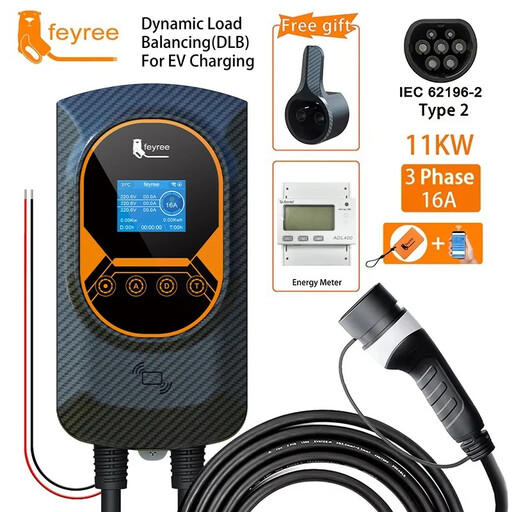
Why it stands out: This model is a balanced solution for households with a three-phase power connection. The dynamic load balancing (DLB) continuously monitors the home's total electricity consumption. It ensures that the EV charging station only uses the surplus energy not currently needed by other appliances. This intelligently adjusts the charging power to prevent overloading the home's connection, while charging the vehicle as quickly as possible.
Advantages:
- Dynamic Load Balancing (DLB): Automatically adjusts charging power based on household consumption.
- App Control: Full control and monitoring via the Tuya app (for iOS and Android).
- Adjustable Current: Manual adjustment from 8A to 16A is possible.
- High Protection Rating: With an IP66 rating, it's suitable for safe operation indoors and outdoors.
- Comprehensive Safety Features: Integrated protection against residual current, over/undervoltage, and overheating.
Who is it for? This wallbox is ideal for electric vehicle owners with a three-phase home connection who are looking for a reliable and intelligent solution for daily charging. It is compatible with all vehicles that use a Type 2 EV charger connection.
feyree 7.6 kW Wallbox with Dynamic Load Balancing
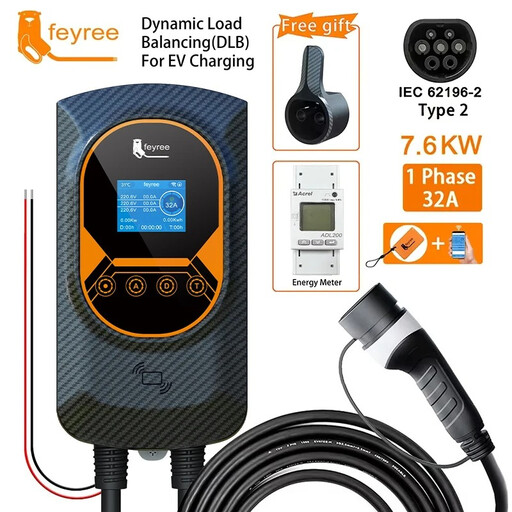
Why it stands out: This model brings the benefits of dynamic load balancing to households with only a single-phase power connection. Despite the lower phase count, the smart control ensures that available power is optimally distributed between the household and the vehicle. Its function as a charging station with load shedding is particularly valuable here, as single-phase connections have a lower total capacity.
Advantages:
- Single-Phase DLB: Specifically designed for households with a single-phase connection.
- Flexible Current: Very wide adjustment range from 8A to 32A.
- Smart Connectivity: Control and scheduling via the Tuya app.
- Informative Display: An LCD screen shows charging data such as current, voltage, and temperature directly on the unit.
- Weatherproof: Certified with an IP66 rating, making it suitable for outdoor installation.
Who is it for? Perfect for users with a single-phase home connection who need a smart and safe charging solution. It is well-suited for plug-in hybrids (PHEVs) or battery electric vehicles (BEVs) where a charging power of up to 7.6 kW is sufficient for daily needs.
feyree 22 kW Wallbox with Dynamic Load Balancing
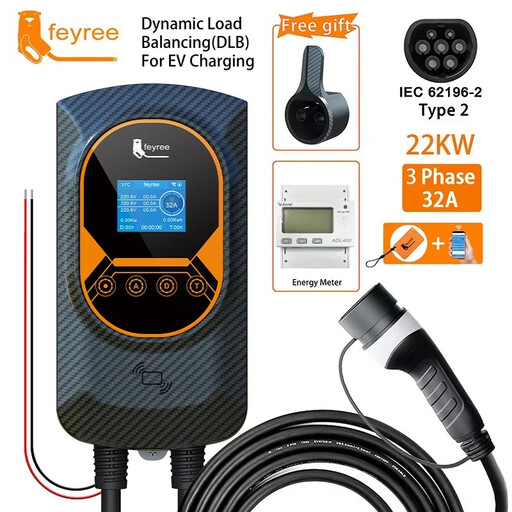
Why it stands out: This model is aimed at users who want maximum charging power without compromising on safety. With up to 22 kW of charging power, compatible vehicles can be charged in a very short time. The integrated dynamic load balancing is essential here to safely integrate the high power into the home's grid and intelligently manage peak loads.
Advantages:
- Maximum Charging Power: Up to 22 kW for extremely fast charging sessions.
- Intelligent Load Management: Ensures safe distribution of high power within the home's grid.
- Access Control: In addition to app control, an RFID card function allows for authorising charging sessions.
- Flexible Adjustment: The current is adjustable from 8A to 32A.
- Robust Construction: The housing is IP66 certified and ready for all environments.
Who is it for? This feyree wallbox is the choice for discerning EV drivers whose vehicle supports 22 kW AC charging and who prioritise the shortest possible charging times. Note that the installation of a 22 kW wallbox requires approval from the local grid operator.
Looking for More Options?
The models presented cover common use cases and demonstrate the benefits of dynamic load balancing. However, if you prefer different specifications, cable lengths, or designs, you are sure to find a suitable solution in our broader selection.
Explore our full range of Type 2 EV Charging Cables and find the perfect charging station for your electric car.
Frequently Asked Questions (FAQ)
What is dynamic load balancing in a wallbox?
Dynamic load balancing is a smart feature that measures a building's total electricity consumption in real time. The wallbox only releases the power for charging the electric vehicle that is not currently being used by other appliances in the household. This actively prevents an overload of the home's connection and the tripping of the main circuit breaker. It functions like an automatic and predictive load shedding system.
Is an 11 kW or 22 kW wallbox more practical?
For most private users, an 11 kW wallbox is the more practical and economical choice. It can easily charge most EVs overnight and only needs to be registered with the grid operator. A 22 kW wallbox charges faster but requires approval from the grid operator, which is not always granted. Furthermore, the home's electrical connection must be suitable for it, and the vehicle must be capable of charging with 22 kW AC power.
Does a wallbox have to be installed by an electrician?
Yes, the installation of an EV charging station must be carried out by a qualified electrician. It involves an intervention in the home's electrical system that requires expert knowledge to ensure safety, compliance with standards, and correct functionality. This is especially true for the proper installation of the sensor for the dynamic load balancing system.