
Ubongo Board Game Buyer's Guide 2026: Classic vs. 3D in Detail
The Ubongo board game is a tile-laying game from publisher Kosmos Games, based on a combination of speed and spatial reasoning. Players compete simultaneously to completely fill a specific shape on a template card with a given set of tiles. The challenge lies in solving the puzzle within a time limit set by a sand timer. This article analyses the functional differences between the popular variants and provides a data-driven purchasing guide.
Selection Criteria for Ubongo Games: A Technical Overview
Choosing the right Ubongo game depends on objective parameters that directly impact the gameplay experience. The following criteria serve as a guide.
Game Mechanics: Two-Dimensional vs. Three-Dimensional
The most fundamental distinction lies in the dimensionality of the puzzle pieces.
- 2D Variants (e.g., Ubongo Classic): These feature flat cardboard tiles that are placed on a two-dimensional surface (the puzzle board). This mechanic focuses purely on area recognition and combination.
- 3D Variants (e.g., Ubongo 3D): These versions use three-dimensional blocks that must be built not only flat but also vertically to construct a specified shape. This requires advanced spatial awareness and fine motor skills.
Difficulty Levels and Scalability
The scalability of the difficulty level is a crucial factor for replayability and suitability for groups with mixed skill levels. The Ubongo series offers different approaches to this. The puzzle boards are often double-sided, with one side presenting a simpler puzzle with fewer pieces and the other a more complex puzzle with more pieces. The 3D versions often expand this principle to up to four difficulty levels, allowing for an even finer adjustment to the players' skill levels.
Player Count and Age Rating
Most Ubongo games are designed for 1 to 4 players. The solo mode primarily serves as a way to train logical thinking under time pressure. The manufacturer's specified age rating is typically 8 years and older. This rating is based on the cognitive requirements of quickly analysing and combining geometric shapes.
Materials and Build Quality
According to the manufacturer, the components of the Ubongo games analysed here are made primarily of cardboard. The stability and durability of the tiles and boards are relevant for frequent use. The 3D blocks are designed to be stacked stably on top of each other without easily slipping.
Our Picks for 2026
Based on the criteria above, we present two variants of the game with their specific features.
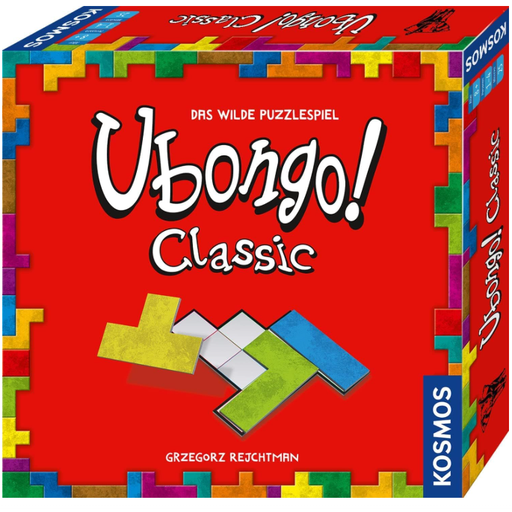
Kosmos 683092 Ubongo! Classic
Why We Recommend This Product
This version represents the core Ubongo mechanic in its original form. The focus is on fast-paced, two-dimensional puzzle-solving. With 648 different puzzles spread across two difficulty levels, the game offers high variability for numerous sessions. The simultaneous gameplay eliminates downtime and ensures consistently high interaction at the table. The optional companion app for rules explanation can ease the onboarding process for new players.
Advantages
- Promotes logical thinking: The game playfully trains spatial awareness and problem-solving skills.
- High replayability: The large number of 648 puzzles ensures long-lasting variety.
- Simultaneous gameplay: All players are active at the same time, which increases the game's dynamic.
- Two difficulty levels: Allows players of different experience levels and age groups to play together.
Who It's For
This family game is suitable for groups and solo players aged 8 and up who are looking for a fast and easy-to-learn tile-laying game for a game night. It is an excellent choice for newcomers to the world of Ubongo games, as well as for families who prefer an intergenerational family board game.
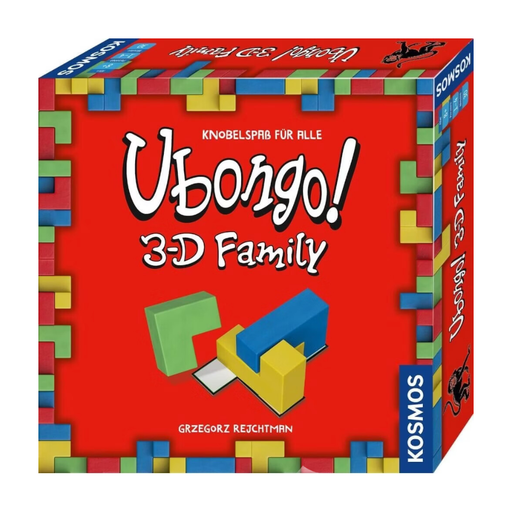
Kosmos 683160 Ubongo 3-D Family
Why We Recommend This Product
The Ubongo 3D variant adds a spatial dimension to the proven game principle. Here, players must not only think and build across a flat plane but also vertically. With four different difficulty levels, this version offers even greater flexibility to tailor the challenge to the players' abilities. The tactile experience of building with three-dimensional pieces presents an additional cognitive and motor challenge.
Advantages
- Advanced spatial challenge: Building in three dimensions trains spatial awareness in a new way.
- Four difficulty levels: Offers very fine-grained scalability for beginners and advanced players.
- Promotes fine motor skills: Precisely placing the 3D pieces under time pressure trains dexterity.
- Modern design: The components are attractively coloured and functionally designed.
Who It's For
This game is aimed at players aged 8 and up who already have experience with 2D puzzle games and are looking for a new challenge. It is particularly well-suited for families and game groups who enjoy tactile and spatial puzzles and appreciate visually appealing components.
Alternatives and Other Options in Tile-Laying Games
If the specific mechanics of Ubongo do not fully meet your requirements, or if you are looking for a broader selection of logic-based challenges, you can find more options in our Board Games and Puzzles category. The assortment includes a variety of games that focus on different cognitive skills such as strategic planning, pattern recognition, or deductive reasoning.
Frequently Asked Questions (FAQ)
Can you play Ubongo solo?
Yes, the product description for Ubongo Classic specifies a player count of 1 to 4. In solo mode, the game can be used as personal training against the clock to improve your own speed and efficiency in solving the puzzles, without the competitive aspect of playing with others.
What is the functional difference between Ubongo Classic and Ubongo 3D?
The main difference lies in the dimensionality of the puzzle. In Ubongo Classic, flat, two-dimensional tiles are placed on a level surface. In Ubongo 3D, three-dimensional blocks are used, which must be assembled into a predefined spatial structure. In addition to an understanding of 2D space, this requires advanced spatial reasoning.
What age group is the Ubongo board game designed for?
For the versions presented here, the publisher Kosmos Games provides a recommended age of 8 years and up. This classification takes into account the cognitive skills required for the game, such as the rapid visual perception of shapes and the ability to mentally rotate objects under time pressure. However, the adjustable difficulty levels ensure that older children and adults are equally challenged.