
TV Backlights: A Buyer's Guide and Recommendations for 2026
A TV backlight serves two primary functions: reducing eye strain and enhancing visual immersion. By creating indirect light behind the screen, it softens the harsh contrast between the bright display and the dark surroundings. This can lead to a more comfortable viewing experience during extended use. Technologically, a distinction is made between static LED strips, which emit a constant colour, and dynamic systems that adapt their colour and brightness to the on-screen content in real time. The latter typically use a camera or software to analyse the colours displayed on the screen and project them onto the wall behind the television.
Buyer's Guide: Technical Criteria for Choosing a TV Backlight
Selecting a suitable TV backlight system should be based on an analysis of specific technical parameters. The following criteria are relevant for making an informed decision.
Technology: Camera-Based Colour Sync vs. Static Lighting
The most fundamental distinction lies in how they operate.
- Static LED Strips: These systems offer a constant, manually set colour or a predefined colour-changing pattern. They are primarily used to create a static atmosphere and reduce eye strain.
- Dynamic Systems (e.g., TV Lighting with a Camera): These more advanced solutions, often referred to as an Ambilight retrofit, use an external camera pointed at the screen. The camera captures the colours at the edges of the on-screen content and relays this information to the LED strips. The result is a dynamic wash of light that extends the image beyond the TV's physical frame, significantly enhancing immersion in movies and games.
Lighting Technology: The Difference Between RGB and RGBIC
The type of LEDs used determines the quality and flexibility of the lighting effects.
- RGB (Red, Green, Blue): Conventional RGB strips can only display a single colour across their entire length at one time. Any colour change therefore affects the entire strip simultaneously.
- RGBIC (Red, Green, Blue, Independent Control): This technology integrates an independent chip (IC) into each LED segment. This allows a single TV LED strip to display multiple colours simultaneously. The result is fluid colour transitions, segmented effects, and a more precise replication of the on-screen content. For dynamic systems, RGBIC TV technology is the de facto standard.
Compatibility and Installation
Before purchasing, the physical dimensions and technical requirements must be checked.
- TV Size: The length of the LED strip must match the perimeter of your television. Manufacturers typically specify compatible screen diagonals, such as 55-inch TV backlight or 65-inch TV backlight. Cutting the strips is not possible with most systems, especially RGBIC models, as this would damage the circuitry.
- Connections and Power Supply: Most systems are powered by an external power adapter. Ensure that an available power outlet is within reach.
- Network Connectivity: For a smart TV light with app or voice control, a connection to your home Wi-Fi network is required. Many devices only support the 2.4 GHz frequency band, which should be taken into account during setup.
Our Top Picks for TV Backlights in 2026
Based on the technical criteria above, we present two models that cater to different user profiles.
Govee Envisual TV Backlight T2 with Dual Cameras for 55-65 Inch TVs
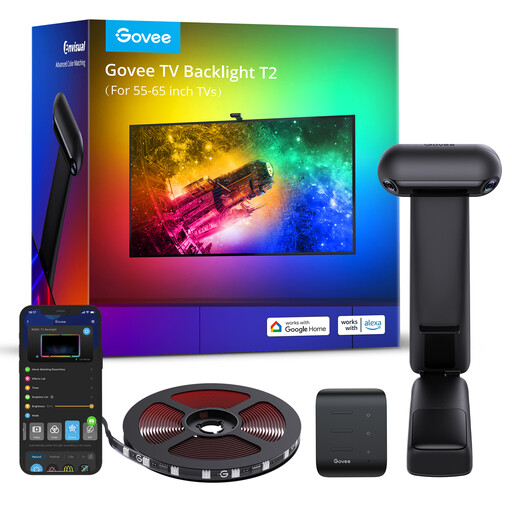
The Govee Envisual TV Backlight T2 is a system designed for maximum immersion through precise colour synchronisation. It uses a patented dual-camera structure to capture colour data from the screen with greater accuracy than single-camera systems.
Why we recommend this product: The core component of this system is its dual camera. It allows for denser sampling of colour points at the screen's edge, resulting in a more accurate and faster lighting response. Combined with RGBIC technology, colour gradients and rapid scene changes are projected onto the wall smoothly and without noticeable lag.
Pros:
- Precise Colour Capture: The dual-camera structure ensures high accuracy in synchronising light and picture.
- Segmented Light Control: RGBIC technology allows for the simultaneous display of multiple colours for fluid transitions.
- Comprehensive Smart Control: The system can be controlled via the Govee Home App and by voice command using Alexa and Google Assistant.
- Music Sync: An integrated mode allows the lights to pulse to the beat of music or other ambient sounds.
Who it's for: This model is aimed at home cinema and gaming enthusiasts for whom maximum visual immersion is a priority. Users who want precise, responsive synchronisation between on-screen content and ambient light will find this to be a technically sophisticated solution.
Govee TV Backlight 3 Lite TV 55-65" SMART LED Backlight RGBICW
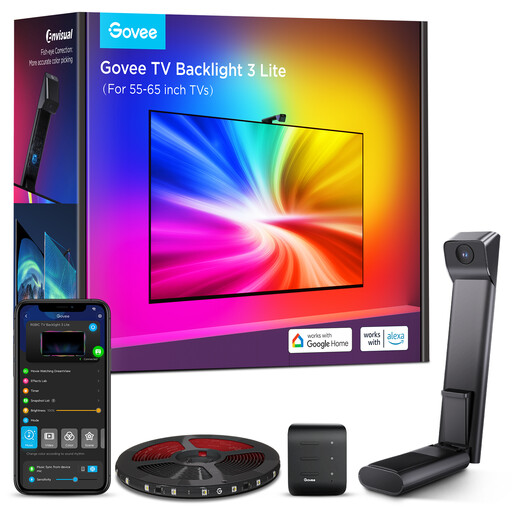
The Govee TV Backlight 3 Lite is an efficient solution for users seeking smart, customisable ambient lighting who can do without camera-based screen synchronisation. It focuses on creating mood lighting using RGBIC technology.
Why we recommend this product: The Backlight 3 Lite offers the core benefits of a smart TV light—app control, voice commands, and segmented colour effects thanks to RGBIC—in an accessible package. It dispenses with the complexity of camera installation and calibration, focusing instead on creating high-quality static or predefined dynamic light scenes.
Pros:
- RGBIC Technology: Enables the creation of complex colour scenes and gradients.
- Simple Installation: With no camera, the calibration steps are eliminated, speeding up the setup process.
- Smart Home Integration: Full control via the Govee Home App and compatibility with Google Home and Amazon Alexa.
- Efficient Application: Provides functional and atmospheric backlighting for everyday use.
Who it's for: This model is ideal for users who primarily want to create atmospheric ambient lighting for their living room. It is suitable for those who appreciate the convenience of app and voice control but do not require dynamic synchronisation with the TV picture. It represents a solid entry point into the world of smart lighting.
Other Options and Electronics Gifts
If the models presented don't exactly meet your requirements, or if you wish to explore other innovative products in smart home and consumer electronics, you can find a wider selection of solutions in our Electronics Gifts category.
Frequently Asked Questions (FAQ)
1. Can you retrofit an Ambilight-style effect on any TV? Yes, a feature similar to the Ambilight effect can be retrofitted to almost any television using third-party systems. Solutions like the Govee TV Backlight with camera technology offer a hardware-independent way to install dynamic backlighting that is linked to the on-screen content.
2. What is the difference between RGB and RGBIC LED strips? The main difference lies in how the LEDs are controlled. On an RGB strip, all LEDs always light up in the same colour. An RGBIC strip has integrated control (IC) chips that allow different segments of the strip to light up in different colours independently. This enables fluid colour gradients and complex lighting effects.
3. Does a TV backlight with a camera require special software? Yes, camera-based systems require the corresponding manufacturer's app (e.g., the Govee Home App) for control and calibration. In the app, the camera is calibrated by defining the corners of the screen. The app then processes the colour information captured by the camera and controls the LEDs accordingly.