
Stainless Steel Pot Buyer's Guide
A high-quality stainless steel pot is an investment for years to come and the foundation for countless meals. But the market can be overwhelming, and not every shiny model delivers on its promise. As your Joybuy Product Recommendation Officer, I'll help you identify the crucial features and avoid buyer's remorse, so you can find the perfect cookware for your kitchen.
The Most Common Pitfalls When Buying Stainless Steel Pots
Many pots look similar at first glance, but the differences are in the details. Pay attention to these three points to avoid disappointment:
- The "Induction-Ready" Trap: The "induction-compatible" label only means the pot's base is magnetic. It says nothing about its efficiency. Pots with a simple, thin base often heat up slowly and unevenly on induction cooktops. This leads to higher energy consumption and unsatisfactory cooking results.
- Misleading Material Specifications: The term "stainless steel" is not a protected classification. Inferior alloys can be more susceptible to rust and discolouration and, in the worst case, can affect the taste of your food. Without a precise specification like 18/10 stainless steel, you might be buying a product with a shorter lifespan.
- Impractical Everyday Design: Handles that get hot during cooking pose a safety hazard. Lids that don't fit snugly or lack a pouring function make handling difficult. Such flaws often only become apparent during daily use and significantly diminish the joy of cooking.
Key Criteria for Your Selection
To find the right pot, you should focus on the technical fundamentals. These three parameters are crucial for the performance and longevity of your cookware.
The Pot Base: The Heart of Induction and Heat Distribution
The construction of the pot's base is the most important quality feature, especially if you're looking for cookware for induction hobs. A high-quality pot has what's known as a sandwich base or encapsulated base. This consists of several layers:
- Outer Layer (on the hob): A ferromagnetic stainless steel layer, which is necessary for induction compatibility.
- Core: A layer of aluminium or copper. These metals are excellent heat conductors and ensure that heat is distributed quickly and evenly across the entire base.
- Inner Layer (inside the pot): A layer of hygienic and food-grade stainless steel, usually 18/10 stainless steel.
Brands like WMF use terms like "TransTherm-Allherdboden" for this, while Zwilling uses "SIGMA Classic+". Such a multi-layered base ensures efficient energy use on all types of hobs and prevents food from scorching in hot spots.
Material Quality: What "18/10" and "304" Mean
The number combination 18/10 stainless steel (also known as material number 1.4301 or AISI 304) is a reliable indicator of quality. It describes the composition of the alloy: 18% chromium and 10% nickel.
- Chromium provides rust resistance and hardness.
- Nickel makes the steel acid-resistant, exceptionally shiny, and non-reactive (taste-neutral).
For even greater corrosion resistance, look for 316 stainless steel, which contains added molybdenum. This is often used for specialised pots like a stainless steel milk pot, as it is even more resistant to salts and acids.
Shape and Size: From Small Saucepans to Complete Sets
Choosing the right size and shape depends on your household and cooking habits.
- Small Pot / 16cm Saucepan: Ideal for sauces, heating milk, or small portions.
- Stock Pot with Glass Lid (20-24 cm): A versatile all-rounder for soups, stews, pasta, or potatoes. A glass lid allows for visual monitoring without letting heat escape.
- Large Stock Pot (26 cm and up): Necessary for large families, making preserves, or preparing broths and stocks.
- Speciality Pots: A tall asparagus pot with an insert gently cooks the vegetables upright. A Hot Pot with a divider allows you to prepare two different broths at the same time, perfect for social gatherings.
- Induction-compatible stainless steel cookware set: Often offers a price advantage and provides a uniform set of essentials for any kitchen. Well-known brands here include WMF and Zwilling.
Selecting Your Perfect Pick
Here are some product recommendations tailored to specific user profiles that meet the quality criteria mentioned above.
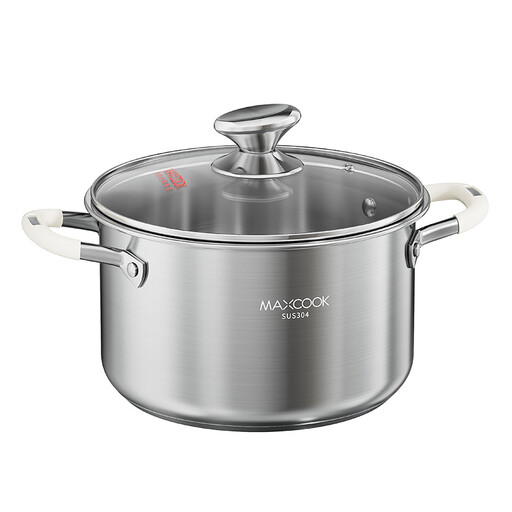
Maxcook 4.3L 304 Stainless Steel Stock Pot (22cm) with Glass Lid
Why it's a great fit: With a 4.3-litre capacity, this pot is the ideal size for preparing daily soups, stews, or pasta for a family. The silicone handles provide extra safety in a busy kitchen.
The flat composite base ensures solid performance on induction hobs. The material is clearly specified as 304 stainless steel, and the heat-resistant silicone handles solve the problem of hot handles.
Practical everyday features like the glass lid for visual monitoring and the secure handles make it a reliable partner for daily meals.
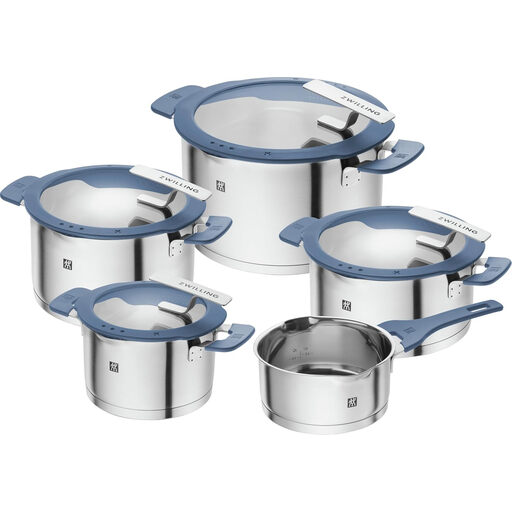
ZWILLING Simplify 5-Piece Cookware Set
Why it's a great fit: This set from Zwilling is aimed at cooks who value thoughtful design and high-quality materials. With various pot sizes, it covers the most common cooking applications.
The SIGMA Classic+ sandwich base is designed for optimal induction performance. The stay-cool handles and the integrated strainer in the lid are direct solutions to common design flaws.
The combination of high-quality 18/10 stainless steel and innovative details like the lid holder and pouring function simplifies kitchen workflows.
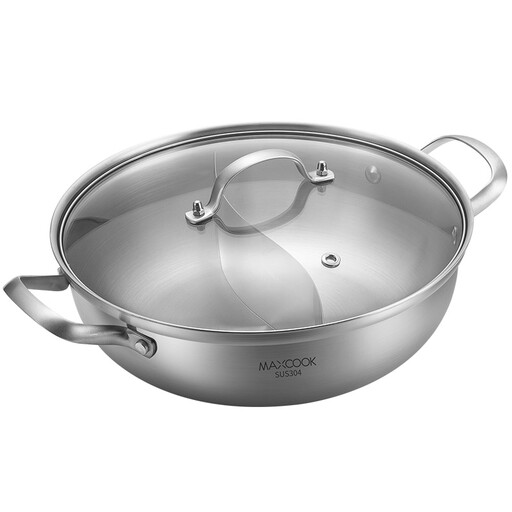
MAXCOOK 26cm Divided Hot Pot (Yin-Yang)
Why it's a great fit: This specialty pot is designed for the Chinese hot pot experience. The divider allows you to offer a spicy and a mild broth simultaneously, ensuring every guest is satisfied.
The thick composite base ensures compatibility with all hob types, including induction. It is made from 304 stainless steel, guaranteeing food safety and durability.
The dual-chamber system is its standout feature, making the pot the centrepiece of a communal dining experience. It is also dishwasher-safe for easy cleanup.
Looking for more options?
We have compiled a complete, up-to-date list of products that fully meet these strict selection criteria and German safety regulations.
Frequently Asked Questions (FAQ)
1. How do you clean stainless steel pots to prevent discolouration or white spots? White spots are usually limescale deposits from hard water, while rainbow-like stains can be caused by overheating or minerals in food. Both are harmless. To remove them, you can briefly boil a little vinegar or lemon juice with water in the pot. To prevent spots, pots should be dried thoroughly immediately after washing.
2. Is a more expensive stainless steel cookware set always the better choice? A higher price often correlates with a more complex base construction for better induction performance, higher-grade steel (e.g., 18/10), and thoughtful design features like heat-insulated handles or integrated measuring scales. However, for occasional use, a simpler, more affordable model may suffice, as long as the base is suitable for your hob.
3. Can I use my stainless steel pot in the oven? This depends on its components. Pots made entirely of stainless steel are often oven-safe up to 250°C (480°F). Models with plastic or silicone handles or glass lids usually have lower temperature limits (e.g., 180°C / 350°F). Always check the manufacturer's specific instructions before using it in the oven to avoid damage.