
Buying a Stainless Steel Food Storage Container Set: What Matters When It Comes to Materials, Seals and Everyday Usability
A stainless steel food storage container set can keep food organised in the fridge, freezer or while you are out and about. For families, working professionals, students and meal-prep users, however, the material description “stainless steel” is not the only consideration. What really matters is how the container, lid, seal, closure and range of sizes work together.
If you focus solely on the price or an eye-catching product description, you can easily overlook important details. The following points will help you choose a suitable set and avoid common purchasing mistakes.
Three Common Pitfalls When Buying Stainless Steel Food Storage Containers
1. “Airtight” Without a Reliable Closure
The term airtight food storage containers alone says little about the construction. A loosely fitting lid protects against dust, but does not reliably prevent liquids from escaping. For soups, sauces or dressings, full silicone seals and a sturdy clip closure are essential.
You should therefore check:
- Is a silicone seal included?
- Can the lid be closed completely and evenly?
- Are closure clips or a comparable mechanism specified?
- Can the lid be removed so that the seal can be cleaned thoroughly?
2. Confusing the Stainless Steel Body with the Lid
A product may have a stainless steel container while the lid is made of glass, PP or another type of plastic. This is not automatically a disadvantage, but it does affect how the product can be used. A glass lid lets you see the contents, but can break if knocked or exposed to sudden temperature changes. Plastic lids are lighter, but their material and care instructions should be checked carefully.
With a stainless steel food container, the material, lid and sealing ring should be described separately. 304 stainless steel refers to a common grade of stainless steel suitable for contact with food. However, it does not replace the need to check the other components.
3. Microwave, Oven and Freezer Suitability Being Advertised Too Broadly
Metal containers should never be placed in a microwave. Even if individual product descriptions contain contradictory heating information, you should follow the specific instructions and labelling for the model in question. With glass lids, rapid temperature changes should be avoided.
For fridge storage and freezer use, details such as “freezer-safe” are relevant. You should also look for:
- enough free space to allow freezing liquids to expand,
- a lid suitable for the intended temperature,
- a seal that remains flexible at low temperatures,
- warnings against direct flames or sudden temperature changes.
The Most Important Buying Criteria at a Glance
Materials and Construction
According to the manufacturer’s product information, a container made from food-grade 304 stainless steel is uncoated and odour-neutral. Smooth inner walls can make cleaning easier, particularly after storing oily foods. Nevertheless, always check the specific care instructions and do not use abrasive cleaners if the manufacturer advises against them.
For borosilicate glass lids, look for a suitable silicone seal and handle the lid with care. For PP lids, details such as BPA-free construction, temperature suitability and dishwasher safety are helpful, provided they are explicitly stated for the product in question.
Seals and Leak Protection
For leak-proof food storage containers, the way several components work together is crucial. A flexible silicone ring must sit neatly in its groove. Clips should close without requiring excessive force and should press the lid down evenly.
Before transporting the container for the first time, it is advisable to test it with a little water. Do not fill the container to the brim, and check that the lid is securely locked in place. This is particularly important when carrying it in a rucksack, work bag or bicycle pannier.
Capacity, Shape and Stackability
For meal prep, a range of different sizes is often more practical than several identical containers. Small containers are suitable for snacks, fruit or side dishes, medium-sized models for individual portions, and large containers for prepared family meals.
Stackable food storage containers should ideally have straight sides and sturdy lids. Round containers can often be nested inside one another, while rectangular models may make better use of the available space in the fridge. Choose according to the dimensions of your shelves and compartments, not just the capacity in millilitres.
Our Selection by User Profile

PURECOOK 304 Stainless Steel Deep Food Storage Container Set
Why this product suits the profile: With 1000 ml, 1800 ml and 3000 ml containers, this 3-piece set accommodates a range of portion sizes and is suitable for fridge storage, meal prep, picnics or commuting.
The product details specify a 304 stainless steel body, a borosilicate glass lid and a silicone ring. Before transporting it, check that the lid is seated correctly and follow the manufacturer’s instructions.
Three clearly specified sizes; according to the product description, stackable design and dishwasher-safe cleaning.
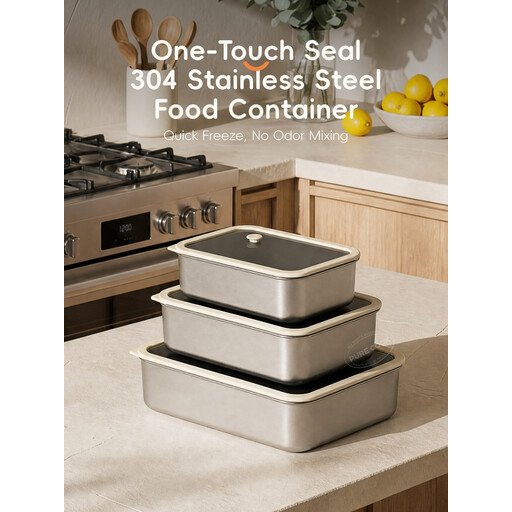
PURECOOK 304 Stainless Steel 3-Piece Shallow Food Storage Container Set
Why this product suits the profile: The shallower design is intended for portion-sized meals, salads and organised fridge storage.
The details list a single-piece 304 stainless steel body, borosilicate glass lid and silicone ring separately. This makes it easier to check the relevant components.
According to the product details, includes 1000 ml, 1800 ml and 3000 ml sizes; stackable and nestable.
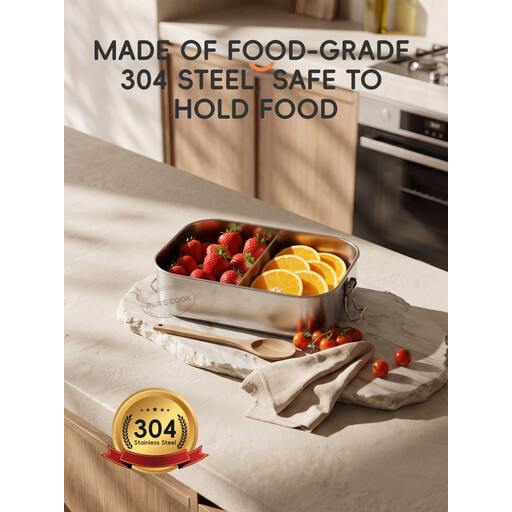
PURECOOK 304 Stainless Steel Dual-Compartment Rectangular Bento Lunch Box
Why this product suits the profile: Two separate compartments are practical for commuters, students and anyone who wants to transport a main course and side dish separately.
The product name specifies a removable silicone seal and lockable clips. Before packing it, make sure all closures are fastened evenly.
Two compartments, rectangular shape and, according to the product details, dishwasher-safe cleaning.
Looking for more options?
We have put together a complete, regularly updated list of products that fully meet these strict selection criteria and the safety regulations applicable in the EU.
Care and Use for a Long Service Life
Even a high-quality stainless steel food storage container requires suitable care. Remove silicone rings from the lids regularly and clean the individual parts separately. This makes it easier to spot residue in the sealing groove. Whether the container is dishwasher-safe depends on the specific model and all its components. Claims such as dishwasher-safe food storage containers should apply to the entire product or explicitly to individual parts.
For freezer use:
- Allow food to cool completely unless the manufacturer’s instructions state otherwise.
- Do not fill the container to the brim.
- Check that the lid and seal are positioned correctly.
- Do not expose a glass lid taken directly from the freezer to a strong heat source.
A stainless steel container is not automatically a stainless steel lunch box. For transporting food, weight, closure, shape and whether internal compartments are needed are also important. A simple lid may be sufficient for dry snacks; for liquid dishes, a full seal with a secure closure is the better choice.
FAQ About Stainless Steel Food Storage Container Sets
Are stainless steel food storage containers microwave-safe?
The stainless steel body must never be placed in a microwave. Transfer food to a container explicitly marked as microwave-safe before reheating. For glass or plastic lids, follow the relevant manufacturer’s instructions; lids often need to be removed before heating.
Are stainless steel food storage containers suitable for the freezer?
Many models are specified as suitable for the fridge and freezer, but not every set meets this requirement. Check the product details for the container, lid and seal. When storing liquids, leave enough room for expansion and avoid sudden temperature changes with glass lids.
How long do stainless steel food containers last?
There is no fixed service life that applies to every product. It depends on the material thickness, closure, seal, cleaning method and frequency of use. Replace a silicone ring if it becomes brittle, misshapen or retains odours permanently. Containers with damaged edges or lids that no longer close securely should not continue to be used for transporting liquids.