
Smart Plug with Energy Monitoring: Buyer's Guide 2026
Analysing and controlling household energy consumption is becoming increasingly important. A smart plug with energy monitoring is a sophisticated device that not only allows you to switch power to individual appliances but also to measure and track their electricity usage. Choosing the right model depends on your existing technical infrastructure, the desired level of automation, and your requirements for data sovereignty. The key differentiators lie in the wireless protocol used: Wi-Fi, Zigbee, or pre-flashed open-source firmware like Tasmota.
Technical Selection Criteria for Smart Plugs
The decision for a smart plug should be based on an analysis of its technical parameters. The following criteria are crucial for functionality and integration.
1. Connectivity Protocol: Wi-Fi vs. Zigbee vs. Tasmota
-
Wi-Fi Smart Plug: This type connects directly to your existing 2.4 GHz Wi-Fi router. Setup is typically handled via a manufacturer's app (app-controlled smart plug).
- Use Case: Ideal for beginners or for controlling a few individual devices. No additional hardware (hub/gateway) is required.
- Technical Consideration: Each Wi-Fi plug occupies an IP address on your network. A large number of devices can potentially impact your router's performance.
-
Zigbee Smart Plug: This model communicates using the Zigbee protocol and requires a central Zigbee hub (gateway) to act as a bridge to your LAN/Wi-Fi.
- Use Case: Suitable for users building a comprehensive smart home with many devices.
- Technical Consideration: Zigbee devices create their own mesh network. This reduces the load on your Wi-Fi, increases range, and improves response speed. Many automations run locally on the hub and continue to function even during an internet outage.
-
Tasmota Smart Plug: This is a Wi-Fi smart plug that comes pre-flashed with the open-source Tasmota firmware.
- Use Case: Designed for tech enthusiasts and privacy advocates who want cloud-independent, purely local control.
- Technical Consideration: All configuration and data processing (e.g., via MQTT) occurs on your local network. This requires some technical expertise but offers maximum control and compatibility with open systems like Home Assistant.
2. Maximum Load Capacity and Safety
Most smart plugs designed for the European market are rated for a maximum current of 16A and a load of up to 3680 watts. This is sufficient for common household appliances like coffee machines, fans, lamps, or consumer electronics. They are not designed for heavy-duty industrial equipment or heating systems. Look for housing materials certified as flame-retardant (e.g., V0 classification) and integrated safety shutters to prevent accidental contact.
3. Compatibility with Smart Home Platforms
Seamless integration into an existing ecosystem is a key feature.
- Alexa / Google Home Plugs: Most Wi-Fi smart plugs offer direct compatibility. Zigbee plugs can be integrated via their respective hubs (e.g., an Amazon Echo with a built-in Zigbee hub).
- Home Assistant Plugs: Tasmota and Zigbee plugs are ideally suited for this. Integration for Zigbee is handled via add-ons like Zigbee2MQTT (Z2M) or ZHA, while Tasmota uses the official Tasmota integration or MQTT.
Our Top Picks for 2026
Based on technical specifications and use cases, we present three models that cater to different user needs.
1. EIGHTREE Zigbee Smart Plug with Energy Monitoring
-
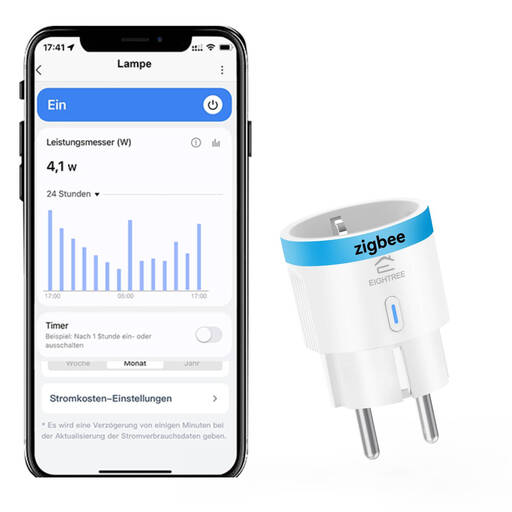
Why We Recommend It: This model uses the Zigbee 3.0 protocol, ensuring fast response times and a low load on your Wi-Fi network. The ability to run automations locally on the gateway guarantees functionality even without an active internet connection. For advanced users, its compatibility with Home Assistant via Zigbee2MQTT or ZHA is a decisive factor.
-
Pros:
- Very low standby power consumption.
- Local automations remain functional during internet outages.
- A precise energy sensor delivers data (voltage, current, power) directly to the Home Assistant Energy Dashboard.
- Acts as a Zigbee router (repeater), strengthening the mesh network.
-
Who It's For: Smart home users with an existing Zigbee system (e.g., Home Assistant with a Zigbee stick, SmartThings, or an Amazon Echo with a built-in hub) who are looking for a reliable and locally-controlled plug with power metering.
2. EIGHTREE Wi-Fi Smart Plug with Energy Monitoring
-
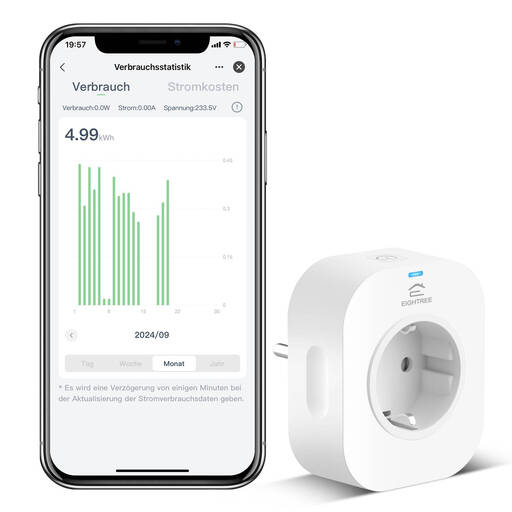
Why We Recommend It: This model's strength lies in its simplicity. It requires no additional hub and integrates quickly into your home's 2.4 GHz Wi-Fi network via the Smart Life app. Bluetooth-assisted pairing significantly simplifies the setup process. It's a practical power consumption measuring device that's ready to use out of the box.
-
Pros:
- No hub required; connects directly to your Wi-Fi router.
- Easy setup via the widely-used Tuya/Smart Life app.
- Compatible with Amazon Alexa and Google Assistant for voice control.
- Detailed consumption statistics (daily/monthly/yearly) available in the app.
-
Who It's For: Newcomers to the smart home world who want to make individual devices like a floor lamp or coffee machine smart and monitor their consumption without building a complex infrastructure.
3. EIGHTREE Tasmota Smart Plug with Energy Monitoring
-
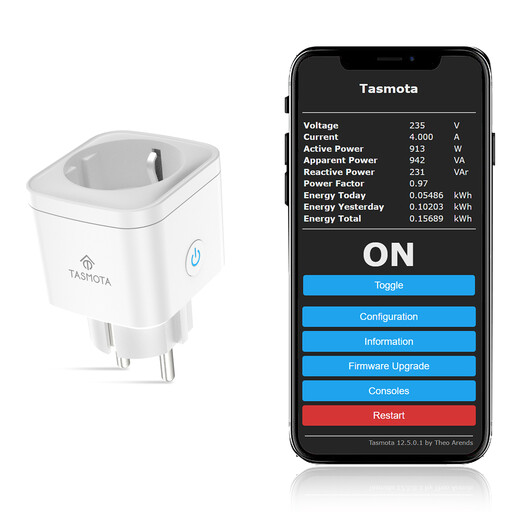
Why We Recommend It: This product targets a specific audience: users who prioritise maximum control and data privacy. With pre-flashed Tasmota firmware, it eliminates the often complex process of manual flashing. The plug operates 100% locally, with no dependency on external cloud servers.
-
Pros:
- No cloud dependency; all data remains on your local network.
- Full functionality is maintained even without an internet connection.
- Full compatibility with open-source systems like Home Assistant, ioBroker, and OpenHAB via MQTT.
- Direct access to configuration through a local web interface.
-
Who It's For: Tech enthusiasts, privacy advocates, and advanced Home Assistant users who need a powerful and customisable 16A smart plug for complex, local automations.
Other Options and Accessories
If the featured models don't perfectly match your requirements, or if you're looking for other energy monitoring devices, you can find a wider selection in our Smart Energy Monitor category. It lists various solutions for measuring and controlling electricity consumption.
Frequently Asked Questions (FAQ)
1. How accurate is the energy monitoring on a smart plug? The integrated sensors are designed for tracking consumption trends and identifying high-draw devices. They provide values for voltage (V), current (A), and power (W). While they are not certified for billing purposes, they offer an excellent data baseline for optimising your own energy use.
2. Do I need a hub for every smart plug? No. Wi-Fi smart plugs connect directly to your router and do not require a hub. Zigbee smart plugs, on the other hand, require a Zigbee hub or a compatible gateway (like a newer Amazon Echo) to be integrated into your network.
3. Can a smart plug reduce standby power consumption? Yes. Many electronic devices consume power even in standby mode. A smart plug can completely disconnect the attached device from the power grid on a schedule or command, thereby reducing standby consumption to zero.