
Shoe Glue Buyer's Guide: Repair Mistake Prevention
A detached sole or a tear in the upper of your favourite pair of shoes is frustrating. However, reaching for the first glue in your drawer often leads to disappointment: the repair only lasts a few steps or leaves behind unsightly, hard spots. Choosing the right adhesive is crucial for a durable and invisible repair. But the market is flooded with products making bold claims.
As your Joybuy Product Recommendation Officer, I'm here to help you cut through the noise. We'll highlight the most common pitfalls when buying shoe glue and show you which technical properties truly matter, so you can make an informed decision.
The 3 Most Common Mistakes When Buying Shoe Glue
Many repair attempts fail not because of a lack of DIY skill, but due to choosing the wrong product. These three issues are the most common culprits behind unsatisfactory results:
- Lack of Flexibility: Ordinary super glue or all-purpose glue often cures rigidly. A shoe, however, is constantly in motion. The rigid bond will break the first time your foot flexes, and the sole will detach again. A flexible glue for shoes isn't just an option—it's a fundamental requirement.
- Not Being Waterproof: Shoes are exposed to moisture, whether from puddles or simple cleaning. A non-waterproof glue will soften and lose its adhesive strength. The repair will fail after the first contact with moisture.
- Wrong Adhesive Type for the Material: Not all glues adhere equally well to all surfaces. An adhesive designed for porous wood will barely hold on smooth rubber or treated leather. Using an unsuitable product, like a simple craft glue, to glue a shoe sole is one of the main reasons for failure.
What Really Matters in a Glue for Shoes
To avoid the mistakes mentioned above, you should check three key parameters before buying. These will determine if the glue is suitable for your specific repair.
Parameter 1: Flexibility After Curing
The most important quality of a shoe glue is its ability to remain elastic after drying. The bond line must be able to withstand the natural bending and twisting movements of the shoe without breaking.
- Look for terms like: "flexible," "elastic," or "for moving joints."
- Avoid products described as: "rigid curing" or "for fixed components," unless you are repairing a hard decorative element on the shoe.
Parameter 2: Water Resistance and Material Compatibility
A long-lasting repair must withstand the elements. Check the product description for explicit information on water resistance.
At the same time, the glue must be compatible with your shoe's materials. A good leather glue, for example, is formulated so that it doesn't discolour or make the natural material brittle. There are also specialised formulas for rubber soles, textiles, or plastics. Checking the manufacturer's recommended materials is essential.
Parameter 3: The Right Adhesive Type (Contact vs. Super Glue)
For shoe repair, two main types of adhesive are relevant, and they differ fundamentally in their application:
- Contact Adhesive: This type is applied thinly to both surfaces to be bonded. After a flash-off time of typically 10–15 minutes (the surfaces will feel dry to the touch), the parts are pressed together with high, brief pressure. Contact adhesives are ideal for large-area bonds, like an entire shoe sole, as they remain flexible and create a strong, expansive connection.
- Super Glue (Cyanoacrylate): These adhesives cure in seconds through contact with air moisture. They are suitable for small, precise repairs, such as on broken eyelets or small cracks in hard materials. For flexible soles, they are often too brittle, unless it's a special gel formula with the "flexible" additive.
Product Matches For You
Instead of making a one-size-fits-all recommendation, we've matched products to typical repair scenarios.

UHU Shoe and Leather Glue Tube
Why it's a good fit: Ideal for the classic problem of a detached sole. Designed as a contact adhesive, it creates a large-area, durable bond for typical shoe materials like leather and rubber.
This glue cures flexibly and won't break with movement. It is specially formulated as a shoe repair adhesive, bypassing the problem of insufficient elasticity.
Its application as a contact adhesive ensures an exceptionally strong bond on large, high-stress areas like the entire shoe sole.
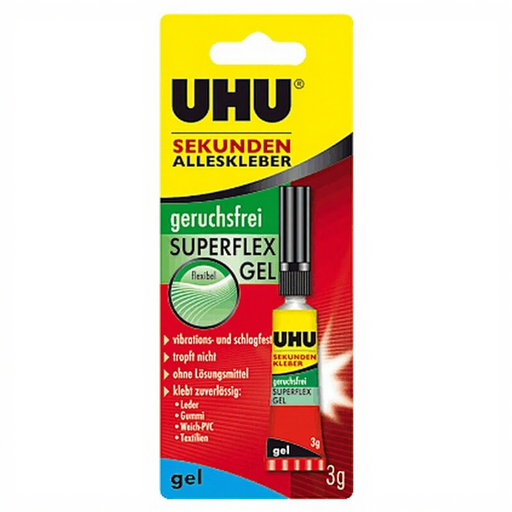
UHU All-Purpose Superflex Gel Odorless 3g
Why it's a good fit: Perfect for spot repairs where precision is key, such as attaching a decorative element or sealing a small tear in the upper. The gel formula is non-drip.
Despite the rapid bond of a super glue, this formula remains elastic thanks to "Superflex" technology. It avoids the pitfall of brittle curing and is suitable for slightly uneven surfaces.
The gel consistency allows for a clean, drip-free application, even on vertical spots. The formula is also solvent-free and low-odour.
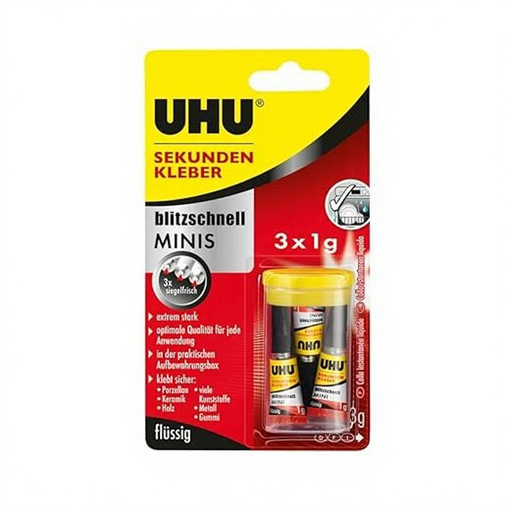
UHU Super Glue Gel Minis 3x1g
Why it's a good fit: Anyone who frequently performs small repairs on shoes, as well as on other household items made of ceramic or plastic, will benefit from these small, individually sealed tubes.
The division into three 1g tubes prevents the glue from drying out after the first use—a common problem with larger tubes. This ensures you have fresh, fully effective adhesive ready for every repair.
The gel formula is versatile and, according to the manufacturer, even dishwasher-safe, which indicates high resistance to moisture and temperature fluctuations.
Looking for more options?
A repair lives or dies by the right material. In addition to specialised adhesives, you'll find a wide selection of products for your DIY and craft projects.
Frequently Asked Questions (FAQ)
1. How long does shoe glue need to dry? Drying time varies greatly depending on the adhesive type and manufacturer. A contact adhesive requires a flash-off time of 10–15 minutes before joining the parts and often only reaches its final bond strength after 24 hours. Super glues cure in minutes or even seconds. Always follow the specific instructions on the product packaging for reliable results.
2. Is every super glue suitable for shoes? No. Standard cyanoacrylate-based super glues cure to be very brittle and are unsuitable for flexible parts like shoe soles. They would break under the first sign of stress. If you use a super glue, choose a special gel formula that is explicitly labelled as "flexible" or "impact-resistant."
3. How do I prepare the shoe for repair? Proper preparation is crucial. Both surfaces to be bonded must be completely clean, dry, and free of grease or old adhesive. For smooth materials like rubber or plastic, lightly roughening the surface with fine sandpaper can significantly improve the glue's mechanical adhesion.