
Rechargeable Battery Buyer’s Guide: Avoid Costly Mistakes
Switching to rechargeable batteries is a smart choice for both your wallet and the environment. However, the market is crowded and full of technical jargon that can make purchasing difficult. Misleading claims often lead to batteries that don't deliver the expected performance or are unsuitable for certain devices. This guide will help you understand the key criteria and make an informed decision.
The 3 Most Common Pitfalls When Buying Rechargeable Batteries
Before you buy, you should be aware of the typical marketing traps that lead to disappointment.
- Unrealistic Capacity Claims: Many unknown brands advertise extremely high capacity ratings (measured in milliampere-hours, mAh) that are never achieved in practice. The result is an unexpectedly short runtime, especially in high-drain devices like digital cameras or gaming controllers.
- Ignoring Self-Discharge: A high-capacity battery is useless if it quickly loses its charge when not in use. Batteries without a "low self-discharge" or "Ready2Use" label can be empty after just a few weeks of storage, making them impractical for remote controls or flashlights.
- The 1.2-Volt Problem: Standard NiMH batteries provide a voltage of 1.2 volts, whereas disposable batteries offer 1.5 volts. Some electronic devices, particularly older or very basic ones, rely on the higher voltage and will malfunction or not work at all with 1.2-volt batteries.
What Really Matters: The Key Parameters
To find the right batteries for your needs, focus on three objective technical specifications.
1. Capacity (mAh) and the Right Use Case
Capacity, measured in mAh, describes how much energy a battery can store. A higher number means a potentially longer runtime per charge. The choice depends on the device type:
- High-Drain Devices: For batteries for controllers, cameras, flash units, or electronic toys, high-capacity batteries are required. For AA batteries, values from 2100 mAh to 2600 mAh are a good benchmark.
- Low-Drain Devices: For remote controls, clocks, or wireless mice, batteries with lower capacity are sufficient. For AAA batteries, models with 700 mAh to 900 mAh are often adequate and more cost-effective.
2. Battery Technology: NiMH vs. Li-Ion with USB-C
The chemical composition determines the battery's performance and potential applications.
- Nickel-Metal Hydride (NiMH): This is the established and most common technology for rechargeable batteries. NiMH batteries are robust, cost-effective, and available from a wide range of brands like Varta or Energizer. They deliver a stable voltage of 1.2 volts and are suitable for most household devices. Modern NiMH batteries have low self-discharge and are often available pre-charged as "Ready2Use."
- Lithium-Ion (Li-Ion) with USB-C: A more recent innovation is Li-Ion batteries with a USB-C port. Their key advantage is the constant 1.5-volt output, which matches that of disposable batteries. This makes them the ideal solution for voltage-sensitive devices. Charging is done conveniently via a standard USB-C cable, eliminating the need for a separate charger.
3. Charge Cycles and Self-Discharge
Durable batteries are defined not only by high capacity but also by the number of possible charge cycles. A rating of 500 to 1000 cycles is common for quality batteries and ensures a long lifespan. Also, look for the "low self-discharge" label. According to manufacturers, such batteries often retain up to 80% of their charge after a year in storage, significantly increasing their reliability.
Top Picks for Every User
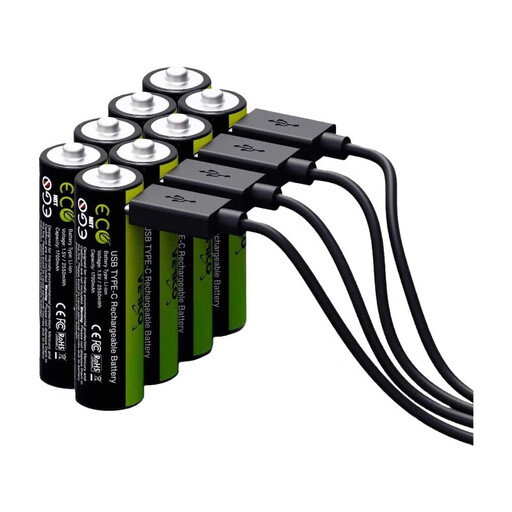
Verico LoopEnergy USB-C Li-Ion Battery 1700 mAh 1.5 V 8 Pack
Why This Fits Their Persona: Ideal for users who want a hassle-free charging solution without an extra device and value maximum compatibility. Perfect for modern households with many USB-C powered gadgets.
Solves the 1.2-volt problem with a constant 1.5-volt output, making it suitable for sensitive electronics. The integrated USB-C port eliminates the need for a separate charger.
Stable 1.5V output; direct charging via USB-C; very low self-discharge thanks to Li-Ion technology.
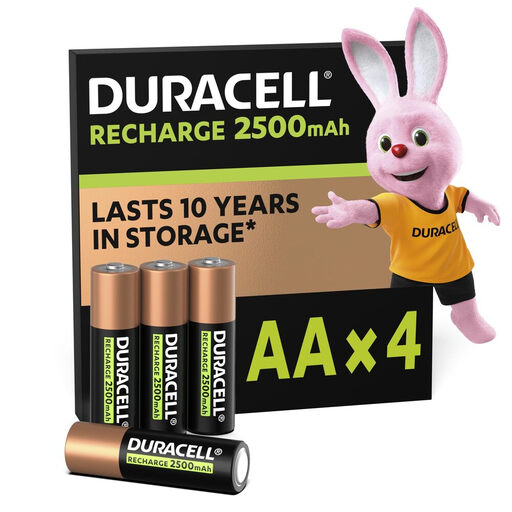
DURACELL Rechargeable AA Batteries 2500mAh – 4 Pack
Why This Fits Their Persona: Designed for users who need maximum performance for power-hungry devices like game controllers, camera flashes, or high-powered flashlights and won't compromise on runtime.
Delivers a realistic and high capacity of 2500 mAh from an established brand, avoiding the trap of exaggerated marketing claims. The low self-discharge ensures they are ready when you need them.
Very high capacity for long runtimes in high-drain applications; guaranteed to last for up to 10 years in storage, according to the manufacturer.
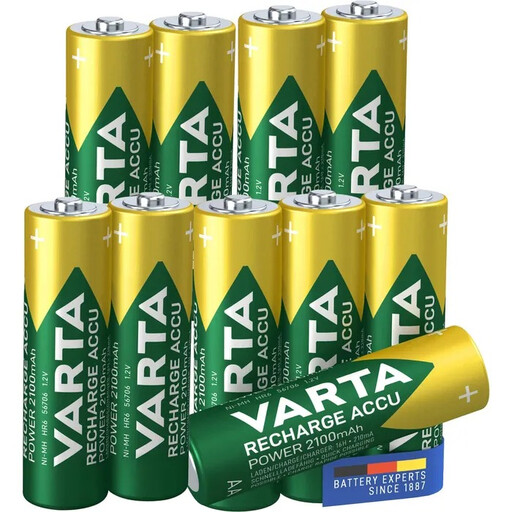
VARTA Rechargeable Battery NiMH, AA, 2100mAh Accu Power (10-Pack)
Why This Fits Their Persona: An economical solution for families and households with a high demand for standard batteries. The bulk pack covers the needs for toys, remote controls, and other everyday devices at an excellent value.
Relies on proven NiMH technology from a well-known brand with a realistic 2100 mAh capacity. The "Ready2Use" feature prevents the frustration of self-discharge in less frequently used devices.
Excellent value for money with a 10-pack; pre-charged and ready to use right out of the box; reliable capacity for most everyday applications.
Looking for More Options?
We have compiled a complete, up-to-date list of products that fully meet these strict selection criteria and UK/EU safety regulations.
Frequently Asked Questions (FAQ)
Can rechargeable batteries be used in any device? In most cases, yes. The majority of modern devices are compatible with the 1.2-volt output of NiMH batteries. However, very basic or older devices that explicitly require 1.5 volts may experience functional limitations. In such cases, 1.5-volt Li-Ion batteries are a great alternative. For safety-critical devices with very low power consumption over a long period, such as smoke detectors, you should only use rechargeable batteries if the device manufacturer explicitly recommends it.
What capacity (mAh) do I need for my devices? As a rule of thumb: the higher the device's energy consumption, the higher the battery's capacity should be. For devices like cameras, game controllers, or motorized toys, AA batteries with 2000 mAh or more are recommended. For remote controls, clocks, or wireless keyboards, models with lower capacity (e.g., 800–1300 mAh for AA) are perfectly sufficient and often a more economical choice.
What does "low self-discharge" or "Ready2Use" mean? These terms describe batteries that hold their charge for a long time, even when not in use. According to manufacturers, these batteries often retain 70% to 80% of their capacity even after a year of storage. This is a crucial quality feature as it ensures the batteries are ready to go when you need them, without having to be charged first.