
Rapid Trigger Keyboard: 2026 Buyer's Guide and Recommendations
By a Joybuy Product Recommendation OfficerPublished on July 10, 2026
In competitive gaming, especially in FPS and rhythm genres, milliseconds can decide the outcome of a match. Therefore, players are constantly seeking a technological edge to improve their reaction times. One of the most recent developments in this area is Rapid Trigger technology. This article explains how Rapid Trigger keyboards work, highlights key purchasing criteria, and presents a selection of models for different needs.
Buyer's Guide: What to Look for in a Rapid Trigger Keyboard
Choosing the right keyboard depends on specific technical features that go beyond pure aesthetics. Here are three key aspects that play a role in selecting a high-performance keyboard.
1. Switch Technology: Hall Effect and Adjustable Actuation
At the heart of a Rapid Trigger keyboard is often a Hall Effect keyboard design. Unlike traditional mechanical switches, which rely on physical contact for actuation, Hall Effect switches use magnetic fields. A sensor measures the exact position of the key throughout its entire press.
This enables two crucial features:
- Rapid Trigger: The key resets the moment it begins to travel upwards, rather than waiting to reach a fixed reset point. This allows for extremely fast, repeated inputs, as the key does not need to return fully to its starting position.
- Adjustable Actuation Point: Users can define the press depth (e.g., between 0.1 mm and 4.0 mm) at which a command is registered for each individual key via software. This allows for fine-tuning to an individual's playstyle.
2. Polling Rate and Latency
The polling rate, measured in Hertz (Hz), indicates how often the keyboard sends information to the computer per second. A standard keyboard often has a rate of 1000 Hz. Models with an 8000Hz polling rate update their status 8000 times per second. This reduces the theoretical input delay from 1 millisecond (at 1000 Hz) to 0.125 milliseconds. For professional players where every microsecond counts, this difference can be noticeable.
3. Form Factor and Customisability
The physical design of the keyboard is also an important factor.
- Form Factor: A 60% gaming keyboard omits the number pad, the function key row, and often the arrow keys to create maximum desk space for sweeping mouse movements. Other formats like 75% or TKL (Tenkeyless) offer a compromise between compactness and functionality.
- Customisability: Making a mechanical keyboard customisable is a must for many enthusiasts. A hot-swappable keyboard allows switches to be changed without soldering. This lets you try out different switch types or easily replace faulty ones, increasing the device's longevity and versatility.
Our Top Keyboard Picks for 2026
Based on the criteria above, we have compiled a selection of keyboards that cater to different user requirements.
MageGee 60% Rapid Trigger Gaming Keyboard
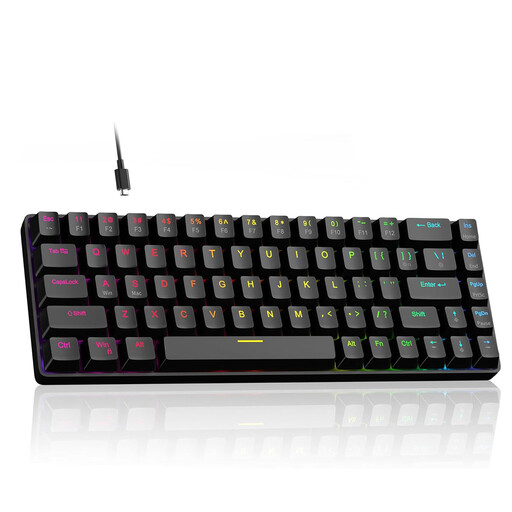
Why It Stands Out: This model focuses on maximum competitive performance by combining Hall Effect switches, an 8000Hz polling rate, and a compact 60% layout.
Pros:
- Hall Effect Magnetic Switches: Enable Rapid Trigger and an individually adjustable actuation point from 0.1 mm to 4.0 mm.
- 8000Hz Polling Rate: Ensures extremely low input latency, which is advantageous in fast-paced games.
- Hot-Swappable: The switches can be replaced without soldering, allowing for a high degree of customisation.
- Compact 60% Form Factor: Provides more desk space for the mouse while retaining dedicated arrow keys for navigation.
Who Is It For? Competitive gamers, especially in the FPS and rhythm game genres, who are looking for a keyboard with maximum responsiveness and precise customisation to gain a competitive edge.
AJAZZ AK980 V2 Wireless Mechanical Keyboard
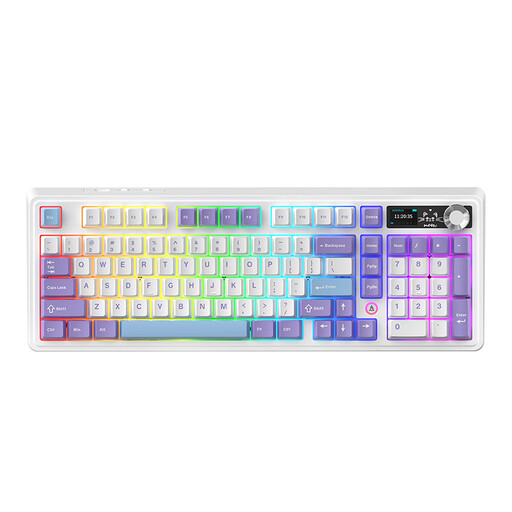
Why It Stands Out: The AJAZZ AK980 V2 is a versatile powerhouse that combines extensive features like a TFT display, a rotary knob, and triple-mode connectivity in a 98% layout.
Pros:
- Smart TFT Display and Rotary Knob: Allow for displaying system information, GIFs, and quick adjustments to volume, lighting, and other settings.
- Triple-Mode Connectivity: Flexible use via cable (USB-C), Bluetooth 5.0, or 2.4G wireless.
- Hot-Swappable PCB: Compatible with 3-pin and 5-pin switches for maximum freedom in personalisation.
- Gasket-Mount Structure: Five layers of sound-dampening foam ensure a muted and pleasant typing sound.
Who Is It For? Keyboard enthusiasts and gamers who, in addition to pure performance, also value customisability, connectivity, and extra features like a display and a multi-function rotary knob.
CHERRY KC 6000 SLIM
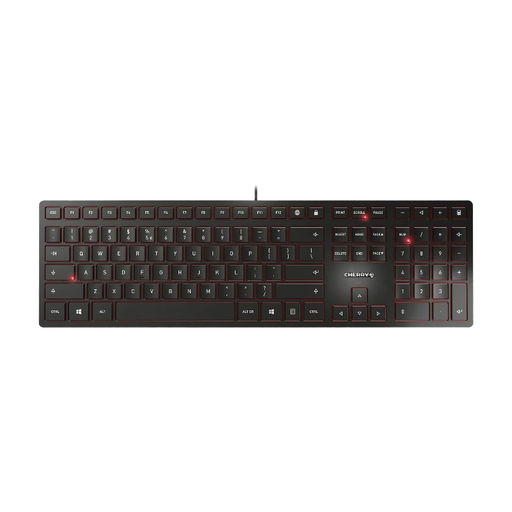
Why It Stands Out: This model stands in contrast to the gaming-focused keyboards, concentrating on a slim design, quiet typing, and robust reliability for office and everyday use.
Pros:
- CHERRY SX Scissor-Switch Mechanism: Provides a precise, quiet, and tactile typing feel. According to the manufacturer, the keys are rated for a lifespan of over 10 million actuations.
- Stable Construction: An integrated metal plate ensures high torsional rigidity and stability on the desk.
- Low Profile: The slim design is space-saving and blends discreetly into modern workspaces.
- Full-Size Layout: Includes a number pad and six dedicated multimedia keys for efficient control.
Who Is It For? Users looking for a reliable, low-profile, and quiet keyboard for the office or home office who value a precise typing experience but do not need specialised gaming features like Rapid Trigger or RGB lighting.
Looking for More Options?
The models presented here cover specific use cases. If you are looking for a different type of input device, you might find the right model in our broader selection.
️ Discover more wired keyboards here
Frequently Asked Questions (FAQ)
Q1: What exactly is the advantage of Rapid Trigger? Rapid Trigger allows a key to reset instantly as soon as it moves upwards, instead of having to reach a fixed mechanical point. This enables extremely fast, repeated keystrokes, which is particularly useful in games that require quick directional changes (e.g., "strafing" in FPS games) or rapid note sequences (in rhythm games).
Q2: What is the difference between Hall Effect switches and optical switches? Both technologies avoid traditional metallic contact. Hall Effect switches use magnetic fields to measure the exact position of a key, which allows for analogue control and adjustable actuation points. Optical switches use a beam of light that is interrupted to register an input. They are very fast but generally do not offer the same granular, analogue adjustment of the actuation point as Hall Effect models.
Q3: Is an 8000Hz polling rate worth the extra cost? The perceptible difference of an 8000Hz polling rate compared to 1000 Hz is subtle and depends heavily on individual perception and the game being played. For casual gamers, the benefit is likely negligible. However, for professional esports athletes and highly competitive players operating at the highest level, reducing system latency by fractions of a millisecond can make a measurable difference and is therefore considered a valuable feature.