
Quiet Fans 2026: A Technical Guide to Silent Cooling
Choosing a fan for your home or office requires balancing cooling power against noise level. In noise-sensitive environments like the bedroom or home office, a quiet fan is crucial. This guide analyses the technical parameters relevant for quiet yet effective operation and presents a selection of models with different functional profiles.
Buyer's Guide: Technical Selection Criteria
To make an informed decision, several technical specifications should be considered. These objective metrics allow for a direct comparison of the performance and comfort of different devices.
1. Operating Noise Level (Decibels, dB)
A fan's noise level is measured in decibels (dB). The dB scale is logarithmic, meaning a 10 dB increase is perceived as a doubling of loudness. For use in bedrooms or quiet workspaces, levels below 40 dB on the low setting are recommended. Models that achieve 20 to 30 dB in their lowest mode are considered exceptionally quiet. Pay attention to the manufacturer's specified noise range, which reflects operation from the lowest to the highest setting.
2. Fan Types and Their Characteristics
- Tower Fan: These devices are characterised by their slim, vertical design. They draw in air from the side or back and expel it through a long, vertical opening. Their construction often allows for wide, horizontal oscillation, and their enclosed design makes them a safe option for households with children or pets.
- Pedestal Fan / Air Circulator: Classic pedestal fans with rotor blades move large volumes of air and are often height-adjustable. Modern air circulators take it a step further: they generate a focused, spiral-shaped air stream that circulates air throughout the entire room, rather than just providing spot cooling. This leads to a more even temperature distribution.
3. Airflow and Cooling Performance
Two key metrics are central here:
- Air Volume (m³/h): Indicates how many cubic metres of air the fan can move per hour. A higher value suggests the ability to effectively ventilate larger rooms.
- Air Speed (m/s): Describes how fast the airflow is. A high speed creates a stronger cooling sensation on the skin (wind chill effect). A powerful fan combines high air volume with high air speed.
4. Energy Efficiency and Motor
Power consumption is specified in watts (W). An energy-efficient fan features a high-performance motor that achieves high airflow with low energy use. Modern AC motors are optimised for efficient operation. Combining a fan with an air conditioner can also help reduce energy costs, as the cooled air is distributed more quickly throughout the room.
5. Additional Features
Modern fans offer a range of convenience features that enhance their practical use:
- Fan with Remote Control: Allows for controlling all functions from a distance.
- Fan with Timer: Enables programming an automatic shut-off time, ideal for nighttime use.
- Oscillating Fan: The swivel function distributes air over a wide area in the room.
- Fan with Air Purifier: Combination devices filter particles like dust, pollen, and allergens from the air, which is particularly beneficial for allergy sufferers and health-conscious individuals.
Our Top Picks for 2026
Based on the technical criteria above, we present three models that stand out for their specific features.
1. DREO DR-HTF019 Tower Fan
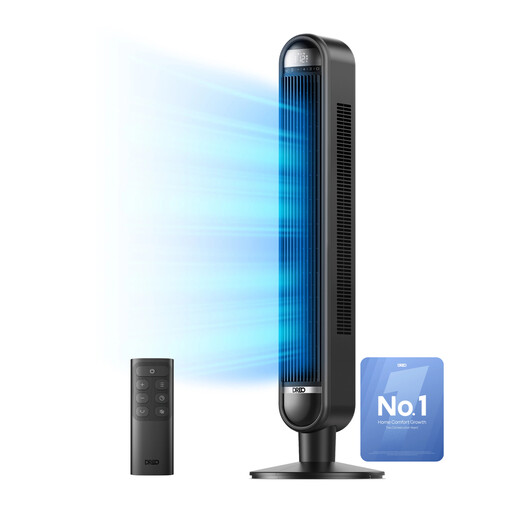
Why We Recommend This Product The DREO DR-HTF019 is a tower fan that combines high cooling performance with quiet operation. With a minimum noise level of 34 dB in sleep mode, it is well-suited for nighttime use. Its 1350 RPM motor generates an air speed of up to 7.6 m/s, providing a noticeable cooling effect. The wide 90° oscillation ensures even air distribution in medium-sized rooms.
Pros
- Quiet Operation: Minimum noise level of 34 dB in sleep mode.
- Customisable Performance: 6 speed settings and 4 operating modes (Normal, Natural, Sleep, Auto).
- Wide Coverage: 90° oscillation and an airflow range of up to 7.3 metres.
- Convenience Features: Includes a fan with remote control and a programmable 12-hour timer.
Who It's For This model is an excellent choice for users looking for a quiet and powerful fan for the bedroom or office. The combination of various modes and its slim design makes it highly versatile.
2. Monsga AP200 2-in-1 Air Purifier & Circulator Fan
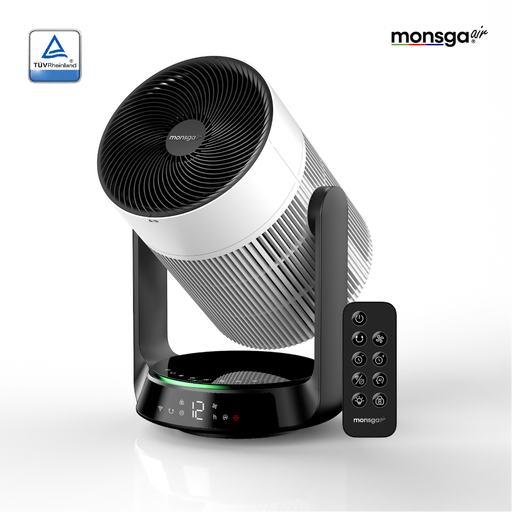
Why We Recommend This Product The Monsga AP200 is a hybrid device that combines the functions of an air circulator and an air purifier. With a minimum noise level of just 25 dB, it is exceptionally quiet. Its standout feature is the 3D air circulation, achieved through 360° rotation and 90° oscillation. Simultaneously, the integrated purification system, with a CADR (Clean Air Delivery Rate) of 280 m³/h, effectively filters particles like PM2.5, dust, and pollen from the air.
Pros
- Dual Functionality: Fan with air purifier for year-round use.
- Extremely Quiet: Only 25 dB in sleep mode.
- Comprehensive Air Circulation: 360° base rotation and 90° oscillation for whole-room distribution.
- Smart Control: Can be operated via the Tuya app, remote control, or touch panel.
Who It's For Ideal for allergy sufferers, health-conscious individuals, and anyone living in poorly ventilated or urban environments. The combination of cooling and air purification makes it a practical year-round solution.
3. DREO HPF022 Air Circulator
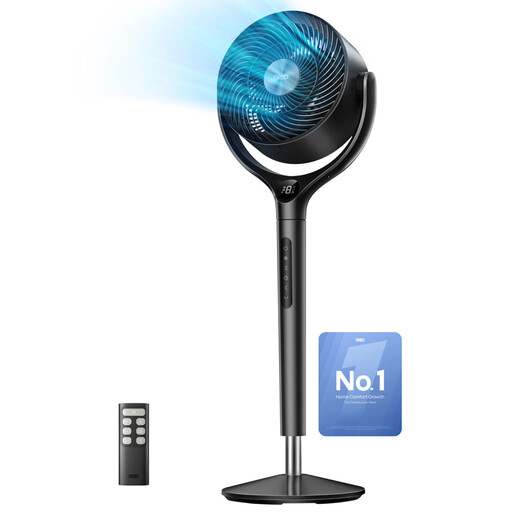
Why We Recommend This Product The DREO HPF022 is designed as a powerful fan that focuses on circulating air throughout the entire room. According to the manufacturer, its airflow can reach up to 30 metres. Despite its high performance (air volume of 1868 m³/h), it achieves a remarkably low noise level of 20 dB on its lowest setting. The multi-directional oscillation (120° horizontal, 100° vertical) ensures effective mixing of the room's air.
Pros
- Very Quiet: Minimum noise level of 20 dB.
- Long-Range: Focused airflow for circulation in large rooms.
- Flexible Alignment: Wide-angle horizontal and vertical oscillation.
- Adaptable: 9 speed settings, 6 modes, and an adjustable height (94-109 cm).
Who It's For This model is perfectly suited for users with large living areas or open-plan layouts. It is the right choice when the goal is not spot cooling, but creating a uniform room climate with a powerful yet quiet air circulator.
Other Options and Alternatives
The market offers a wide variety of models tailored to different needs. Devices with a swivel function are particularly popular as they allow for broader air distribution. For a wider selection of models, especially in the oscillating fan category, you can find more devices in our main category.
Frequently Asked Questions (FAQ)
1. What does the decibel (dB) rating on a fan mean? The decibel rating measures the loudness of the operating noise. A value below 30 dB is often compared to the noise level in a library or a quiet whisper and is considered very quiet. Levels between 30 and 40 dB are still acceptable for most people in a bedroom.
2. Which type of fan is best for the bedroom? For the bedroom, tower fans or air circulators with a dedicated sleep mode and a low minimum noise level (under 35 dB) are often a great choice. They produce a steady, gentle airflow without disturbing sleep with loud operating noises. An integrated timer is also a useful feature for nighttime use.