
Guide to 14K Resin 3D Printers
Additive manufacturing using resin 3D printing has become a key technology for professionals and businesses. The introduction of devices with 14K resolution, in particular, marks a significant leap forward in detail accuracy and surface finish. These printers enable the creation of objects with a level of precision previously only attainable through industrial-grade processes. This guide analyses the technical parameters relevant to selecting a 14K Resin 3D Printer and presents a selection of current models based on their specifications.
Buyer's Guide: Technical Selection Criteria for High-Resolution Resin Printers
The decision to invest in a professional 3D printer should be based on an objective evaluation of its technical specifications. The following parameters are crucial for determining a device's performance and its suitability for various applications.
Resolution and Level of Detail
The "14K" designation refers to the pixel count of the MSLA (Masked Stereolithography) exposure screen. A typical 10.1-inch screen with 14K resolution has 13,312 × 5,120 pixels. More critical than the raw pixel count is the XY resolution, measured in micrometres (μm). This value describes the size of a single pixel, thereby defining the smallest representable feature size on the horizontal plane. Values below 20 μm are crucial for applications such as 3D printers for miniatures, jewellery, or dental technology. The Z-axis precision, also measured in μm, determines the minimum layer height and influences the smoothness of surfaces.
Print Speed and Efficiency
A fast resin 3D printer is a key factor for cost-efficiency in small-batch production and prototyping. The speed is specified in millimetres per hour (mm/h) and depends on several factors:
- Light Source Technology: Modern COB (Chip-on-Board) light sources, combined with a Fresnel lens, provide high and uniform light intensity, which reduces the curing time for each layer.
- Resin Type: Special high-speed resins are optimised for shorter exposure times.
- Release Film: An advanced ACF (Advanced Composite Film) reduces the separation forces between the printed object and the film, enabling higher lift speeds and an improved success rate.
Build Volume and Scalability
The available large 3D printer build volume, specified in millimetres (L × W × H) or litres, defines the maximum size of printable objects. A generously sized build chamber is essential for producing large prototypes, architectural models, or for the simultaneous production of many small parts.
Workflow and Automation
For professional use, features that reduce manual intervention and increase process reliability are of great importance. These include:
- Levelling-Free: A factory-calibrated build plate that requires no manual adjustment.
- Automatic Resin Feeding: Systems that monitor the resin level in the vat and automatically refill it as needed.
- Temperature Control: An integrated heater that maintains the resin at an optimal processing temperature to ensure consistent viscosity and reliable print results.
Guide to Selecting Goods
The following selection is based on the technical specifications and intended applications of the devices.
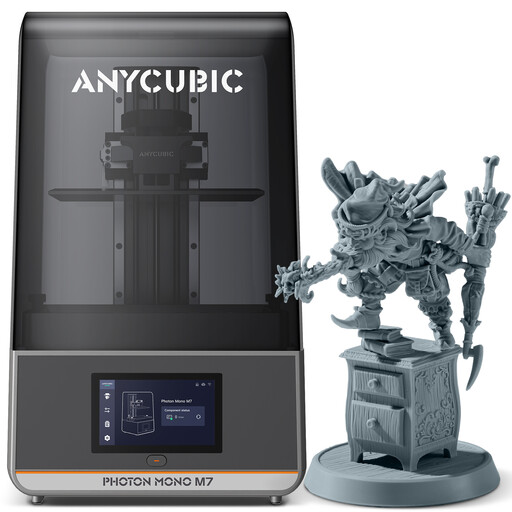
ANYCUBIC Photon Mono M7 14K
-
Why we recommend this product: The Photon Mono M7 offers an entry point into 14K printing technology with a focus on high resolution and speed. Its LighTurbo 3.0 system ensures uniform exposure, while the levelling-free design significantly simplifies the setup process.
-
Pros:
- Resolution: 10.1-inch 14K monochrome LCD (13,312 × 5,120)
- XY Resolution: 16.8 × 24.8 μm
- Print Speed: Up to 150 mm/h (with High-Speed Resin 2.0, according to Anycubic)
- Build Volume: 223 × 126 × 230 mm (6.5 L)
- Usability: Levelling-free design, 4.3-inch touchscreen
-
Who it's for: Prosumers and SMEs in product design and model making who require very high detail accuracy for medium-sized objects and value a straightforward, fast workflow. Those looking to buy an Anycubic 3D printer will find this model offers a well-balanced ratio of resolution to speed.
Find more technical details and current availability on the product page.
ANYCUBIC Photon Mono M7 Pro 14K
-
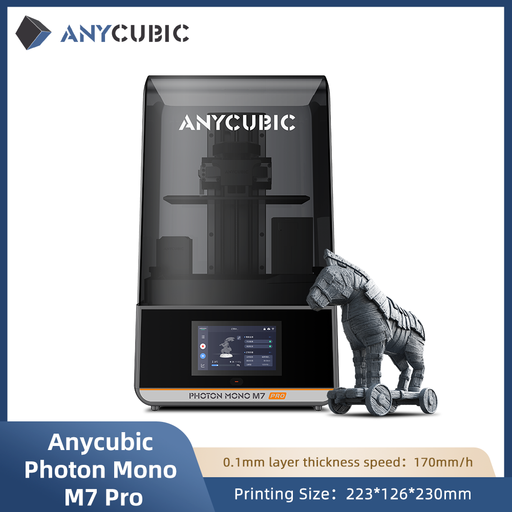
Why we recommend this product: The Photon Mono M7 Pro is designed as a professional 3D printer engineered for maximum productivity and process stability. The integration of automatic resin feeding and dynamic temperature control minimises manual intervention and increases reliability for long print jobs and small-batch production.
-
Pros:
- Automation: Automatic resin feeding and removal, dynamic temperature control of the resin vat
- Print Speed: Up to 170 mm/h (with High-Speed Resin, according to Anycubic)
- Resolution: 10.1-inch 14K monochrome LCD (13,320 × 5,120)
- XY Resolution: 16.8 × 24.8 μm
- Light Intensity: 5500 ±10% μW/cm?
-
Who it's for: Professional users, dental labs, and small-batch manufacturers for whom high throughput rates, process reliability, and a largely automated operation are top priorities.
Find more technical details and current availability on the product page.
Anycubic Photon Mono M7 Max 7K
-
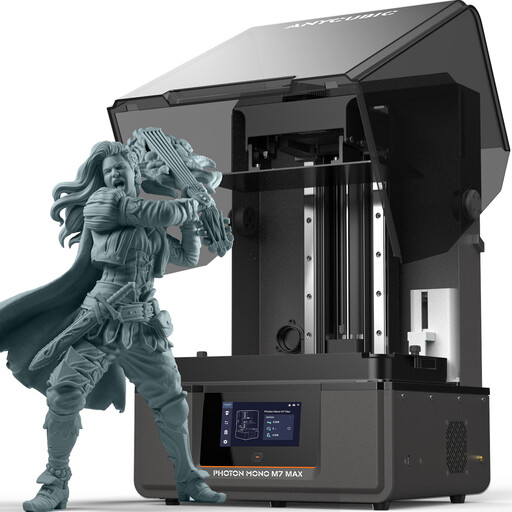
Why we recommend this product: The Photon Mono M7 Max prioritises build volume. With a 14.7-litre build chamber, it is designed for producing very large components or for the mass production of smaller objects. Although its 7K resolution is lower than that of the 14K models, its 46 μm XY resolution still offers high fidelity for large-format applications.
-
Pros:
- Build Volume: 298 × 164 × 300 mm (14.7 L)
- Automation: Automatic resin feeding and temperature control (20–40 °C)
- Resolution: 13.6-inch 7K monochrome LCD
- XY Resolution: 46 × 46 μm
- Stability: Dual linear Z-axes for tall and heavy prints
-
Who it's for: Users in engineering, prototyping, and architecture whose primary requirement is a very large build volume. The device is suitable for producing full-scale functional prototypes and end-use parts.
Find more technical details and current availability on the product page.
Further Options and Alternatives
For users whose requirements extend beyond this specific selection or who have different technical priorities, our main category offers a broader overview. There you will find a wider selection of devices with varying build volumes, resolutions, and feature sets.
Discover more models in our 3D Printers in the UK category.
Frequently Asked Questions (FAQ)
1. What does "14K" mean for a resin 3D printer? The "14K" designation describes the number of horizontal pixels on the LCD screen, which is typically over 13,000. In conjunction with the screen size, this results in a very high pixel density and, consequently, a fine XY resolution. The result is exceptionally detailed prints with sharp edges and smooth surfaces.
2. How fast is a "fast" resin 3D printer in reality? The maximum print speed, often quoted at over 100 mm/h, is achieved under optimal conditions. These include using a special high-speed resin, a low layer height (e.g., 0.1 mm), and a print object geometry that requires low separation forces. In practice, the actual speed will vary depending on the material and the complexity of the model.
3. Which resin is suitable for 14K printers? In principle, 14K printers are compatible with most resins that cure with 405 nm UV light, including standard, ABS-like, water-washable, or plant-based variants. To fully leverage the printer's high resolution, resins with low viscosity and high pigment stability are recommended, as they can accurately reproduce the finest details. For maximum speed, special high-speed resins are required.