
Professional 3D Printing Setups: A Technical Analysis for 2026
The demands on professional 3D printing have shifted significantly in recent years. While basic functionality and resolution were once the primary focus, today's key metrics are speed, material versatility, and system integration. In 2026, labelling a 3D printer setup as professional implies a configuration that extends beyond the printer itself. It describes a coordinated ecosystem of a printer, material management, and optimised consumables, designed for demanding applications in prototyping, low-volume manufacturing, and engineering.
Selection Criteria for Professional 3D Printing Systems
The evaluation of a professional 3D printer setup is based on objective technical specifications. For users who need to produce complex components with high precision and speed, the following criteria are of central importance.
Kinematics and Speed: The CoreXY Factor
A 3D printer's mechanical structure is a key determinant of its maximum print speed and precision. CoreXY systems have established themselves as a leading solution for high-speed 3D printers. In this kinematic design, two stationary stepper motors move the print head in the XY plane via a belt system. Since the motors themselves do not move, the moving mass is lower. This allows for higher accelerations and speeds of up to 600 mm/s and beyond, without introducing significant vibrations or a loss in quality. Furthermore, precision-engineered linear rails, as opposed to rollers, minimise play and increase repeatability.
Material Compatibility: Enclosed Build Chamber and High Temperatures
The ability to process engineering-grade plastics like ABS, ASA, PC (Polycarbonate), or fiber-reinforced filaments (e.g., PA-CF, PET-CF) is a hallmark of professional equipment. These materials are prone to warping as they cool. An actively heated and enclosed build chamber is therefore essential. It maintains a constant ambient temperature, reduces thermal stress within the part, and significantly improves layer adhesion. For a carbon fiber 3D printer or one handling other high-performance polymers, a nozzle temperature exceeding 300°C and a hardened extruder gear are necessary to withstand the abrasive nature of these filaments.
System Integration: The Filament Ecosystem
An often-underestimated factor in print quality is the condition of the filament. Many engineering plastics are hygroscopic, meaning they absorb moisture from the ambient air. Moist filament leads to poor extrusion, bubbling (stringing, oozing), and mechanically weaker parts. A professional setup, therefore, must include a filament dryer. Modern drying boxes allow for drying during the printing process, ensuring the material is fed under optimal conditions. Systems capable of holding multiple spools are particularly relevant for multi-material 3D printers.
Our Selection for Professional 3D Printing in 2026
Based on the aforementioned technical criteria, the following combination of components represents a high-performance, cohesive system for demanding users.
Main Component: QIDI Q2 Combo 3D Printer
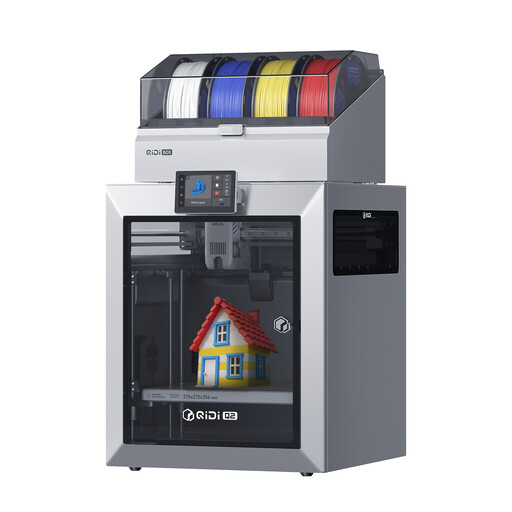
Why we recommend this product: The QIDI Q2 Combo integrates a multitude of features relevant for professional use. Its CoreXY structure with linear rails provides the foundation for print speeds of up to 600 mm/s. The actively heated enclosed build chamber, reaching up to 65°C, enables the processing of warp-prone materials. In combination with the multi-material unit (QIDI BOX), the printer becomes a multi-material 3D printer for up to 16 colours or materials.
Pros:
- High Speed: Up to 600 mm/s print speed thanks to the CoreXY design.
- Heated Build Chamber: Active PTC heating up to 65°C to reduce warping.
- High-Temperature Nozzle: 370°C maximum nozzle temperature for engineering filaments like PC and fiber-reinforced composites.
- Automation: Fully automatic levelling, AI camera monitoring, and filament sensors.
- Multi-Material Capability: The Combo version allows printing with up to 16 different filaments.
Who it's for: Engineers, designers, and small businesses who need an all-in-one solution for rapid prototyping, manufacturing functional parts from engineering-grade plastics, and creating complex multi-colour models.
Essential Add-on: Creality Space Pi Filament Dryer Plus
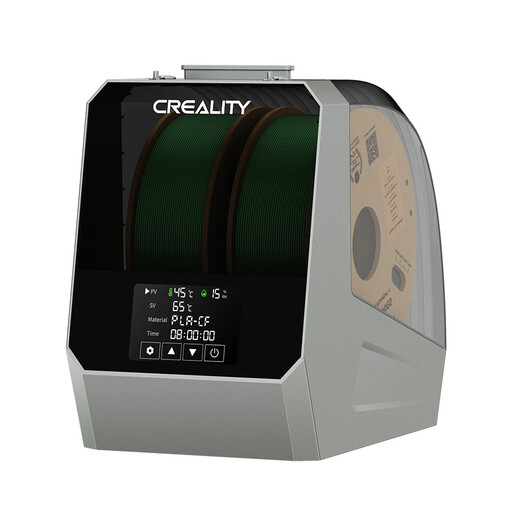
Why we recommend this product: This drying box is an essential component for ensuring material quality. It can hold two spools simultaneously and features 360° heating for uniform drying. The adjustable temperature (45-70°C) and time (0-48h) allow for precise customisation to the specifications of various filaments, from PLA to PC and Nylon (PA). The ability to dry filament during printing integrates seamlessly into a professional workflow.
Pros:
- 2-Spool Capacity: Efficient for long print jobs or for use in multi-material systems.
- PTC Fast Heating Technology: Uniform 360° air heating for effective drying.
- Broad Compatibility: Supports 12 preset material types and manual adjustment.
- Real-Time Monitoring: LCD screen displays the internal temperature and humidity.
Who it's for: All users working with hygroscopic materials like PETG, ABS, TPU, PA, or PC who want to ensure consistently high print quality and mechanical strength in their parts.
Optimised Consumable: Creality Hyper PLA
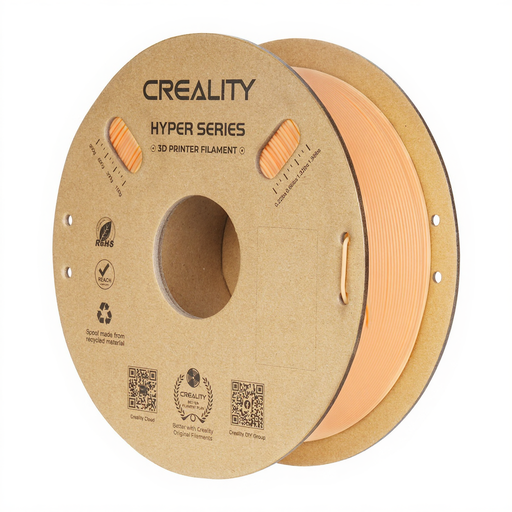
Why we recommend this product: Standard PLA filaments are often not designed for the high flow rates required by a high-speed 3D printer. According to the manufacturer, Creality Hyper PLA is specially formulated for speeds of up to 600 mm/s. It has higher fluidity and cools faster, which ensures dimensional accuracy and surface quality at high print speeds.
Pros:
- Optimised for High Speeds: Developed for use in printers with speeds ranging from 30 to 600 mm/s.
- High Dimensional Accuracy: Specified diameter accuracy of +/- 0.02 mm.
- Good Compatibility: Works with most FDM 3D printers, but unleashes its full potential in high-speed models.
Who it's for: Users of high-speed printers who want to leverage their machine's maximum speed even for PLA prints, without compromising on quality.
Further Options and System Components
The products featured here form a powerful and cohesive system for professional 3D printing. However, the market offers a wide range of specialised devices, accessories, and materials. For a more comprehensive overview of available printers and peripherals, you can explore our main category.
-> Discover more products in the Computer with Printer category
Frequently Asked Questions (FAQ)
What distinguishes a professional 3D printer setup from an entry-level model?
A professional setup is characterised by a combination of high speed (often through CoreXY kinematics), the ability to process engineering-grade materials (enabled by an enclosed build chamber and high nozzle temperatures), and an integrated system approach. This includes components like a filament dryer and automated calibration processes, which are typically absent in entry-level models.
Why is an enclosed build chamber necessary for printing with carbon fiber filaments?
Carbon fiber-reinforced filaments (e.g., PA-CF, PETG-CF) are typically based on polymers like Nylon or PETG, which are prone to significant thermal warping. An enclosed, and ideally heated, build chamber creates a stable, warm environment. This slows the cooling process, reduces internal stresses in the part, and ensures significantly better adhesion between layers and to the print bed, which is crucial for the final product's mechanical stability.
Do I need special filament for a high-speed 3D printer?
Yes, to achieve maximum print speed while maintaining good quality, special high-speed filament is often required. These filaments have a modified chemical composition that allows for a higher melt flow rate and faster solidification. Standard filaments cannot be melted quickly enough at very high speeds, which leads to under-extrusion and poor layer adhesion.
Authored by: Joybuy Product Recommendation Officer