
Portable Power Bank Buyer's Guide: What to Consider
A dead battery on your smartphone, laptop, or headphones is more than just an annoyance—it can disrupt your workflow or limit your connectivity while traveling. A power bank, also known as an external or portable battery, is the obvious solution. However, the market is crowded and full of technical terms that often confuse more than they clarify. Many buyers invest in a device that fails to meet their expectations.
This guide will help you understand the crucial criteria and avoid common purchasing pitfalls. We focus on the objective parameters that truly matter for a reliable mobile power supply.
The Most Common Power Bank Pitfalls
Marketing promises can be misleading. Two pitfalls are particularly common and often lead to disappointment:
- The Capacity Illusion: The advertised capacity in milliamp-hours (mAh) never equals the actual usable energy. A significant portion of the energy is lost during the voltage conversion from the power bank's internal battery to your device's battery. A 20000mAh power bank often delivers only 12,000 to 14,000 mAh to your end device in practice.
- The "Fast Charging" Misconception: The term "fast charging" is not standardized. A power bank can be advertised as fast-charge capable without supporting the specific protocols like Power Delivery (PD) or Quick Charge (QC) that your smartphone or laptop requires. The result: your device only charges at standard speed.
What Really Matters: The Key Specs of a Power Bank
To avoid a bad buy, you should focus on three core technical aspects. These determine whether a portable charger is suitable for your needs.
Capacity: Why 20,000 mAh Isn't Always 20,000 mAh
The rated capacity is the more honest value. While the cell capacity (e.g., 10,000 mAh or 20,000 mAh) describes the capacity of the internal battery cells, the rated capacity indicates how much energy can actually be delivered to your device after conversion losses. Look for this specification in the technical data.
An even better benchmark is Watt-hours (Wh). This value is crucial for air travel, as most airlines impose a 100 Wh limit for power banks in carry-on luggage. The Wh are calculated as follows: (mAh / 1000) x V = Wh. With a typical cell voltage of 3.7 V, a 20,000 mAh power bank has 74 Wh, making it airline-compliant.
Charging Power and Protocols: The Key to Fast Charging
The charging power, measured in Watts (W), determines the charging speed. Modern devices benefit from a power bank with a fast-charging function that supports specific standards:
- Power Delivery (PD): This standard, delivered via USB-C, is essential for many modern devices, including iPhones and laptops. A power bank for a laptop should deliver at least 45W, ideally 65W or more, through a PD-enabled USB-C port.
- Quick Charge (QC): A standard developed by Qualcomm, common in Android smartphones.
- Other Protocols: Standards like AFC (Samsung) or SCP (Huawei) are also relevant if you own corresponding devices.
Check which protocols your devices require and ensure the power bank supports them with the appropriate wattage.
Ports and Extra Features: From USB-C to MagSafe
A power bank's functionality heavily depends on its ports and extras:
- Ports: A modern external battery should have at least one USB-C power bank port that serves as both an input and an output. Additional USB-A ports offer flexibility for older devices.
- Wireless Charging: A wireless power bank with the Qi standard offers convenience. For newer iPhones, a MagSafe power bank is ideal, as it attaches magnetically and ensures optimal charging efficiency.
- Integrated Cables: A power bank with a built-in cable (USB-C or Lightning) reduces cable clutter and is especially practical for on-the-go use.
- Display: A power bank with a display shows the remaining battery level as a percentage, which is more precise than simple LED dots.
Our Picks: The Right Power Banks for Different User Profiles
Based on the criteria above, we have identified a few models for specific use cases.
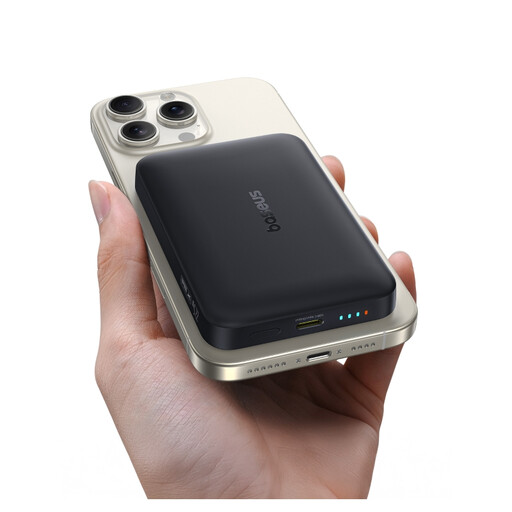
Baseus EnerFill FM11 Magnetic Mini Wireless Fast Charge Power Bank 10000mAh 22.5W
Why This Fits Their Persona: Ideal for users who need a compact yet powerful solution for daily use. The 10,000 mAh capacity is enough for 1-2 full smartphone charges. The magnetic function is perfect for iPhone owners who appreciate a wireless and secure connection without extra accessories.
This model combines wired fast charging (22.5W) with wireless charging, thus avoiding the "fast charging" misconception by offering clear options for different use cases.
Strong Magnetic Attachment: Ensures a stable connection with MagSafe-compatible devices. Compact Design: Fits easily into any bag and is ideal for on-the-go use.
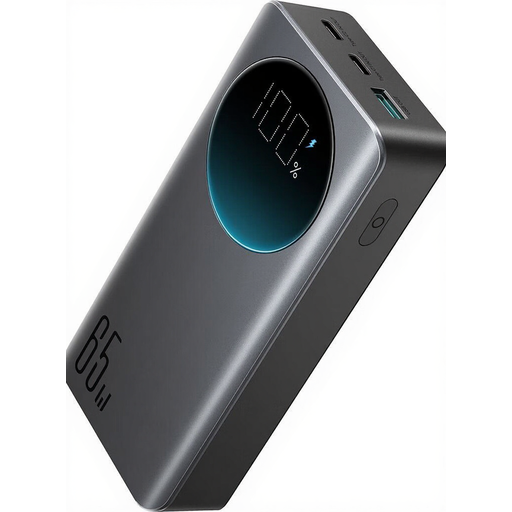
JOYROOM Powerbank 65W 20000mAh Fast Charging Technology PD Black
Why This Fits Their Persona: Perfect for business travelers, students, or anyone who needs to charge multiple devices, including a laptop, on the go. The high 20,000 mAh capacity and 65W PD output make it a true all-in-one solution.
This model addresses both pitfalls: it transparently states the rated capacity (12,000 mAh) and specifies the charging power as 65W PD 3.0, ensuring true fast charging for laptops and other compatible devices.
High Power Output: With 65W of power, it can charge most USB-C laptops. Digital Display: Accurately shows the remaining battery level and fast-charging status.
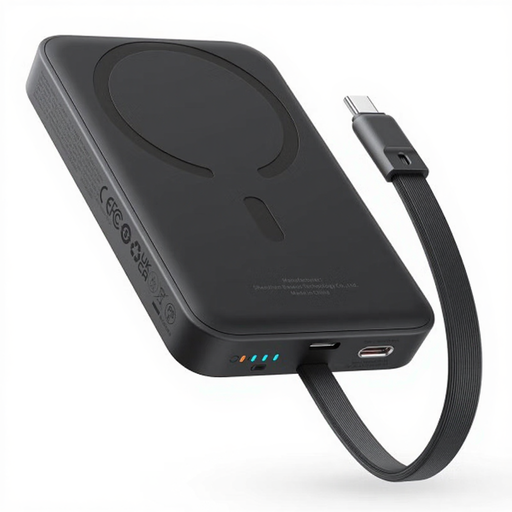
Baseus 10000mAh Magnetic Mini Wireless Fast Charge Power Bank 30W With Built-In Type-C Cable
Why This Fits Their Persona: For users seeking an all-in-one solution without cable clutter. The combination of magnetic wireless charging for iPhones, a built-in USB-C cable, and 30W PD fast charging makes it extremely versatile and user-friendly.
It offers clearly defined charging options: 30W PD via the cable for maximum speed and 15W wirelessly. The built-in cable ensures the fast-charging feature can be used without purchasing a separate, compatible cable.
Built-in USB-C Cable: Serves to both charge devices and recharge the power bank itself. 2-in-1 Solution: Combines wireless and wired charging in one compact device.
Looking for More Options?
We've compiled a complete, up-to-date list of products that fully meet these strict selection criteria and safety regulations.
Frequently Asked Questions (FAQ)
How many times can a 10,000 mAh power bank charge my smartphone?
This depends on your smartphone's battery capacity and the power bank's rated capacity. A 10,000 mAh power bank with a typical rated capacity of about 6,000-7,000 mAh can fully charge a modern smartphone (e.g., iPhone 15 Pro with approx. 3,300 mAh) about 1.8 to 2 times.
Can I take a power bank on an airplane?
Yes, power banks must be transported in your carry-on luggage. Most airlines limit the capacity to 100 Watt-hours (Wh). A power bank with 20,000 mAh (approx. 74 Wh) or even 25,000 mAh (approx. 92.5 Wh) is usually within this limit. Models with a higher capacity (up to 160 Wh) often require airline approval.
What does "rated capacity" mean for a power bank?
The rated capacity is the amount of energy a power bank can actually deliver to a device after internal energy losses from voltage conversion and heat generation. It is a more realistic indicator of charging performance than the often larger advertised cell capacity and should play a central role in your purchasing decision.