
Power Bank Buyer's Guide: Avoid Common Mistakes
By: Joybuy Product Recommendation Officer Date: August 30, 2026
A dead battery at a critical moment is more than just an annoyance—it can interrupt your workflow, disrupt travel navigation, or cut off contact with important people. A power bank promises a solution, but the market is overwhelming. If you're not careful, you could invest in a device that fails to meet your expectations. Before you buy a new external battery, you should know the most common pitfalls that lead to disappointment.
The 3 Most Common Traps When Buying a Power Bank:
- The Capacity Illusion (mAh): Many manufacturers advertise high milliamp-hours (mAh), but this number doesn't reflect the energy that actually reaches your device. Due to voltage conversion and energy loss during charging, the real-world usable capacity is often 30–35% lower than the advertised value. A 20000mAh power bank will, in practice, deliver closer to 13,000 to 14,000 mAh.
- Vague "Fast Charging" Promises: The term "fast charging" isn't regulated. Without specifying the exact wattage and supported protocol (e.g., Power Delivery (PD) or Quick Charge (QC)), the claim is worthless. A power bank can be advertised as "fast charging," but if it only delivers 18 watts, it won't effectively charge a modern laptop.
- Insufficient Power Output (Watts): High capacity is useless if the power output is too low. Many budget-friendly power banks only deliver 10-15 watts. That might be enough for a smartphone, but a power bank for a laptop requires at least 45 watts, and preferably 65 watts or more. Otherwise, the laptop's battery will drain faster during use than it charges.
What Really Matters: The Decisive Parameters
To make an informed decision, focus on the following technical specifications. These determine whether a portable power supply is right for your needs.
1. Capacity in Watt-hours (Wh) – The Honest Metric
Instead of just looking at milliamp-hours (mAh), the rating in watt-hours (Wh) is the more precise indicator of stored energy. It accounts for the battery cells' voltage and allows for a direct comparison, especially for devices like laptops or a power station.
- Calculation: Watt-hours (Wh) = (Milliamp-hours (mAh) × Voltage (V)) / 1000
- Pro Tip: For air travel, there is a limit, which is usually 100 Wh. Power banks above this (up to 160 Wh) often require airline approval.
2. Power Output (W) and Charging Protocols (PD/QC)
The power, measured in watts (W), determines the charging speed. Ensure the power bank supports your devices' charging protocols.
- Power Delivery (PD): The standard for modern devices, especially laptops, tablets, and current smartphones. A power bank for a laptop should support at least PD 65W. High-performance models offer 100W or more.
- Quick Charge (QC): A standard developed by Qualcomm, common in Android smartphones.
- MagSafe / Qi2: For newer iPhones, a MagSafe power bank (or the newer, open standard Qi2) is ideal. It enables wireless charging with magnetic alignment and typically delivers up to 15W of power.
3. Ports and Design
The type and number of ports define the device's versatility.
- USB-C: The modern standard for input and output. A USB-C PD port is essential for fast charging both the power bank and your devices.
- USB-A: Still useful for older devices and accessories.
- Power Station / Solar Generator: For demanding use cases like camping or as a home emergency power supply, larger units like a power station are the right choice. In addition to USB ports, they also offer standard 230V AC outlets and often the ability to be recharged via a solar generator.
Our Top Picks For You
Here are some recommendations tailored to specific use cases that avoid the pitfalls mentioned.
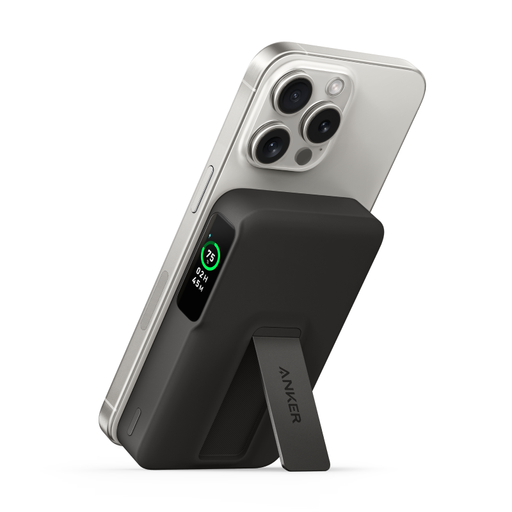
Anker MagGo Power Bank Qi2 Certified 15W, 10,000mAh
Why it's a match: Ideal for iPhone users seeking a compact, wireless solution for daily use. The magnetic attachment and fold-out stand are perfect for commuters who want to watch videos or make video calls on the go.
Instead of a vague "fast charging" promise, this model offers Qi2-certified 15W charging. This is a clear, verifiable performance spec that is twice as fast as the old Qi standard.
The smart display shows the remaining charging time. The integrated stand significantly enhances user convenience.
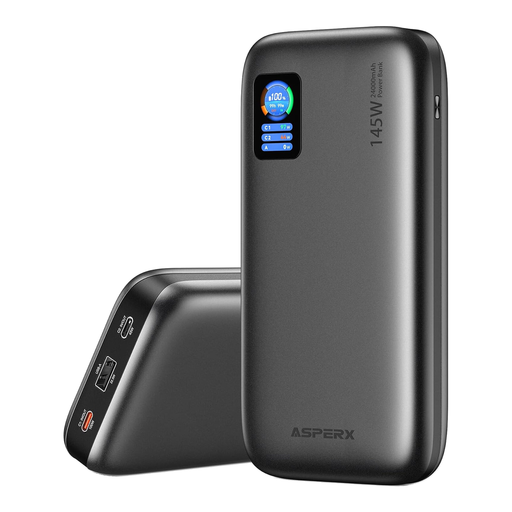
ASPERX 145W 24000mAh Laptop Power Bank
Why it's a match: Designed for professionals, students, and travelers who need to power a laptop, tablet, and smartphone simultaneously. Its high capacity and extreme power output make it a mobile powerhouse.
This model bypasses the trap of insufficient power. With a maximum output of 100W from a single USB-C port (PD 3.1), it can efficiently charge even demanding laptops like a MacBook Pro.
The TFT smart display shows real-time battery level, remaining time, and input/output power, providing full transparency over the charging process.
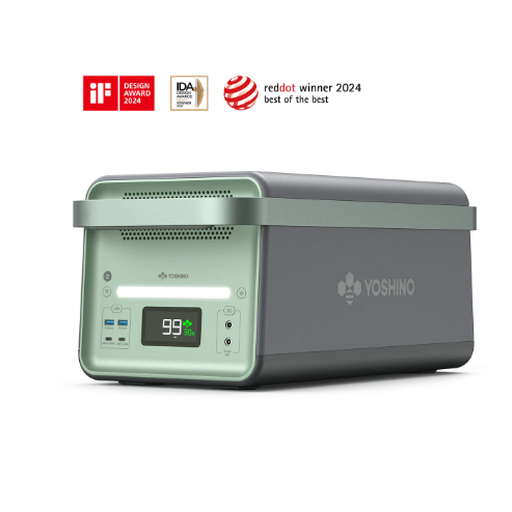
Yoshino B3600SST 3600Wh Portable Power Station
Why it's a match: This isn't just a power bank; it's a fully-fledged power station for camping, the backyard, or as an emergency power supply during outages. It can run home appliances, power tools, and multiple electronic devices at once.
This unit avoids the trap of buying an underpowered solution for a demanding use case. With 3600Wh of capacity and 2200W AC output, its specifications are clearly defined for high-performance operation.
Features two 230V outlets, multiple USB ports (incl. 100W PD), and can be charged via solar panels (up to 600W), making it a self-sufficient solar generator.
Looking for more options?
We have compiled a complete, up-to-date list of products that fully meet these strict selection criteria and UK safety regulations.
Frequently Asked Questions (FAQ)
1. How many times can a 20000mAh power bank charge my smartphone?
This depends on your smartphone's battery capacity and the power bank's efficiency. As a rule of thumb, take the power bank's nominal capacity (e.g., 20,000 mAh) and multiply it by an efficiency factor of about 0.65 (to account for conversion losses). This gives you a real-world capacity of around 13,000 mAh. An iPhone 15 with an approx. 3,350 mAh battery could be fully charged about 3-4 times.
2. Can any power bank charge a laptop?
No. To effectively charge a laptop, you need a power bank with high power output. Look for a USB-C port that supports Power Delivery (PD) and delivers at least 45 watts (W), or preferably 65W or more. Check your laptop's power adapter requirements to determine the necessary wattage.
3. What is the difference between a power bank and a power station?
A power bank is a compact, portable battery primarily designed for charging mobile devices like smartphones and tablets via USB ports. A power station is a significantly larger and more powerful unit with a very high capacity (often over 500 Wh). In addition to USB ports, it also features 230V AC outlets and can therefore power household appliances, tools, or medical equipment. It is ideal for camping, outdoor activities, or as an emergency power generator.