
Power Bank Buyer's Guide: Preventing Common Pitfalls
By Joybuy Product Recommendation Officer, July 28, 2026
A low battery on your smartphone, tablet, or laptop is more than just an inconvenience—it can disrupt your workflow or limit your availability at critical moments. A power bank seems like a simple solution, but the market is flooded with products that make lofty promises and often fail to deliver in practice. Before you make a purchase, it's crucial to understand the common pitfalls that can lead to a bad buy.
The 3 Most Common Traps When Buying a Power Bank:
- The Capacity Trap: Many manufacturers advertise high milliampere-hour (mAh) figures that are not achievable in reality. A portion of the stored energy is lost during power conversion and due to heat dissipation. As a result, a 10,000 mAh power bank often only delivers a net capacity of 6,000 to 7,000 mAh to your device. Models without clear specifications for rated capacity or energy efficiency are often an indicator of exaggerated marketing claims.
- The False Fast-Charging Promise: A "Fast Charge" label means little if the technology isn't compatible with your devices. For fast charging to work, the power bank, fast-charging cable, and the end device must all support the same charging standard, such as Power Delivery (PD). A high-performance power bank is useless if connected with an incompatible cable.
- Port Chaos and Outdated Tech: Buying a power bank that primarily relies on outdated USB-A ports can quickly become frustrating for owners of modern devices like the iPhone 17 or current MacBooks. A future-proof model should have at least one bidirectional USB-C port that serves to both charge the power bank itself and power other devices.
What Really Matters When Making Your Choice
To avoid these traps, you should focus on three objective core parameters. These will help you correctly assess a power bank's performance and find a model that truly meets your needs.
1. Decoding Capacity Correctly: Watt-hours (Wh) Instead of Just mAh
While capacity is usually listed in milliampere-hours (mAh), the specification in Watt-hours (Wh) is often more meaningful and is crucial for air travel. Most airlines limit batteries carried in hand luggage to 100 Wh.
- Calculation Formula: Watt-hours (Wh) = (Milliampere-hours (mAh) × Voltage (V)) / 1000
- Practical Example: A 20000mAh power bank with a typical cell voltage of 3.7V has 74 Wh (20,000 mAh × 3.7 V / 1000), making it permissible for carry-on luggage on flights.
For daily use, a capacity of 10,000 mAh is often sufficient to fully charge a modern smartphone once or twice. For longer trips, multiple devices, or charging a laptop, a capacity of 20,000 mAh or more is a sensible choice.
2. Charging Power and Protocols: Power Delivery (PD) is Key
Charging speed is measured in watts (W). Modern devices benefit from fast-charging protocols, of which Power Delivery (PD) via USB-C is the most widespread standard.
- For Smartphones (e.g., iPhone 17, Samsung Galaxy): 20W to 30W is ideal for rapid charging.
- For Tablets and Small Laptops: 30W to 65W is recommended.
- For High-Performance Laptops (e.g., MacBook Pro): A laptop power bank should deliver at least 65W, and ideally 100W, through a single USB-C port.
Ensure that both the power bank and your charging cable for iPhone 17 or other devices support the PD standard. A high-quality USB C charger and cable are essential for achieving full performance.
3. Ports and Extra Features
The right ports and thoughtful features significantly increase a power bank's utility.
- Ports: A modern standard is at least one USB-C PD port (input and output) and an additional USB-A port for older devices. Models with multiple USB-C outputs offer maximum flexibility.
- Integrated Cables: Power banks with built-in cables are especially convenient for on-the-go use, as you don't need to carry a separate cable.
- Wireless Charging: A MagSafe power bank offers users of compatible iPhones a particularly convenient, wireless charging option where the power bank attaches magnetically to the device.
Ideal Picks For You
Here are three recommendations tailored to different use cases that meet the quality criteria mentioned above.
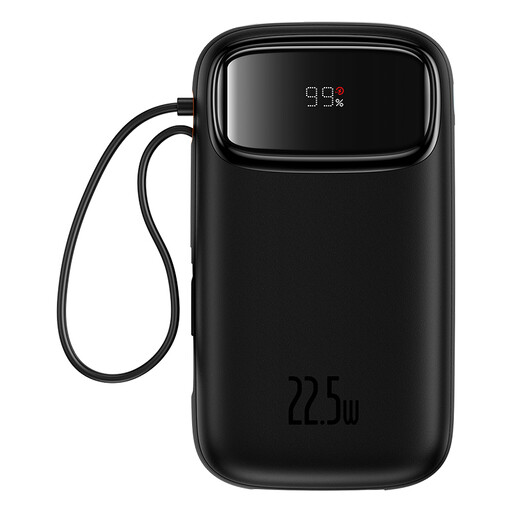
Baseus Qpow2 Dual-Cable Digital Display Fast Charge Power Bank, 10000mAh 22.5W
Why This Fits Their Persona: Ideal for commuters and daily use. Its compact form factor and integrated cables (Type-C and Lightning) make it extremely practical, eliminating the need to carry extra cables. The 10,000 mAh capacity is sufficient to fully charge a smartphone on the go.
The digital display shows the exact battery level as a percentage, bypassing the imprecise LED dots found on many other models. It supports a solid 22.5W fast-charging speed, avoiding the slow-charging trap.
Two integrated charging cables (USB-C and Lightning) for maximum compatibility without cable clutter. Capable of charging up to four devices simultaneously.
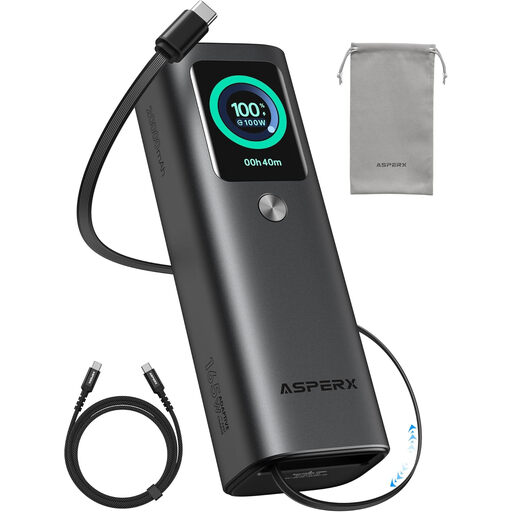
ASPERX Laptop Power Bank 20000mAh, Total 165W Fast Charging
Why This Fits Their Persona: Perfect for business travellers and digital nomads who need to charge a laptop and multiple devices on the go. The high total output of 165W allows for simultaneous fast charging of two laptops (e.g., 100W + 65W).
This model delivers true Power Delivery at up to 100W on a single port, solving the problem of many power banks that are advertised as "laptop-capable" but charge too slowly. The TFT display provides precise data on power and remaining runtime.
True 165W total output and two PD 100W USB-C ports. The 74 Wh capacity is approved for air travel. Features an integrated, retractable USB-C cable.
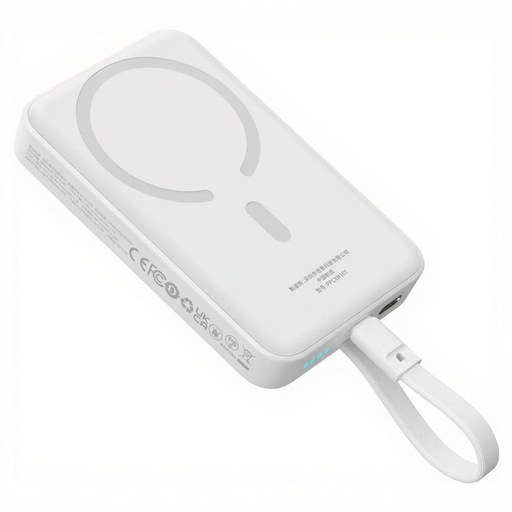
BASEUS 10000mAh Magnetic Mini Wireless Fast Charge Power Bank 30W
Why This Fits Their Persona: For users of an iPhone (12 series and newer) who seek maximum convenience. The MagSafe Powerbank attaches magnetically to the back of the iPhone and charges it wirelessly, without blocking the camera or requiring cables.
This model combines the convenience of wireless charging with true fast-charging capability. While many MagSafe battery packs charge slowly, this model also offers a 30W PD port for rapid charging via cable.
Combines magnetic wireless charging (up to 15W) with fast wired charging (30W PD). Features a compact design and an integrated USB-C cable.
Looking for More Options?
If you're looking for other charging solutions, our Charging Accessories category features a wide selection of cables designed for high performance and durability.
Frequently Asked Questions (FAQ)
1. How many mAh do I really need? For daily use to charge a smartphone once or twice, a 10,000 mAh power bank is generally sufficient and offers a good balance between size and performance. For longer trips, charging multiple devices, or use with a laptop, a 20000mAh power bank or larger is the better choice.
2. Can I take a power bank on an airplane? Yes, power banks must be transported in your carry-on luggage. Most airlines permit batteries with a capacity of up to 100 Wh without prior approval. Power banks between 100 Wh and 160 Wh often require airline approval. Devices over 160 Wh are generally prohibited. A 20,000 mAh power bank, at approx. 74 Wh, is well below the limit.
3. What is the difference between Power Delivery (PD) and Quick Charge (QC)? Both are fast-charging technologies. Power Delivery (PD) is a universal standard that works over USB-C and is used by a wide variety of devices, including Apple products (iPhone, MacBook) and many Android devices. Quick Charge (QC) is a technology developed by Qualcomm, found mainly in Android smartphones with Snapdragon processors. Many modern power banks support both standards to ensure broad compatibility. For the latest devices, especially laptops, PD is the definitive standard.