
Portable Power Stations: A Guide to Reliable Mobile Power
Whether for a camping trip, as a home emergency power supply, or for professional use far from any outlet, a reliable mobile power source is becoming increasingly essential. The market for portable power stations is diverse, and choosing the right model can be a challenge. This article provides an overview of the crucial criteria and presents a selection of devices to help you navigate your options.
What to Look for When Choosing a Portable Power Station
The right battery generator for you depends on your specific needs. Three technical features are of central importance.
1. Capacity (Wh) and Power Output (W)
These two values are critical to a power station's functionality.
- Capacity in Watt-hours (Wh): This value indicates how much energy the battery can store. A higher Wh number means a longer runtime. To determine your needs, you can multiply your devices' consumption (in Watts) by the desired usage time (in hours).
- Output in Watts (W): This figure defines the maximum power draw of the devices you can operate. For example, a 1000W power station can easily power laptops, cameras, and small coolers. For power-hungry appliances like electric kettles or power tools, a 2000W power station or higher is required.
2. Battery Technology: The Importance of LiFePO4
Most modern devices rely on Lithium Iron Phosphate (LiFePO4) batteries. A LiFePO4 power station offers clear advantages over older technologies:
- Long Lifespan: LiFePO4 batteries typically endure several thousand charge cycles before their capacity noticeably degrades. This ensures long-term usability.
- Enhanced Safety: This battery chemistry is considered thermally stable and less prone to overheating, which increases operational safety.
3. Ports and Charging Options
A good power station is versatile. Look for a sufficient number and variety of ports, including:
- 230V AC outlets: For standard household appliances.
- USB-A and USB-C (with Power Delivery): For charging smartphones, tablets, and laptops.
- 12V DC ports: For camping accessories like coolers or compressors.
Furthermore, charging flexibility is important. Besides charging from a wall outlet or in the car, compatibility with solar panels is a major advantage. This transforms the power station into a self-sufficient solar generator for on-the-go power.
Our Portable Power Station Picks
Here is a selection of models that are well-suited for different applications due to their specific features.
DJI Power 1000 V2 Portable Power Station
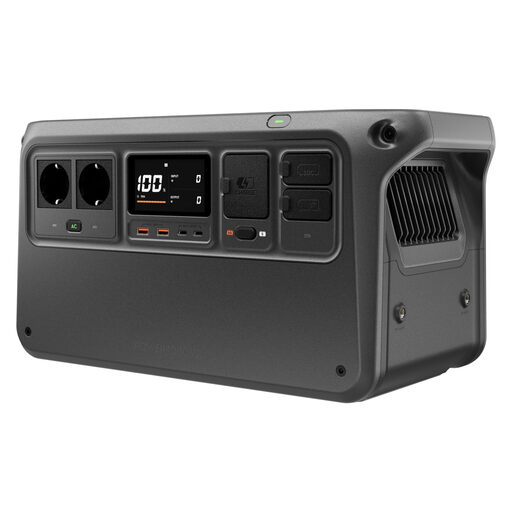
What makes it stand out: The DJI Power Station 1000 V2 is designed for speed and efficiency. According to the manufacturer, DJI, the battery reaches an 80% charge in just 37 minutes. With a capacity of 1024 Wh and a high output of 2600 W, it can power 99% of common devices, according to the manufacturer. A special feature is the SDC fast-charging function for specific DJI drone batteries.
Pros:
- Extremely fast charging from mains power
- High power output for demanding devices
- Functions as a UPS battery with a 10 ms switchover time for an uninterruptible power supply
- Quiet operation at just 26 dB, according to the manufacturer
- Two 140W USB-C ports for powerful laptops and devices
Who is it for? This model is a great choice for content creators and photographers who rely on fast charging for equipment like drones. It is also appealing to campers looking for a powerful and quickly deployable power station for camping.
DJI Power 2000 Portable Power Station
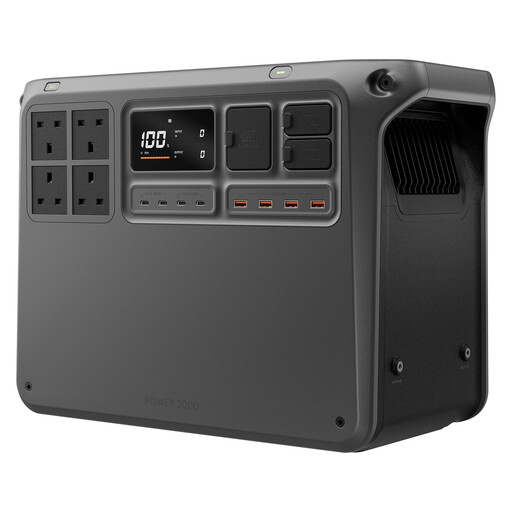
What makes it stand out: The DJI Power 2000 doubles the capacity to 2048 Wh and increases the output to 3000 W. It is designed for the most demanding tasks, from powering electric tools to providing emergency power for the home. A key feature is its expandable capacity with separately sold extra batteries. With 15 ports, it also offers excellent connectivity.
Pros:
- Very high capacity and power output
- Capacity is expandable with extra batteries
- 15 output ports for simultaneously running many devices
- UPS mode with a 10 ms switchover time
- Control and monitoring via the DJI Home App
Who is it for? The Power 2000 is aimed at users with high energy demands. This includes RV owners, tradespeople who need a portable power generator on the job site, or homeowners looking for a reliable backup solution during power outages.
VTOMAN Jump 600X Portable Power Station
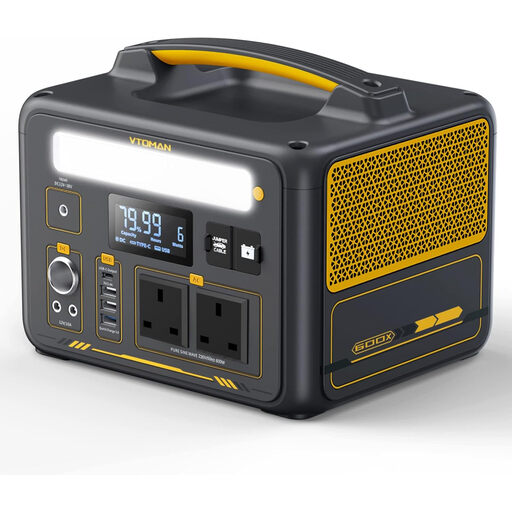
What makes it stand out: The VTOMAN Jump 600X is a compact and versatile entry-level model. With 299 Wh of capacity and 600 W of power (1200 W peak), it reliably powers essential devices. A special feature is its constant power function, which allows it to briefly run devices rated slightly above 600 W. The capacity can be expanded to 939 Wh with a separately sold extra battery.
Pros:
- Compact design and lower weight
- Regulated 12V DC outputs for stable operation of coolers or CPAP machines
- Expandable capacity if needed
- Extensive port options, including a PD 60W USB-C
- Great value for money for basic applications
Who is it for? This model is ideal for weekend campers, festival-goers, or as an advanced power bank with an AC outlet for the garden. Thanks to its regulated 12V outputs, it is also a worthwhile option for users of medical devices like CPAP machines.
More Options for Your Outdoor Space
A reliable mobile power supply is often just one part of a well-equipped outdoor area. If you are preparing your garden or patio for the upcoming season, you might find other useful products with us. For example, discover our selection of [Garden Pergolas and Gazebos] to create a sheltered and comfortable space outdoors.
Frequently Asked Questions (FAQ)
1. What is the difference between a power station and a petrol generator? A portable power station is essentially a large battery generator. Unlike petrol-powered generators, it operates quietly, is emission-free, and is low-maintenance. This allows it to be used safely indoors, in tents, or in RVs.
2. How long does a portable power station last? The lifespan depends on two factors: the runtime per charge and the total lifespan of the battery. The runtime is determined by the capacity (Wh) and the consumption of the connected devices. The total lifespan is measured in charge cycles. Modern LiFePO4 power station models often offer 3,000 or more cycles, which can equate to up to 10 years of life with regular use.