
Portable Air Conditioners 2026: Technical Criteria for Making the Right Choice
Portable air conditioners offer a flexible solution for cooling individual rooms when a permanently installed central air conditioning system isn't feasible or desired. Selecting the right unit depends on a range of technical parameters that must be tailored to the specific requirements of the space. This guide breaks down the crucial criteria—such as cooling capacity, energy efficiency, noise level, and design—to provide a solid foundation for an informed decision.
Buyer's Guide: What to Look for in a Portable Air Conditioner
A proper evaluation of a portable AC unit is based on objective performance data. The following four criteria are fundamental to your selection.
1. Cooling Capacity (BTU and Watts)
Cooling capacity, expressed in BTU (British Thermal Unit) per hour or in Watts (W), is the most important indicator of a unit's effectiveness. It describes how much heat energy an air conditioner can remove from a room per hour. Insufficient cooling capacity leads to inefficient, continuous operation, while an oversized unit will cool the room too quickly and cycle off, which can cause temperature fluctuations and increased humidity.
A rule of thumb for calculating the required capacity is:
- Room area in m² × 60 to 100 Watts = required cooling capacity in Watts
The factor varies depending on insulation, window area, sun exposure, and the number of people in the room. For example, a 30 m² room with average sun exposure requires approximately 1,800 to 3,000 Watts (approx. 6,100 to 10,200 BTU).
2. Energy Efficiency and Refrigerant
Energy efficiency is indicated by the energy efficiency class (e.g., A++) on the EU energy label. A high rating, expressed by the SEER (Seasonal Energy Efficiency Ratio), signifies lower power consumption for the same cooling output.
Modern units increasingly use the natural refrigerant R290 (Propane). Compared to older refrigerants like R410A, R290 has a very low Global Warming Potential (GWP of 3) and does not contribute to ozone layer depletion.
3. Noise Level (Sound Pressure Level in dB)
The operating noise, measured in decibels (dB), is a critical factor, especially for use in bedrooms or offices. The value is typically specified as the sound pressure level at a certain distance.
- Below 45 dB: Considered very quiet, comparable to a quiet library.
- 45 to 55 dB: Equivalent to a quiet conversation and is often acceptable for living areas.
- Above 55 dB: Can be perceived as disruptive, comparable to a normal conversation or a running television.
A quiet air conditioner often features special sleep or silent modes that reduce fan speed and, consequently, the noise level.
4. Designs and Additional Features
- Monobloc Units: This is the most common design. All components are housed in a single casing. The warm process air is vented outside through an exhaust hose via a window or wall opening.
- Split Units: These consist of an indoor and an outdoor unit connected by a flexible line. The noisy compressor is located in the outdoor unit, making indoor operation significantly quieter.
- Additional Features: Many models offer more than just cooling. An air conditioner with a heating function can also be used during transitional seasons. Other useful features include dehumidification and fan-only modes. A battery-powered air conditioner offers maximum portability for use when camping or in vehicles.
Our Top Picks for 2026
Based on the technical criteria above, we present three models with different specialisations.
Midea PortaSplit Cool Portable Split Air Conditioner
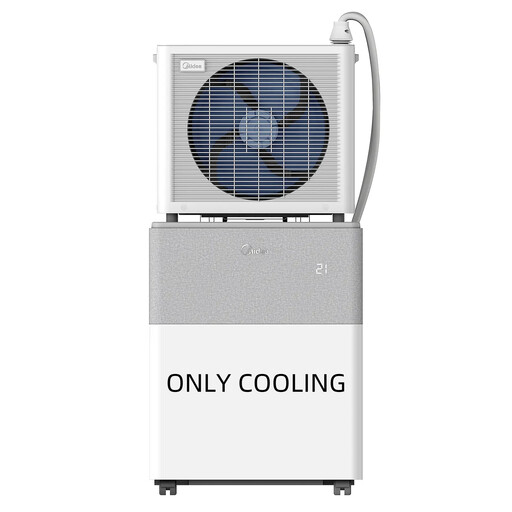
Why we recommend this product: The Midea PortaSplit Cool solves the core problem of many portable air conditioners: noise. Its split design moves the compressor outside, lowering the indoor sound pressure level to as low as 38 dB(A) in Silent Mode. This makes it an ideal solution for noise-sensitive environments. The A++ energy efficiency class also highlights its economical operation.
- Pros:
- Split design for quiet indoor operation
- Very low noise level from 38 dB(A) according to the manufacturer
- High energy efficiency class A++ (SEER 6.1)
- Control via remote and app
- Who it's for:
- Users looking for a quiet air conditioner for bedrooms, children's rooms, or a home office.
- Apartment dwellers where a permanent split system cannot be installed.
Humhold 12000 BTU Mobile Air Conditioner
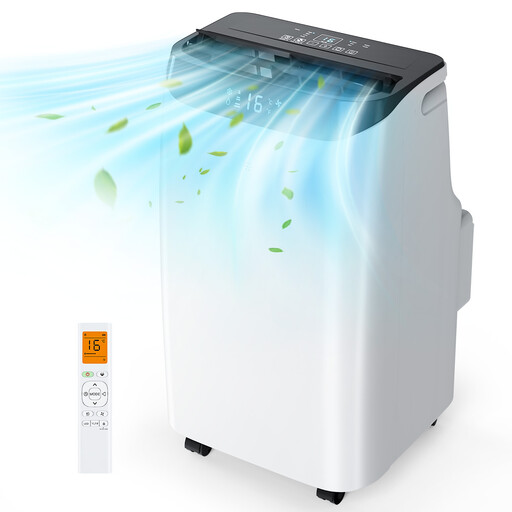
Why we recommend this product: This monobloc unit from Humhold stands out with its high cooling capacity of 12,000 BTU (3.5 kW). It is designed to effectively cool even larger rooms up to 45 m². The integrated self-evaporating system reduces the need to manually empty the water tank, minimising maintenance. Its 3-in-1 functionality (cooling, dehumidifying, fan) makes it a versatile air conditioner for apartments.
- Pros:
- High cooling capacity of 12,000 BTU for rooms up to 45 m²
- Self-evaporating system for reduced maintenance
- 3-in-1 functionality and 3-speed fan
- Uses the more eco-friendly R290 refrigerant
- Who it's for:
- Owners of large living or office spaces who need a powerful and straightforward cooling solution.
- Users looking for an all-in-one device for cooling and dehumidification.
ECOFLOW WAVE 3 Portable Air Conditioner
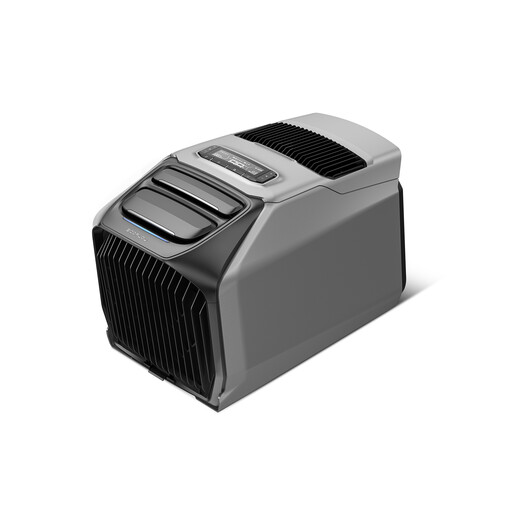
Why we recommend this product: The ECOFLOW WAVE 3 redefines the portable air conditioner category by focusing on off-grid independence. With an optional add-on battery, it provides up to 8 hours of wireless operation. The combination of cooling and heating functions makes it a year-round companion. Its compact design and versatile charging options (AC power, solar, 12V port) make it perfect for mobile use.
- Pros:
- Battery-powered air conditioner (optional) for off-grid operation
- Integrated air conditioner with heating function (2000 W)
- Compact and lightweight design for high portability
- Flexible charging options, including solar
- Who it's for:
- Campers, RV owners, and outdoor enthusiasts who need an air conditioner for camping.
- Users looking for a flexible emergency cooling solution for power outages or remote locations.
Discover More Options
If these models don't meet your specific needs, you can find a broader selection in our main category. There, you can filter units by other criteria such as price, cooling capacity, or specific features to find the ideal model for you.
Discover our full range of Portable Air Conditioners.
Frequently Asked Questions (FAQ)
1. How does a portable air conditioner with an exhaust hose work? A monobloc air conditioner draws in warm room air. Inside, the air is cooled as it passes over a heat exchanger filled with a refrigerant. The cooled air is then blown back into the room. The heat generated during this process is collected and expelled outside through the exhaust hose. Without venting this warm air, cooling the room would be physically impossible.
2. How many BTU per m² do I need for a portable air conditioner? A precise calculation depends on many factors, but a common rule of thumb is to plan for about 205 BTU (approx. 60 Watts) of cooling capacity per square metre of room area. For a 25 m² room, that would be around 5,125 BTU (approx. 1,500 Watts). For rooms with high sun exposure, poor insulation, or in top-floor apartments, the value should be increased to up to 340 BTU (approx. 100 Watts) per m².
3. Can you operate a portable air conditioner without an exhaust hose? No, a true air conditioner based on compression technology always needs a way to vent waste heat outside. Devices without an exhaust hose are typically air coolers (evaporative coolers). These cool the air through the evaporation of water, which increases the room's humidity and has a very limited cooling effect in muggy weather. An effective reduction in room temperature can only be achieved with an air conditioner that has an exhaust hose or with a split unit.