
5-Port Gigabit PoE Switch: A Technical Buyer's Guide for 2026
A 5-port Gigabit PoE switch is a core component for building efficient and streamlined network environments. By transmitting data and power over a single Ethernet cable (Power over Ethernet), it eliminates the need for separate power adapters for devices like IP cameras, VoIP phones, or Wi-Fi access points. This significantly simplifies installation and reduces cable clutter. This article analyses the technical parameters relevant for selecting such a switch for home networks or small business environments.
Buyer's Guide: What to Look for in a 5-Port PoE Switch
Choosing the right model depends on specific technical requirements. The following criteria are crucial for making an informed decision.
1. PoE Standard and Total Budget
The most important metric is the PoE budget, measured in watts. It indicates the total amount of power the switch can deliver to all connected devices combined.
- IEEE 802.3af (PoE): Delivers up to 15.4 watts per port. Suitable for devices with lower power consumption, such as static IP cameras or basic VoIP phones.
- IEEE 802.3at (PoE+): Delivers up to 30 watts per port. Necessary for more powerful devices like PTZ (Pan-Tilt-Zoom) cameras, modern access points, or video phones.
A PoE+ switch is backward compatible and can also power PoE devices. It's crucial to add up the total power requirements of all planned devices and ensure the switch's PoE budget exceeds this value to guarantee stable operation.
2. Managed vs. Unmanaged PoE Switch
The choice between a managed and an unmanaged switch defines the level of network control.
- Unmanaged PoE Switch: These devices are plug-and-play. They require no configuration and are ideal for simple networks where connectivity and power delivery are the main priorities.
- Managed PoE Switch: Offers advanced configuration options via a web interface or software. Features like VLAN (Virtual Local Area Network) for network segmentation, QoS (Quality of Service) for prioritising traffic (e.g., for video streams or VoIP), and network monitoring allow for precise control and optimisation. A 4-port PoE switch with an additional uplink port is a common configuration in this segment.
3. Casing and Cooling
The build quality directly impacts longevity and placement.
- Metal Casing: A robust metal casing not only offers better protection against physical impacts but also serves as a passive heatsink. It dissipates heat more effectively than plastic, which extends the lifespan of the internal components.
- Fanless: A fanless switch operates silently. This is a key advantage for use in offices, living spaces, or professional practices where operational noise would be disruptive.
Our Product Selection for 2026
Based on the technical criteria mentioned, we present three models that cover different requirement profiles.
TP-Link TL-SG105MPE: For Demanding Networks with High Power Requirements
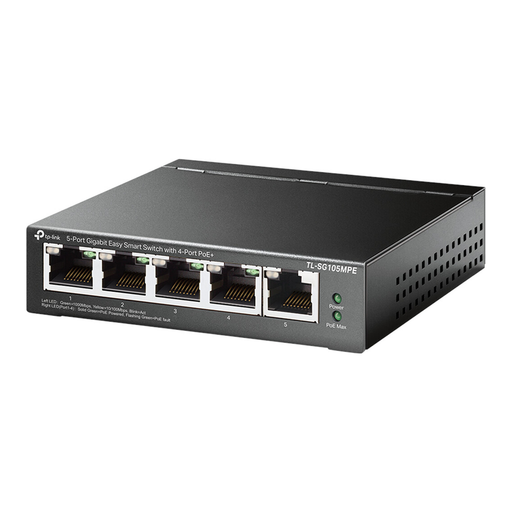
Why we recommend this product The TL-SG105MPE stands out for its high total PoE budget of 120 watts and its extensive management features. It supports the PoE+ standard on four ports, providing enough power for multiple power-hungry devices simultaneously. Features like QoS, VLAN, and PoE Auto-Recovery, which automatically reboots unresponsive devices, offer a high degree of control and reliability.
Advantages:
- High PoE Budget: 120 watts total power, up to 30 watts per port.
- Comprehensive Management: Web-based interface for VLAN, QoS, IGMP Snooping, and network monitoring.
- PoE Auto-Recovery: Increases the stability of connected devices like IP cameras.
- Robust Build: Durable, fanless metal casing.
Who It's For: Users and small businesses that operate multiple high-power PoE+ devices and require granular control over their network traffic. Ideal as a switch for IP cameras in surveillance systems or for powering multiple access points.
TP-Link TL-SG105PE: The Balanced Solution with Smart Management
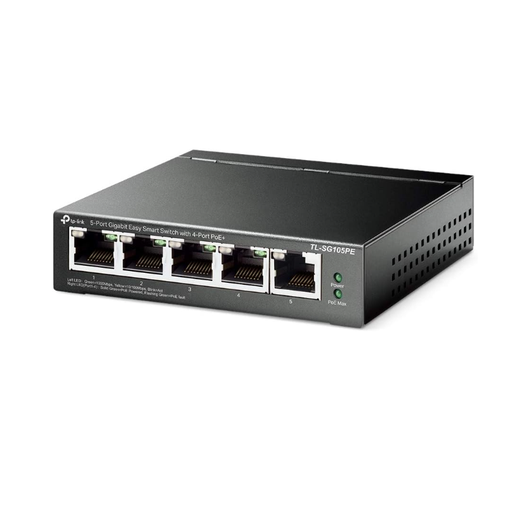
Why we recommend this product The TL-SG105PE strikes a balance between a pure unmanaged switch and a fully managed model. With a 65-watt PoE budget and four PoE+ ports, it covers common use cases. The "Easy Smart Management" provides access to essential features like VLAN and QoS without the complexity of a full-fledged managed PoE switch.
Advantages:
- Solid PoE Budget: 65 watts total power for up to four PoE+ devices.
- Easy Smart Management: Simple configuration of VLAN and QoS via a web interface.
- Efficient and Silent: Fanless design in a robust metal casing.
- Excellent Value: Offers management features at an attractive price point.
Who It's For: Tech-savvy home users (prosumers) and small offices that need basic network segmentation or prioritisation but can do without complex enterprise features.
Mercusys MS105GP: Simplicity with Practical Extra Features
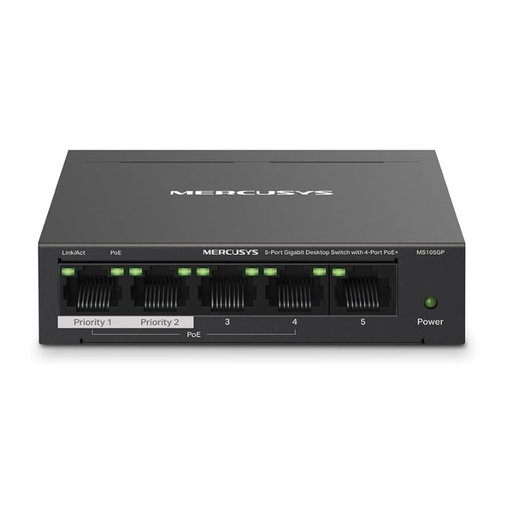
Why we recommend this product The Mercusys MS105GP is an unmanaged PoE switch designed for maximum simplicity, yet it offers two useful hardware features. With a 65-watt budget, it reliably powers up to four PoE+ devices. The switch-activated "Extend Mode" enables PoE transmission up to 250 metres, which is ideal for distant cameras. The "Isolation Mode" separates the ports from each other to enhance security.
Advantages:
- Plug-and-Play: No configuration required.
- Extend Mode: Allows PoE power delivery over long distances (up to 250 m at 10 Mbps).
- Port Isolation Mode: Improves network security by separating traffic between ports.
- Reliable Hardware: 65-watt PoE budget and a durable metal casing.
Who It's For: Users looking for a straightforward plug-and-play solution who can benefit from the specific advantages of the Extend or Isolation modes. Especially practical for simple video surveillance installations with long cable runs.
Further Options and Alternatives
The 5-port models presented here cover a wide range of standard applications. For network requirements that go beyond this selection—whether due to a higher number of required ports, a larger PoE budget, or specific management needs—a variety of other devices exist. You can find a more comprehensive overview in our PoE Network Switch category.
Frequently Asked Questions (FAQ)
1. What is the difference between a PoE and a PoE+ switch? The main difference lies in the maximum power per port. A standard PoE switch (IEEE 802.3af) delivers up to 15.4 watts, while a PoE+ switch (IEEE 802.3at) can provide up to 30 watts. PoE+ is required for devices with higher energy demands, such as modern Wi-Fi access points or pan-and-tilt cameras, and is backward compatible with PoE.
2. Can I connect a non-PoE device to a PoE switch? Yes. PoE switches automatically detect whether a connected device is PoE-capable (via a handshake protocol). If a device like a computer or printer that does not require power over Ethernet is connected, the port will only supply data and no power. There is no risk to the end device.
3. How many watts do I need for my IP cameras? Power consumption varies by camera model. A simple, fixed HD camera often requires only 5-7 watts. A camera with night vision (infrared LEDs) might need 10-12 watts, and a PTZ (Pan-Tilt-Zoom) camera can require up to 20 watts or more. Check the camera's datasheet and add up the consumption of all devices to determine the necessary total PoE budget for your switch. Plan for a buffer of about 20%.