
Buyer's Guide to 1.75mm PLA Filament Selection
By: Joybuy Product Recommendation OfficerDate: August 30, 2026
Choosing the right PLA Filament 1.75mm 1kg can make or break a 3D printing project. A failed print is not only frustrating but also wastes time and material. Many users unknowingly fall into traps set by exaggerated marketing claims or hidden product defects. This guide highlights the most common issues and explains which technical parameters you should look for to make an informed purchasing decision.
The three most common causes of print failures related to filament are:
- Inconsistent Diameter Tolerance: Fluctuations in filament diameter are a primary cause of nozzle clogs (clogging) and uneven extrusion (under/over-extrusion), leading to messy layers and unstable objects.
- Poor Spool Winding: Improperly wound filament can tangle during printing, blocking the feed and interrupting the process after hours—often when you're not looking.
- Misleading Surface Finish Descriptions: Terms like "Silk" or "Matte" are often used loosely. The result is a filament that doesn't deliver the expected sheen or desired low-reflection surface, which is especially disappointing for aesthetic projects.
Crucial Quality Characteristics for Your 3D Printer Filament
To avoid these problems, it's essential to scrutinise the product specifications. Three parameters are of central importance.
The Importance of Diameter Tolerance
The diameter tolerance indicates how much the actual diameter of the filament may deviate from the target value (in this case, 1.75 mm). A specification like ±0.02 mm means the diameter ranges between 1.73 mm and 1.77 mm. A low tolerance is an indicator of a precise manufacturing process and ensures a constant material flow in the extruder. This minimises the risk of clogs and guarantees a uniform layer height, which is crucial for the dimensional accuracy and surface quality of the printed object.
Material Variants: PLA, PLA+, and Special Effects
Standard PLA (Polylactic Acid) is the most widely used filament for 3D printers. It is easy to work with, has a low odour, and is made from renewable resources, making it biodegradable under industrial conditions.
For applications requiring greater mechanical durability, PLA+ filament was developed. Special additives make it tougher and more impact-resistant than standard PLA, making it a good choice for functional prototypes or mechanical parts.
Additionally, there is a wide variety of specialty filaments for aesthetic purposes:
- Matte PLA: Creates a low-reflection, velvety surface that conceals layer lines very well.
- Silk PLA: Contains additives that give the printed object a distinct, metallic-like sheen.
- Rainbow Filament: Offers smooth colour transitions across the entire length of the spool, making every printed object unique.
Spool Quality: Winding and Packaging
An often-underestimated characteristic is the quality of the spool winding. A neat, overlap-free wind prevents the filament from tangling during the print. Also, look for vacuum-sealed packaging with a desiccant pouch (silica gel). PLA is hygroscopic, meaning it absorbs moisture from the air. Damp filament leads to popping or sizzling sounds during printing, poor layer adhesion, and brittle, unsightly results.
Our Selection: The Right Filament for Your Project
Based on the quality criteria mentioned, we have compiled a few products for different user profiles.
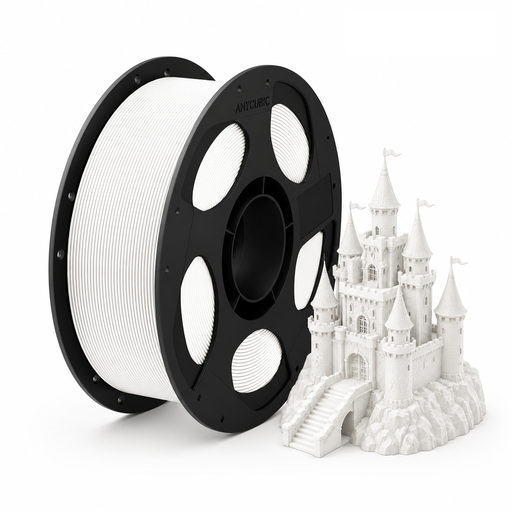
ANYCUBIC PLA Basic Printing Filament - White
Why It's a Match: This ANYCUBIC filament is known for its reliability and ease of use. It is an excellent choice for beginners looking for a hassle-free material for their first projects, as well as for everyday printing tasks where consistent results are a priority.
The specified diameter tolerance of ±0.02 mm directly counters the problem of inconsistent diameters and minimises the risk of nozzle clogs.
High process reliability and consistent print results thanks to precise manufacturing. Low tendency for warping.
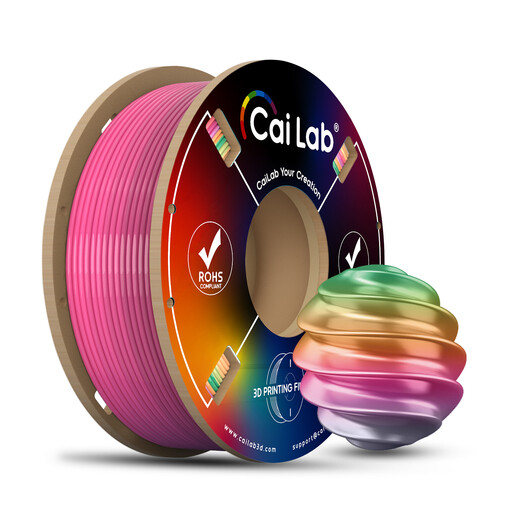
CAILAB 3D Printer Filament PLA Rainbow Gradient - Silk Candy
Why It's a Match: This CaiLab filament is designed for users who want to create visually stunning objects. It combines a silky sheen with a flowing colour gradient, ideal for vases, figures, or decorative elements that immediately catch the eye.
The product is explicitly declared as a Rainbow Filament with a Silk PLA finish, fulfilling this aesthetic expectation instead of providing a vague description.
Creates unique, multi-coloured prints with a pronounced glossy effect, requiring no post-processing or painting.
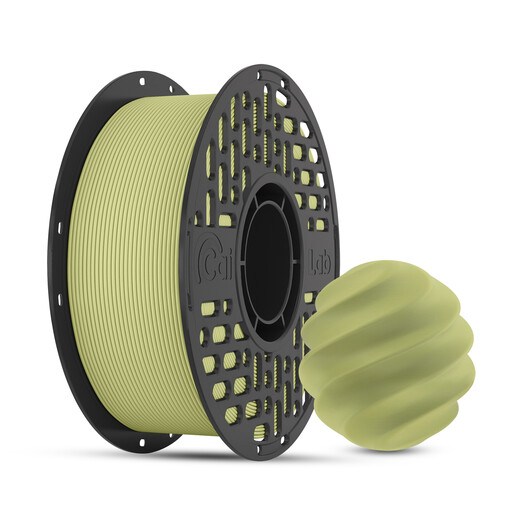
CAILAB 3D Printer Filament PLA Matte - Matcha Green
Why It's a Match: Ideal for models where layer lines should be concealed and a professional, non-glossy surface is desired. This Matte PLA is particularly suitable for architectural models, prototypes, or figures that require a premium feel.
Delivers a true matte finish that reduces reflections and minimises the visibility of layer lines. It thus avoids the trap of "matte" filaments that still have an unwanted sheen.
The low-reflection surface highlights fine details of the printed object and gives it a professional, high-quality appearance.
Looking for more options?
We have compiled a complete, up-to-date list of products that fully meet these strict selection criteria and all applicable regulations.
Frequently Asked Questions (FAQ)
How do I properly store PLA Filament 1.75mm 1kg?
PLA filament should be stored in a cool, dry place, protected from direct sunlight. To prevent moisture absorption from the air, it's best to keep the spool in the resealable bag it came in, along with the included desiccant pouch. For long-term storage, dedicated filament dry boxes are a worthwhile investment.
Is PLA filament biodegradable?
Yes, PLA is biodegradable under the right conditions. However, it does not decompose in a home compost pile. It requires the conditions of an industrial composting facility, where high temperatures and specific microorganisms enable the degradation process. Therefore, dispose of filament scraps and failed prints according to your local guidelines for plastic recycling.
What is the difference between PLA and PLA+ filament?
PLA+ filament is a modified version of standard PLA. The addition of additives improves the material structure, resulting in higher toughness, impact resistance, and better layer adhesion. While standard PLA is sufficient for most decorative and general-purpose applications, PLA+ is the better choice for functional parts that need to withstand some mechanical stress.