
Buyers Guide to Orthodontic Pacifiers
As a Joybuy Product Recommendation Specialist, I know that choosing the right pacifier is a major decision for parents. With so many options on the market, it can be difficult to find a model that not only soothes your baby but also supports healthy jaw and tooth development. This article serves as a guide. It highlights the essential features of an orthodontic pacifier and presents a selection of products based on objective criteria like material, shape, and functionality.
Buyer's Guide: What to Look for When Choosing a Pacifier
To make an informed decision, there are a few fundamental aspects to consider. The following points will help you better evaluate the features of different pacifiers.
1. Material and Safety: Silicone and BPA-Free
The material is a crucial factor for both safety and acceptance. Silicone pacifiers are now standard. The material is taste and odour-neutral, particularly temperature-resistant, and hygienic, as it is easy to clean. Always look for the BPA-free pacifier label. Bisphenol A (BPA) is a plasticiser whose use in baby products is legally banned in the EU. Furthermore, all pacifiers sold in the EU must comply with the EN 1400 safety standard, which defines requirements for materials, construction, and labelling.
2. Teat Shape: Symmetrical and Narrow
The shape of the teat is the core feature of an orthodontic pacifier. Models developed in collaboration with dentists and orthodontists typically have the following characteristics:
- Narrow teat neck: A thin bridge between the teat and the shield reduces pressure on the jaw and teeth.
- Flat and symmetrical teat: This allows the tongue sufficient room to move and ensures the pacifier is always positioned correctly in the mouth, no matter how it is turned.
- Soft material: A flexible teat adapts to the baby's palate without exerting excessive pressure.
Brands like MAM pacifiers and NUK pacifiers place a special focus on these jaw-friendly designs.
3. Practical Features for Everyday Life
Modern pacifiers often offer thoughtful details that make daily life easier for parents and children:
- Pacifiers for sensitive skin: Models with large air holes in the shield allow the skin to breathe, preventing redness or irritation around the mouth.
- Glow-in-the-dark pacifiers: A glowing element on the pacifier button helps parents and babies find the pacifier quickly at night without turning on the light.
- Pacifiers with a steriliser box: Some products come in a travel case that doubles as a steriliser box for the microwave. This saves time and energy.
- Sustainable pacifiers: Manufacturers are increasingly using bio-based materials and climate-neutral production processes to reduce their ecological footprint.
Our Pacifier Recommendations
Based on the criteria above, we have compiled a selection of products that stand out for their specific features.
1. MAM Original Night Silicone Pacifier (0–6 Months)
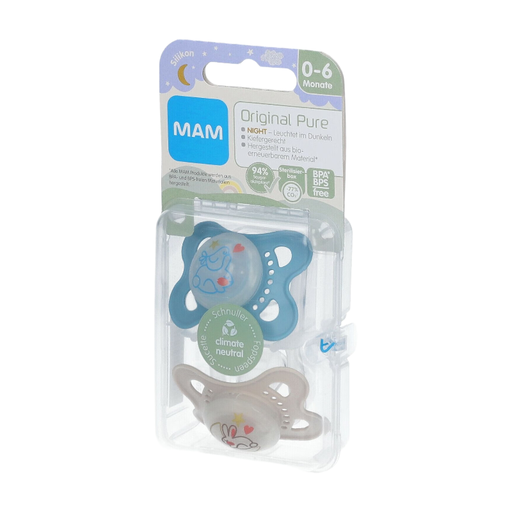
Why it stands out This model combines a jaw-friendly shape with a practical night-time feature. The pacifier button glows in the dark, making it easy to find when your baby wakes up. According to MAM, it is also the brand's first climate-neutral pacifier, with a shield and button made from bio-based materials.
Benefits
- Glow-in-the-dark feature: The button stores daylight and glows softly in the dark.
- Skin-friendly shield: Large air holes and nubs on the inside are gentle on sensitive baby skin.
- MAM SkinSoft Silicone: According to a MAM study, the extra-soft silicone is instinctively accepted by 94% of babies.
- Includes steriliser box: Allows for quick and energy-saving sterilisation in the microwave.
- Safety:BPA- and BPS-free, complies with the EN 1400 standard.
Who it's for This pacifier for 0–6 months is a great choice for parents looking for a practical solution for quieter nights while also valuing sustainable materials.
2. MAM Original Pure Silicone Pacifier (0–6 Months)
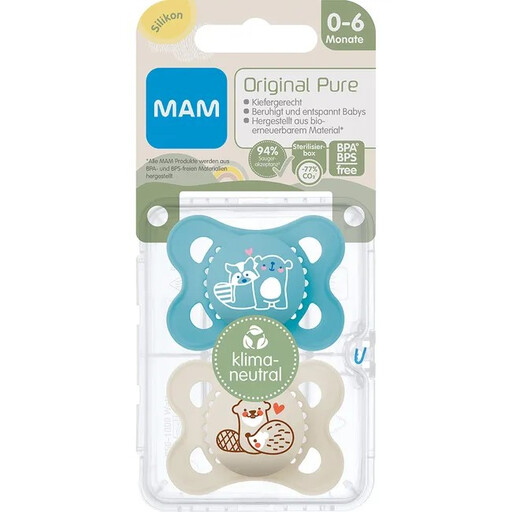
Why it stands out The MAM Original Pure consistently focuses on sustainability. As the first climate-neutral MAM pacifier, its shield and button are made from a bio-renewable material to minimise its CO? footprint. According to the manufacturer, the remaining emissions are offset in cooperation with Climate Partner.
Benefits
- Sustainable materials: The shield and button are made from a bio-based plastic.
- Orthodontic design: The symmetrical, flat teat was developed in collaboration with dentists.
- High acceptance: The soft SkinSoft silicone provides a familiar feeling.
- Practical steriliser and travel box: Saves up to 77% in energy and CO? compared to other sterilisation methods, according to MAM.
Who it's for Ideal for environmentally conscious parents who want a sustainable pacifier with proven orthodontic properties for their baby aged 0 to 6 months.
3. NUK Space Silicone Soother (6–18 Months)
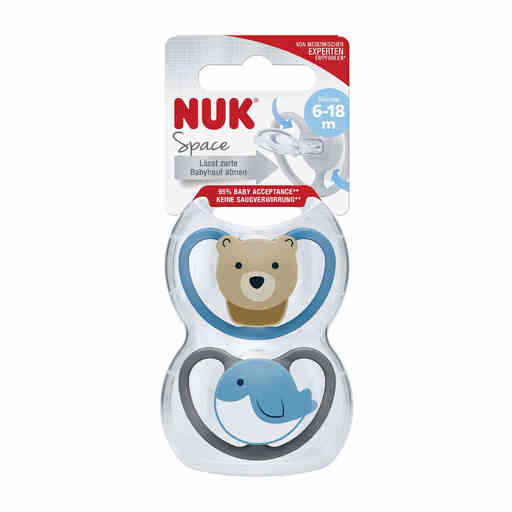
Why it stands out The NUK pacifier Space was specially designed for babies with very sensitive skin. Its design features extra-large openings in the shield, which allow for maximum air circulation and minimise skin contact.
Benefits
- Maximum air circulation: The extra-large openings let the skin breathe and are ideal as a pacifier for sensitive skin.
- Optimised shape: The teat is particularly soft at the top (Soft Zone) and has a narrow, flat neck to reduce pressure on the jaw and teeth. According to a scientific comparison study published by NUK, the NUK shape has the least impact on teeth, jaw, and palate.
- Reusable box: The packaging serves as a travel and hygiene box and can be used for sterilisation in the microwave.
- Made in Germany: The pacifier is 100% made in Germany and is, of course, BPA-free.
Who it's for This pacifier is an excellent option for parents of babies aged 6 to 18 months whose skin is prone to irritation and who prefer a product with a scientifically-backed design.
Looking for other soothing options?
If your baby is starting to teethe or you are looking for alternative ways to soothe them, other products might also be helpful. Discover a selection of teething aids in our Baby Teether category.
Frequently Asked Questions (FAQ)
How can I identify an orthodontic pacifier?
An orthodontic pacifier is characterised by several features: a thin, flat teat neck that minimises the gap between the dental arches, and a symmetrical, soft teat that gives the tongue enough space. Look for products that have been developed in collaboration with dental professionals.
How often should you replace a baby pacifier?
For hygiene and safety reasons, most manufacturers recommend replacing a baby pacifier every one to two months. Inspect the pacifier before each use for cracks, bite marks, or stickiness, and discard it at the first sign of damage.
What does "BPA-free pacifier" mean?
"BPA-free" means that the product was made without the chemical Bisphenol A. BPA is a plasticiser found in some plastics, and its use in baby bottles and pacifiers is legally banned in the European Union to eliminate potential health risks for infants and young children.