
No Frost Fridge-Freezers: 2026 Buyer's Guide and Recommendations
Selecting a new fridge-freezer is a decision that should be grounded in objective criteria. Key factors such as energy consumption, usable capacity, noise emissions, and maintenance requirements are pivotal for long-term satisfaction. No-Frost technology has emerged as a central feature, rendering manual defrosting of the freezer section obsolete. This guide analyses the technical aspects to consider when choosing such an appliance and presents a curated selection of models based on their specifications.
Buyer's Guide: Technical Selection Criteria for Fridge-Freezers
The decision for a particular model should be based on an analysis of technical data sheets and product features. The following parameters are essential for making an informed choice.
No-Frost Technology: How It Works and Its Variations
The core function of No-Frost technology is to reduce humidity within the freezer compartment. A circulating air system directs moist air from the interior to an evaporator, where the moisture freezes. At regular intervals, this evaporator is heated, and the resulting meltwater is drained away and evaporated. The result is an ice-free freezer, which eliminates the need for manual defrosting and ensures consistent energy efficiency.
Variations such as Less-Frost or Low-Frost also exist. In these systems, the evaporator coils are integrated into the side walls, which reduces ice build-up compared to conventional appliances but does not prevent it entirely. Manual defrosting is required less frequently but is still necessary periodically.
Energy Efficiency Class According to EU Standards
Since 1 March 2021, a new EU energy label has been in effect, with a scale from A (highest efficiency) to G (lowest efficiency). Appliances previously rated A++ or A+++ are now often found in classes C, D, or E. Under the current standard, an energy efficiency class of C already represents a very efficient appliance. The annual energy consumption, specified in kilowatt-hours (kWh/a), is a precise indicator of running costs.
Compressor Type: Standard vs. Inverter
The compressor is the heart of the cooling system. While standard compressors switch on and off at full power, an Inverter Compressor continuously adjusts its speed to match the actual cooling demand. This results in several advantages:
- Lower energy consumption: Demand-driven operation avoids peak loads.
- Lower noise emissions: The compressor usually runs at a low speed, making it quieter.
- Longer lifespan: Fewer start-stop cycles reduce mechanical wear.
Usable Capacity and Design
The required usable capacity depends on the size of your household. A general guideline is approximately 50–80 litres per person for the refrigerator section. For a large fridge-freezer, models with a total volume of over 350 litres are a practical option. In terms of design, a freestanding fridge-freezer is the most flexible solution, as it can be placed independently of kitchen cabinetry. Stainless steel fridge-freezer models offer a modern aesthetic and often feature an anti-fingerprint coating.
Noise Emissions in Decibels (dB)
For open-plan kitchens or noise-sensitive individuals, a quiet fridge-freezer is essential. Noise emission is specified in decibels (dB(A)). Values below 38 dB(A) are considered quiet. Appliances with an Inverter Compressor often have an advantage here.
Our Selection of Fridge-Freezers for 2026
The following models have been selected based on their technical specifications and practical benefits.
Bauknecht KGLR 185 IN
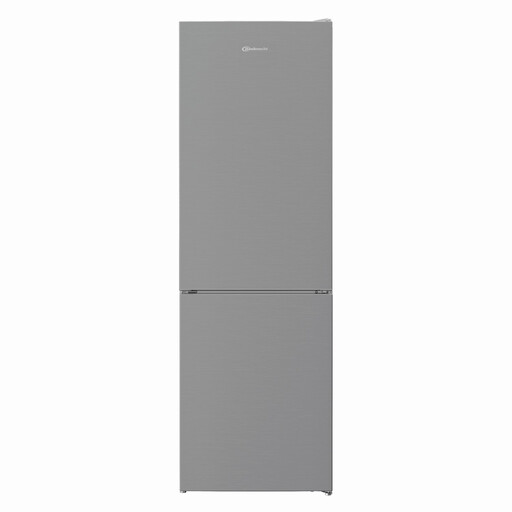
Why we're analysing this product: This Bauknecht model offers a solid set of core features with a focus on efficiency and quiet operation. Its LessFrost technology represents a compromise that significantly reduces maintenance compared to appliances without this feature.
Pros:
- Low noise emission: At 35 dB(A), the appliance is well-suited for open-plan living spaces.
- Efficient operation: Its energy efficiency class C rating, with an annual consumption of 156 kWh, is a good value for an appliance of this size.
- Flexible installation: The door hinge is reversible, simplifying placement in the kitchen.
- Good spatial distribution: With a total usable capacity of 343 litres, the appliance offers a balanced split between the refrigerator (223 L) and freezer (120 L) sections.
Who it's for: Households looking for a quiet, energy-efficient appliance that offers good value for money and are willing to perform occasional manual defrosting to benefit from the LessFrost technology.
Bauknecht KDNF 203C IN
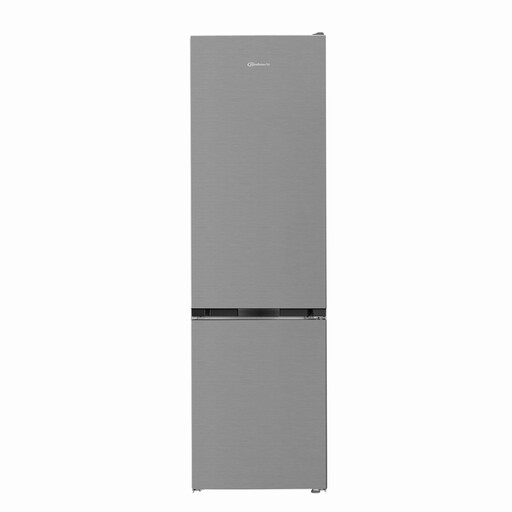
Why we're analysing this product: This Bauknecht fridge-freezer combines a large capacity with advanced technology. Its Dual Cool Total NoFrost system and Inverter Compressor directly address the key demands of modern cooling appliances: maintenance-free operation and efficiency.
Pros:
- Full No-Frost functionality: Two separate cooling circuits prevent odour transfer and make defrosting obsolete.
- Quiet and durable operation: The Inverter Compressor ensures a noise emission of just 35 dB(A) and efficient energy use.
- Large usable capacity: With a total volume of 415 litres (297 L fridge, 118 L freezer), the appliance is designed for families or households with high storage needs.
- Additional features: FreshShield technology to optimise humidity and a SmoothFit design for a flush-to-wall 90° door opening.
Who it's for: Families and demanding users seeking a large fridge-freezer with full No-Frost technology, ultra-quiet operation, and modern freshness features.
CHiQ JR460WSE Cross-Door
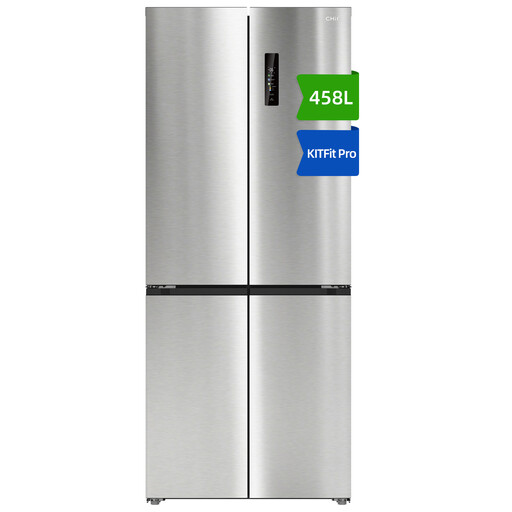
Why we're analysing this product: This Cross-Door model from CHiQ stands out for its large volume and a unique installation concept. The KITFit Pro technology allows for a near-flush integration into the kitchen unit, which is uncommon for a freestanding appliance.
Pros:
- Very large usable capacity: 458 litres of total volume (300 L fridge, 158 L freezer) provide maximum storage space.
- Flush-fit design: Thanks to heat dissipation via the base and only 4 mm of side clearance, the appliance can be integrated almost like a built-in unit.
- No-Frost and Inverter technology: The appliance combines maintenance-free operation with quiet (37 dB(A)) and efficient performance.
- Modern controls: An external LED touch display allows for easy control without opening the door.
Who it's for: Large households and design-conscious buyers who want to combine the storage space of an American-style refrigerator with the aesthetic of a flush-integrated solution.
Alternatives and Built-in Solutions
While the freestanding models presented here offer great flexibility, achieving a completely seamless integration into your kitchen design requires a built-in solution. Such appliances are integrated directly into the kitchen cabinetry and fitted with a matching furniture front. This requires precise planning and dedicated built-in cabinets.
Frequently Asked Questions (FAQ)
1. What does No Frost really mean in a fridge-freezer? No Frost refers to a technical system that actively prevents the formation of ice in the freezer compartment. A fan circulates cold, dry air and expels moist air from the interior. This completely eliminates the need for manual defrosting, keeps cooling performance constant, and ensures stable energy consumption.
2. How quiet is a "quiet" fridge-freezer? The noise level is measured in decibels (dB(A)). Appliances with a rating below 38 dB(A) are generally perceived as quiet and are well-suited for open-plan kitchens. Models at 35 dB(A) or less are barely perceptible and are roughly equivalent to a whisper.
3. Is an energy efficiency class C rating good for a refrigerator? Yes, following the switch to the new EU energy label in 2021, energy efficiency class C is a good rating. The scale was made significantly stricter, so many appliances that previously held the top A+++ rating are now classified as C, D, or E. Class C represents a comparatively low energy consumption.
Authored by: Joybuy Product Recommendation Officer