
Essential Kitchen Cart Buying Guide
A kitchen cart promises more counter space, extra storage, and flexibility—right where you need it. But the selection is vast, and not every model lives up to its claims. An ill-considered purchase often leads to frustration: a wobbly cart that poses a hazard, or a surface that becomes unsightly after just a few weeks.
As your Joybuy Product Recommendation Officer, I'm here to help you identify the typical pitfalls. Instead of falling for marketing promises, we'll focus on the critical features that define a truly useful and durable utility cart.
The Most Common Pitfalls When Buying a Kitchen Cart
Many buyers regret their decision because they focus on superficial features while overlooking fundamental design flaws. Here are the three most common problems you should avoid:
- Unstable Construction and Low-Quality Casters: The biggest nuisance is a kitchen cart that wobbles with every movement. This is often caused by flimsy materials and cheap plastic casters that aren't lockable. Such a cart is not only impractical but also a safety hazard, especially when transporting hot food or heavy appliances.
- Impractical Surface Materials: A countertop made of untreated wood may look appealing, but it's susceptible to stains, scratches, and moisture. In contrast, cheaply processed stainless steel surfaces can dent easily and are difficult to keep clean. The countertop material determines the cart's longevity and maintenance requirements.
- Lack of Adaptability and Low Load Capacity: A good rolling cart adapts to your needs. Models without adjustable shelves, useful hooks, or collapsible features severely limit its utility. Equally critical is a low load capacity, which makes it impossible to safely place a microwave or a heavy kitchen machine on it.
What Really Matters: The Core Features in Detail
To avoid a bad purchase, you should focus on objective, technical parameters. These three aspects are crucial for the functionality and durability of your new cart.
1. Material and Load Capacity of the Frame and Countertop
The foundation of any good rolling cart is its material. A frame made of powder-coated steel or solid wood offers significantly more stability than simple particleboard constructions.
When it comes to the work surface, you have several choices:
- Stainless Steel: Hygienic, heat-resistant, and easy to clean. Ideal for direct food preparation. Pay attention to the material thickness to avoid dents.
- Solid Wood (e.g., pine, bamboo): Offers a warm aesthetic and is robust when properly sealed. However, it requires more maintenance than stainless steel.
- Engineered Wood (E1 Standard): A cost-effective option. Look for a high-quality, water-resistant coating (e.g., melamine) to prevent swelling.
Always check the manufacturer's specified maximum total load capacity as well as the load capacity per shelf. A total capacity of less than 40 kg is often insufficient for anything more than serving tea.
2. Quality of the Casters and Braking System
Mobility is the main advantage of a kitchen cart, making the quality of the casters crucial.
- Material: High-quality casters are made of PP (polypropylene) or rubber. They roll quietly, are gentle on floors, and are more durable than simple hard plastic casters.
- Maneuverability: Four 360° swivel casters offer maximum maneuverability.
- Brakes: At least two locking brakes are essential. They prevent the cart from rolling away while you're working and ensure a stable position when used as a stationary rolling kitchen island.
3. Thoughtful Functionality for Everyday Use
A good kitchen utility cart is more than just a shelf on wheels. Useful additional features significantly increase its practical value:
- Drawers: Ideal for cutlery, small kitchen gadgets, or spices.
- Towel Racks or Hook Rails: Provide quick access to dish towels or cooking utensils.
- Collapsible Features: A folding utility cart or a serving cart with an extendable work surface is an excellent solution for small spaces, as it can be stored compactly when not in use.
- Niche Solutions: A slim rolling niche shelf makes optimal use of unused space between cabinets or next to the refrigerator.
Selecting the Right Product
We have identified models that meet the aforementioned quality criteria and are suitable for specific user profiles.
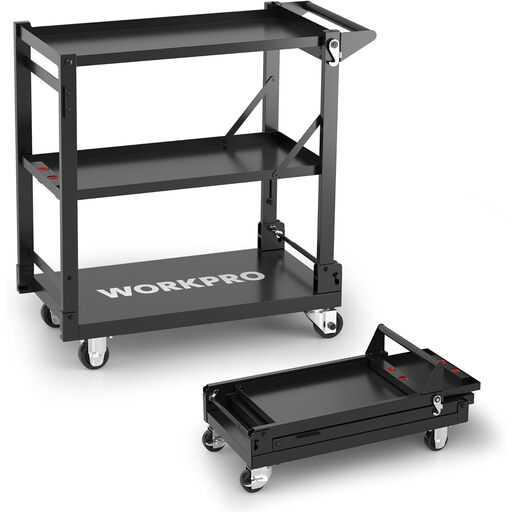
WORKPRO 3-in-1 Folding Steel Service Cart
Why It's a Match: Ideal for anyone who needs maximum flexibility. Whether as a workshop cart in the garage, a transport helper, or a sturdy utility cart in the kitchen—its 3-in-1 function and folding design make it extremely versatile and space-saving.
Solves the problems of limited adaptability and low load capacity. The steel construction is extremely stable and, according to the manufacturer, supports up to 96 kg while in motion. The folding design offers unmatched flexibility.
Three configurations (3-tier, 2-tier, platform cart) in one unit; folds quickly and easily.
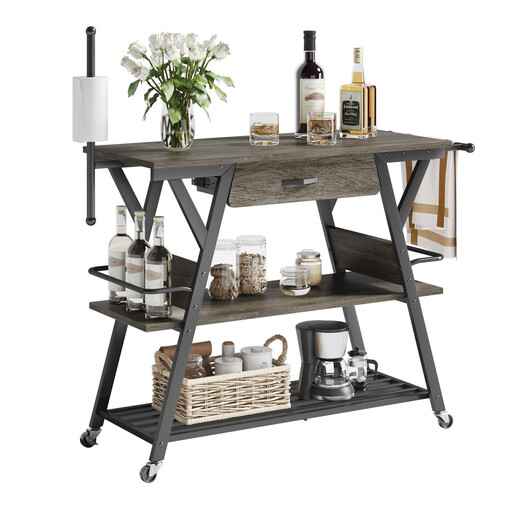
Bestier Serving Cart – Kitchen Cart with Drawer
Why It's a Match: Combines modern industrial design with thoughtful functionality. Perfect as a mobile serving cart in the dining area or as a stylish addition to the kitchen, with practical details like a drawer and towel holder.
The stable Y-frame steel construction prevents wobbling. The low-maintenance surface is practical for daily use and bypasses the problem of delicate materials. The casters with brakes ensure a secure stance.
Smart storage solutions with a drawer, removable tray, and a practical towel holder; stable and visually appealing design.
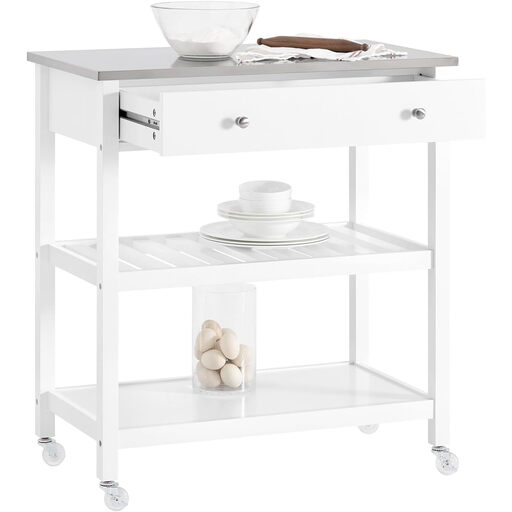
SoBuy Kitchen Trolley with Stainless Steel Countertop
Why It's a Match: Functions as a mobile kitchen island with a durable work surface for food preparation. The combination of a drawer and open shelves offers ample storage for cookware and ingredients.
The stainless steel countertop perfectly solves the problem of impractical surfaces. It is hygienic and easy to maintain. The construction with solid wood legs and a high load capacity of up to 70 kg (according to the manufacturer) prevents instability.
Durable and hygienic stainless steel countertop, ideal for food preparation; high load capacity and stable construction.
Looking for More Options?
We have compiled a complete, up-to-date list of products that fully meet these strict selection criteria and safety standards.
Frequently Asked Questions (FAQ)
How much weight can a kitchen cart hold?
The load capacity varies greatly depending on the model and construction. Simple serving carts often only support 10–15 kg per tier, while more robust models designed as a rolling cart with a countertop can handle a total load of 50 kg, 70 kg, or more. Always check the manufacturer's specified maximum load capacity before purchasing, especially if you plan to place heavy appliances like a microwave on it.
Do I need tools to assemble a serving cart?
Most models are delivered for self-assembly. Typically, the necessary tools, such as an Allen key, and an illustrated instruction manual are included. Assembly is usually straightforward. Some special models, like a folding utility cart, may come pre-assembled and only need to be unfolded.
Are the casters suitable for all floor types?
Most modern kitchen carts are equipped with casters made of PP (polypropylene) or rubber, which are suitable for common floor types like laminate, tile, linoleum, and even low-pile carpets. For sensitive floors such as real wood parquet, you should ensure the casters are labeled as "non-marking." The braking function is crucial on any surface to ensure a secure stance.