
Efficiently Cleaning Baby Bottles: Methods and Product Recommendations for 2026
The hygienic preparation of baby bottles, teats, and breast pump accessories is a fundamental aspect of infant care. Milk and formula residue can become a breeding ground for germs, which is why a structured and reliable cleaning process is essential. This guide analyses the available methods for cleaning baby bottles and presents the technical criteria for selecting suitable products.
Analysis of Cleaning Methods: Manual, Electric, Automatic
The choice of cleaning method depends on individual requirements for time, thoroughness, and mobility. There are three main approaches.
- Manual Cleaning: This is the most basic method, requiring a bottle brush set and washing-up liquid. It offers maximum control over the process and is cost-effective. The downside is that it is time-consuming and requires separate sterilisation, for example, by boiling in a pot.
- Electric Sterilisation and Drying: Electric steam sterilizers use hot steam to achieve thermal disinfection at temperatures around 100°C. This process is commonly known as sterilising baby bottles. Many devices combine this function with a hot-air bottle dryer, which speeds up the entire process and allows for hygienic, dry storage.
- Fully Automatic Cleaning: This class of device combines washing, rinsing, sterilising, and drying in a single, self-contained cycle. They represent the most time-saving solution, minimising manual effort to simply loading and unloading the items.
Technical Selection Criteria for Cleaning Devices
When choosing an electric or automatic device, the following technical parameters should be considered:
- Capacity and Compatibility: The number of bottles that can be processed simultaneously is a crucial criterion. Check whether the device is suitable for different bottle types (standard, wide-neck) and materials (glass, PP, PPSU, silicone), as well as for accessories, which is important for cleaning a breast pump.
- Range of Functions: A dedicated bottle sterilizer performs only one task. Multifunctional devices offer additional modes such as drying, thawing breast milk, or warming baby food. Fully automatic models also integrate a complete washing cycle.
- Sterilisation Method: Steam sterilisation is the established standard. Pay attention to the duration of the sterilisation cycle and its effectiveness, which is often stated as a percentage of germ reduction.
- Drying Function: An integrated hot-air drying function prevents water spots and re-contamination from airborne particles. Systems with HEPA filters offer additional protection by purifying the air used for drying.
- Materials and Safety: The components that come into contact with products should be made from BPA-free plastic or other food-grade materials. A CE marking indicates compliance with EU safety standards.
Our Product Selection for 2026
Based on the technical criteria mentioned above, we have compiled a selection of products that cover different use cases.
Momcozy 8-in-1 Electric Steam Bottle Sterilizer and Dryer
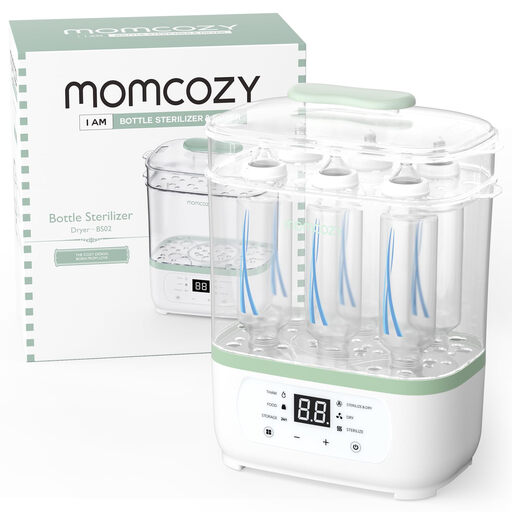
- Why we recommend this product: This device acts as a central hygiene station. It combines the core functions of steam sterilisation and hot-air drying with useful additional features like warming baby food and thawing. Its large capacity makes it an efficient solution for daily use.
- Advantages:
- Multifunctionality: 8-in-1 design (Sterilising, Drying, Thawing, Warming, etc.).
- High Capacity: Holds up to 8 standard baby bottles plus accessories.
- Hygienic Drying: Hot-air drying with an air purification system.
- Easy Operation: Intuitive control panel for selecting the various functions.
- Who it's for: Parents looking for a versatile all-in-one solution that goes beyond simple bottle sterilisation to support the entire feeding process.
Momcozy BS03 Full-Automatic Baby Bottle Washer & Sterilizer
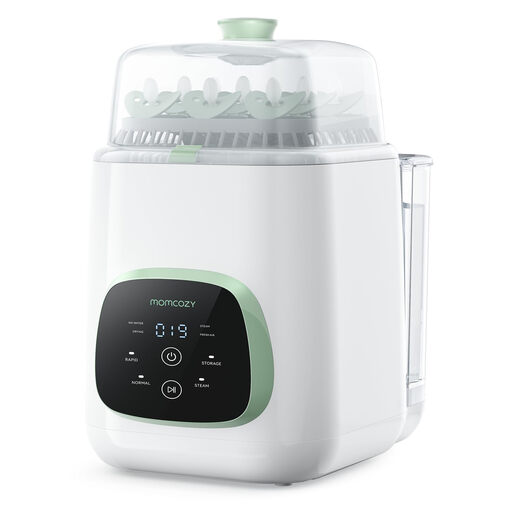
- Why we recommend this product: The BS03 automates the entire cleaning process, from washing to sterile storage. With 26 high-pressure water jets, it achieves a thorough mechanical clean before thermal sterilisation begins. This represents the highest level of automation currently available in bottle care.
- Advantages:
- Fully Automatic Process: Washes, sterilises, dries, and stores in one device.
- Thorough Cleaning: 26 water jets clean bottles inside and out.
- Flexible Modes: 9 combinable cleaning modes, including a 19-minute quick wash cycle.
- Hygienic Storage: Keeps contents sterile and dry for up to 72 hours, supported by an H13 HEPA filter.
- Who it's for: Parents who want to maximise their time savings and prefer a fully autonomous, standardised hygiene process.
Momcozy 7-in-1 Portable Bottle Cleaning Brush Set
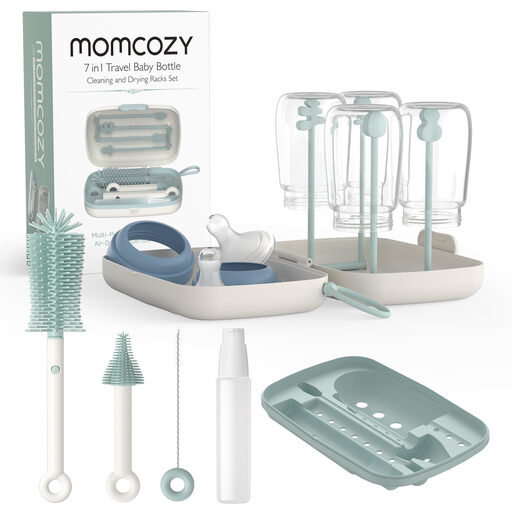
- Why we recommend this product: This set addresses the need for manual cleaning, especially when travelling. It bundles all the necessary tools into a compact, waterproof case, including an integrated drying rack. The use of silicone brushes is gentle on bottle materials.
- Advantages:
- Complete Solution: Includes a bottle brush, teat brush, straw brush, soap dispenser, and drying rack.
- Portability: All components are housed in a compact, travel-friendly case.
- Hygienic Materials: The food-grade silicone brush heads are boil-proof and therefore sterilisable.
- Thoughtful Design: The integrated, foldable drying rack allows for hygienic air-drying of bottles and accessories.
- Who it's for: Families who are often on the go and need a reliable baby travel cleaning set, or as a supplement to an electric device for quick manual cleaning.
Further Options and Accessories
The products featured cover specific use cases. Depending on household size, bottle type, and personal preferences, other models or additional accessories may be more suitable. You can find a wider selection of bottle cleaning devices and accessories in our Baby Bottles category.
Frequently Asked Questions (FAQ)
1. How often do baby bottles need to be sterilised? General recommendations from health organisations advise daily sterilisation of bottles and teats for infants in their first few months of life, especially for premature or immunocompromised babies. After the sixth month, the frequency can often be reduced, but thorough cleaning after each use remains essential.
2. Can baby bottles be cleaned in the dishwasher? Yes, many baby bottles and accessories are dishwasher-safe, if specified by the manufacturer. They should be washed on the top rack at a temperature of at least 65°C to achieve a basic level of germ reduction. However, note that using a dishwasher for baby bottles does not necessarily replace a full, clinical-standard sterilisation. Some parents use the dishwasher for pre-cleaning and then run a short sterilisation cycle in a steam sterilizer.
3. How do you clean breast pump accessories correctly? Breast pump accessories that come into contact with breast milk should be cleaned after every use. Disassemble the pump according to the instructions. First, rinse the parts with cold water to remove milk residue, then wash them in warm, soapy water or in a special basket in the dishwasher. Daily sterilisation, similar to baby bottles, is recommended. Devices like the Momcozy 8-in-1 Sterilizer or the BS03 Washer are explicitly designed to accommodate pump parts as well.