
Heavy-Duty Shelving Buyer's Guide for Basements, Garages & Workshops
A cluttered garage, an overflowing basement, or a workshop where heavy tools and materials have no designated place—these situations call for a sturdy and reliable storage solution. A heavy-duty shelf is designed to safely store heavy items and create lasting order.
This article serves as a guide. It explains the key features you should look for when making your selection and presents various models suitable for different needs. The goal is to provide you with an objective basis for your decision.
What to Look for When Choosing a Heavy-Duty Shelf
To find the right model for your needs, a few technical criteria are crucial. The following points will help you objectively compare the features of different shelving systems.
1. Load Capacity and Material Quality
The most important metric is the load capacity. Manufacturers typically provide two figures: the maximum load capacity per shelf and the total load capacity of the unit. Ensure that the capacity per shelf is sufficient for your heaviest items. A high-capacity shelf usually consists of a robust metal frame, often made of powder-coated or galvanized steel, which protects against corrosion. The shelves are frequently made of medium-density fiberboard (MDF), which helps distribute weight evenly.
2. Assembly System and Flexibility
Modern heavy-duty shelves are usually offered as boltless metal shelving. This system allows for quick and easy assembly without screws. The components simply slot into one another, which significantly simplifies the setup process. A rubber mallet can be helpful. Another advantage is flexibility: many models can be split horizontally to create two half-height shelves or a workbench. Additionally, the shelves are often height-adjustable, allowing you to customize the storage space to fit the size of your items.
3. Dimensions and Application
Before making a decision, precisely measure the available space in your basement, garage, or workshop. Consider not only the width and depth but also the height of the room. A tall garage shelf makes optimal use of vertical space, while a lower basement shelf can fit under sloped ceilings or windows. For storing food or canned goods, a sturdy pantry shelf is ideal, with material properties that ensure clean storage.
Recommended Heavy-Duty Shelving Options
Here is a selection of shelving systems that are well-suited for various applications due to their specific features.
Ochama x SONGMICS 5-Tier Steel Shelf, 875 kg Load Capacity
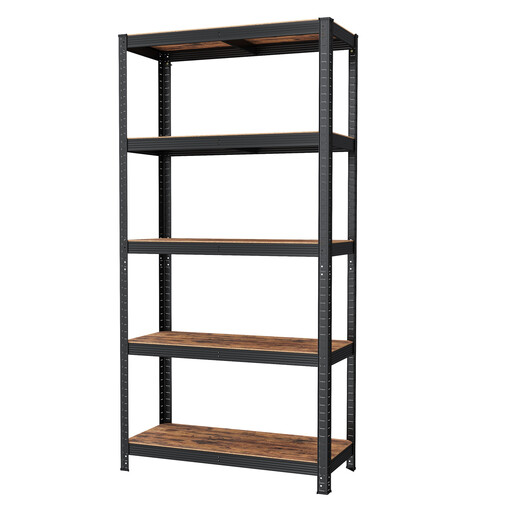
Why it stands out: This model combines a very high total load capacity with an attractive rustic brown and black finish. This makes it suitable not only for traditional utility rooms but also for visible areas in workshops or hobby rooms.
Advantages:
- High total load capacity: Up to 875 kg (175 kg per shelf) with evenly distributed weight.
- Flexible assembly: Can be assembled as one tall shelf or as two separate, half-height units.
- Easy assembly: The boltless system requires no screws.
- Safety: An anti-tip kit for wall mounting is included.
Who is it for? Ideal for users who need high capacity for heavy tools, car tires, or large material crates and who value a sturdy construction. With its dimensions of 90 cm in width and 180 cm in height, it fits well in garages or larger basements.
Ochama Set of 2 Heavy-Duty Shelves, 650 kg Load Capacity Each
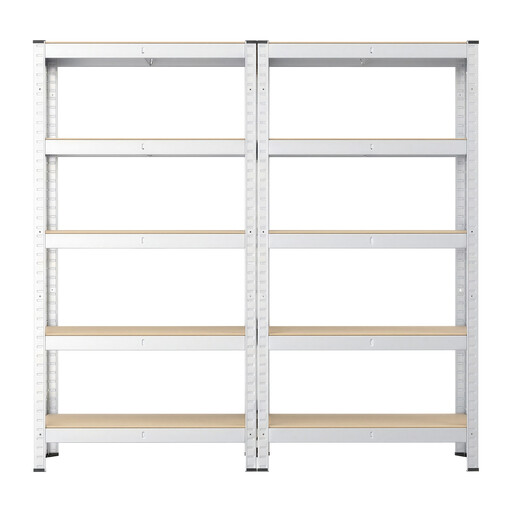
Why it stands out: This set offers a practical solution for those who need more storage space from the start. The two identical shelves can be placed flexibly in the room or combined to create a continuous shelving wall.
Advantages:
- Convenient 2-pack: Two shelves to meet comprehensive organizational needs.
- Solid load capacity: Each shelf supports up to 650 kg (130 kg per shelf).
- Compact dimensions: With a width of 75 cm and a height of 150 cm, these shelves are also suitable for smaller alcoves or rooms with lower ceilings.
- Adjustable shelves: The height of the five shelves can be customized.
Who is it for? This set is a great choice for homeowners or small business owners looking to outfit an entire basement, garage, or a small storage shelf system. The slightly lower height makes it more accessible and versatile.
Ochama 5-Tier Steel Shelf, 750 kg Load Capacity
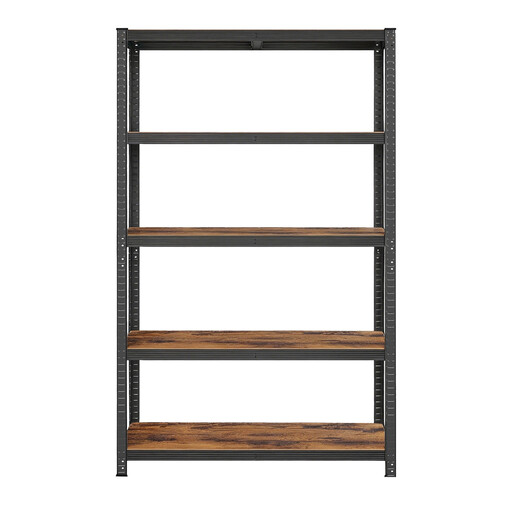
Why it stands out: At 200 cm high and 120 cm wide, this workshop shelf offers maximum storage with a small footprint. The generous 60 cm depth allows for storing particularly bulky items.
Advantages:
- Maximum storage space: The dimensions (200 x 120 x 60 cm) make full use of the room's height.
- High load-bearing capacity: A total load capacity of 750 kg (150 kg per shelf) provides a buffer for heavy loads.
- Deep shelves: The 60 cm depth is ideal for large boxes, machinery, or extensive supplies.
- Splittable: Can also be converted into two workbenches or lower shelves.
Who is it for? Perfect for workshops, warehouses, or garages with high ceilings where every square centimetre counts. Its great depth and width make it the top choice for storing voluminous goods.
Looking for More Options?
Haven't found the right model for your needs yet? There is a wide variety of other shelving systems that differ in size, material, and load capacity.
Discover more garage and storage shelves in our overview.
Frequently Asked Questions (FAQ)
1. Does a heavy-duty shelf need to be mounted to the wall? To increase stability and safety, wall mounting is highly recommended, especially when the shelf is fully loaded or in households with children. For this reason, many manufacturers include an anti-tip kit that allows the shelf to be securely anchored to the wall.
2. How is a boltless heavy-duty shelf assembled? Assembling a boltless shelf is usually possible without special tools. The vertical uprights and horizontal crossbars are connected using precisely fitting slots and tabs. A rubber mallet can help to firmly join the connections. It is recommended to wear work gloves during assembly to prevent injuries from sharp edges.
3. What is the difference between a heavy-duty shelf and a standard basement shelf? The main difference lies in the construction and the resulting load capacity. Heavy-duty shelves are made of thicker, reinforced steel and are designed for a significantly higher load per shelf (often 100 kg and more). Simple household or basement shelves, often made of plastic or thin sheet metal, are only designed for light items like empty boxes or small parts.