
Buying Hawesta Tinned Fish: A Guide to Choosing Products for the Cupboard, Lunch Breaks and Quick Meals
Hawesta tinned fish is a practical choice for many households: it can be stored in portions, served quickly and combined with bread, potatoes or salad. However, products vary considerably in terms of fish species, sauce, pack size, storage requirements and nutritional values. If you only look for terms such as “MSC”, “Asia” or “smoked”, it is easy to overlook important details.
Common pitfalls when buying tinned fish
1. Not every tin is suitable for cupboard storage
The term tinned fish is often used broadly. Some products can be stored unopened at room temperature, while others require uninterrupted refrigeration. For example, the Hawesta MSC Asian Style Tuna Salad 9x160g is labelled for storage at +2 °C to +7 °C. It should therefore not be treated like a conventional tin kept in the cupboard.
Before buying, check the storage temperature, best-before or use-by date, and cold chain requirements. Damaged or swollen packaging should not be placed in your basket.
2. Drained weight and total weight are not the same
For fish in oil or sauce, the total weight refers to the entire contents of the pack. The drained weight shows how much fish remains after the oil or sauce has been removed. Hawesta smoked fish fillets in oil have a net weight of 190 g, but the stated drained weight is only 110 g.
When comparing the prices of individual tins or multipacks, the drained weight is more meaningful than the outer pack size. With multipacks, you should also check whether the stated quantity refers to ten tins or to the pack as a whole.
3. “Sustainable” should be clearly verifiable
A general reference to sustainable fish is no substitute for specific certification. For the Hawesta MSC products included here, the MSC label refers to requirements for certified fisheries. Some products also specify fishing areas, such as the Northeast Atlantic FAO 27 or the Western and Eastern Pacific.
The label should be clearly visible on the product packaging or in the current product listing. It says nothing about taste, nutritional value or health effects. For an informed choice, consider the fish species, fishing area, certification and ingredients list separately.
Parameters to compare before buying
Fish species and preparation
Herring is commonly available as herring fillets in sauce, fried herring or smoked herring. Mackerel fillets are also available smoked, in oil or with tomato sauce. Tuna salad may additionally contain vegetables, cereal products, spices or pulses.
The preparation method affects how the product can be used:
- Herring fillets in sauce go well with bread, potatoes or a simple side dish.
- Fried herring is offered in a tangy marinade with vinegar, onions and tomato ingredients.
- Smoked fish fillets in oil are suitable for bread, salads or a cold meal.
- Tuna salad can be portioned and served straight away, but may require refrigeration depending on the product.
- A ready meal with fish is convenient, but often contains additional ingredients such as sugar, oil, starch or pasta.
Ingredients and allergens
Tinned fish is not automatically free from other allergens. Depending on the variety, it may contain milk, mustard, celery, wheat or egg. For the herring fillets in pepper sauce, fish, celery and milk are listed as allergens present; mustard may be present there in traces. The Hawesta MSC Asian Style Tuna Salad contains wheat and egg, among other ingredients.
If you have an intolerance, always check the current labelling on the packaging. Recipes and product information can change. Similarly, the term “lactose-free” on individual products does not mean that all Hawesta fish products are free from milk ingredients.
Nutritional values and salt content
Sauces and oil can significantly affect nutritional values. According to the product information, Hawesta MSC Herring Fillets in Pepper Sauce contain 216 kcal, 17 g of fat and 12 g of protein per 100 g. The smoked mackerel fillets in rapeseed oil are listed as containing 348 kcal and 32 g of fat per 100 g. Hawesta MSC Mexican Style Tuna Salad contains 178 kcal and 0.9 g of salt per 100 g.
So do not compare only the quantity of fish. Also consider energy, fat, sugar and salt per 100 g. A salad may be practical for a smaller meal, while plain fillets or products with sauce may be more suitable for a versatile store cupboard.
Our selection for different shopping profiles
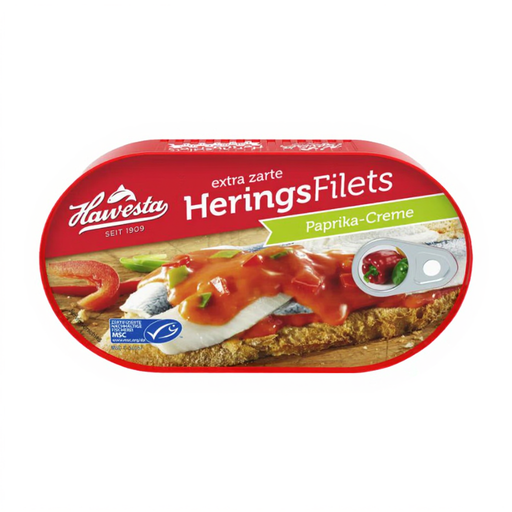
Hawesta MSC Herring Fillets in Pepper Sauce 200g
Why this product suits this profile: The 200-g tin is ideal for a straightforward individual serving and, according to the product information, can be served directly from the cupboard. The sauce combines peppers, tomato purée and spices.
The stated serving size and storage requirements are clearly specified. The product also identifies MSC-certified herring and fishing area FAO 27.
200-g format, ready-to-serve pepper sauce and 12 g of protein per 100 g according to the product information.
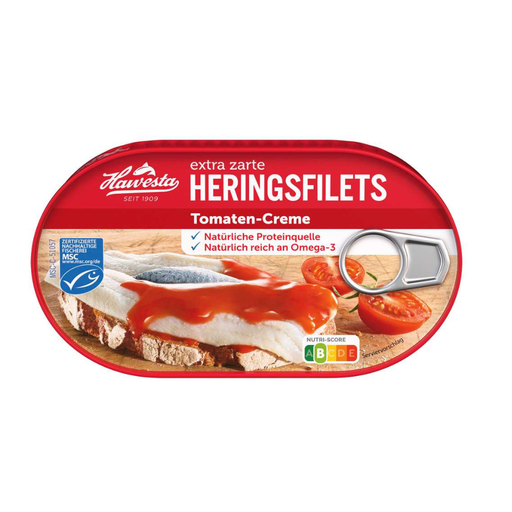
Hawesta MSC Herring Fillets in Tomato Cream Sauce 200g
Why this product suits this profile: The combination of 60% herring fillets and tomato sauce is designed for a classic meal with bread or a side dish. The 200-g format is easy to use in portions.
The product description specifies the fish content, nutritional values and allergens present. This makes it easier to assess the sauce objectively rather than relying on flavour descriptions alone.
60% herring fillets, 214 kcal and 10 g of protein per 100 g according to the product data.
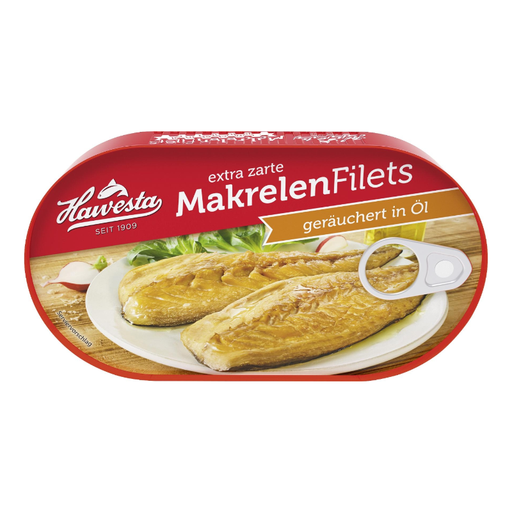
Hawesta MSC Smoked Mackerel Fillets in Pure Vegetable Oil 190g
Why this product suits this profile: The smoked mackerel fillets are intended for salads, open sandwiches or a cold meal. The product contains 190 g, including 133 g of drained weight.
The drained weight prevents the usable quantity of fish from being misjudged. The ingredients list specifies mackerel, rapeseed oil, salt and beechwood smoke.
MSC-labelled mackerel, beechwood smoke and 15 g of protein per 100 g according to the product information.
Looking for more options?
We have put together a complete, regularly updated list of products that fully meet these strict selection criteria and the safety regulations applicable in the EU.
Storage and use after opening
Unopened products should be stored in a dry, cool place, protected from direct sunlight and in accordance with the packaging instructions. After opening, transfer the contents to a non-metallic, sealable container and place it in the fridge. According to the relevant product information, herring fillets in sauce should generally be consumed within two days. Smoked fillets in oil also only keep for a few days.
For chilled tuna salad, the refrigeration temperature is relevant even before opening. An opened pack should be eaten promptly. The best-before date only applies when the product has been stored correctly and the packaging is undamaged.
Frequently asked questions about Hawesta tinned fish
Can unopened Hawesta tinned fish be stored without refrigeration?
This depends on the specific product. Many classic tins of herring fillets should be stored in a cool, dry place. Hawesta MSC Asian Style Tuna Salad, on the other hand, is labelled for storage at +2 °C to +7 °C. You should therefore check the product page and packaging before putting it into storage.
How long does tinned fish keep after opening?
For several Hawesta herring fillet products, consumption within two days is recommended. For smoked fillets in oil, the guidance is “within a few days”. After opening, transfer the contents to another container, cover and refrigerate. The specific instructions on the packaging remain decisive.
How can I identify sustainable fish at Hawesta?
Look for the MSC label and product information about the fish species, fishing area and origin. The Hawesta products listed here are identified as containing MSC-certified, wild-caught fish. The certification describes the certified supply chain, but it is not a general promise of quality or health benefits.