
H7 LED Low Beam Headlights: 2026 Buyer's Guide and Recommendations
Upgrading your vehicle's low beam headlights from halogen to LED technology is a technical decision based on specific performance parameters. An H7 LED low beam headlight can offer superior light output and a different colour temperature compared to conventional halogen lamps. Selecting the right bulb requires an analysis of brightness, cooling system, compatibility, and design to find a functional and durable solution for your vehicle.
Buyer's Guide: Technical Criteria for H7 LED Headlights
The selection of H7 LED bulbs should be based on an objective evaluation of their technical specifications. The following parameters are crucial for making an informed decision.
Brightness (Lumens) and Beam Pattern
A bulb's brightness is measured in lumens (lm), which describes the total luminous flux emitted by a light source. A higher lumen value correlates with greater brightness. However, the beam pattern is more critical than the raw lumen value. A quality H7 LED low beam headlight should precisely replicate the beam pattern of a halogen lamp to create a sharp cut-off line and avoid dazzling oncoming traffic. Look for products where the LED chip layout mimics the filament of a standard H7 halogen bulb.
Colour Temperature (Kelvin)
Colour temperature, measured in Kelvin (K), defines the colour of the light. While halogen lamps typically have a warm white hue around 3200 K, most H7 LED headlights range from 6000 K to 6500 K. This light is perceived as H7 LED white or cool white and closely resembles daylight. A colour temperature of H7 LED 6000K provides high-contrast illumination of the road and gives the vehicle a modern aesthetic.
Cooling System: Fan vs. Passive Cooling
LED chips generate heat that must be dissipated efficiently to ensure their longevity and performance. There are two primary cooling methods:
- Active Cooling: An integrated high-speed fan actively draws heat away from the bulb's body. This allows for high power density in a compact space but can be a potential point of mechanical failure and may produce operating noise.
- Passive Cooling: Heat is dissipated via a heat sink made from materials like aluminium. This method is silent and maintenance-free but often requires a larger form factor.
CAN Bus Compatibility
Modern vehicles monitor headlight bulb function via a CAN bus system. Because LEDs have a lower power consumption than halogen lamps, the system may incorrectly detect a faulty bulb and display an error message on the dashboard. H7 LED Canbus-compatible bulbs have integrated resistors or advanced driver electronics to bypass this issue, ensuring error-free operation in most vehicles.
Design and Installation: Plug and Play
A 1:1 design that matches the dimensions of a standard H7 halogen bulb significantly simplifies installation. These Plug and Play H7 LED models can be fitted directly into the existing socket without any modifications to the headlight housing or the need for additional adapters.
Our Selection of H7 LED Bulbs for 2026
Based on the technical criteria mentioned above, here are a few models that cater to different requirements.
KATUR H7 LED Headlight Bulbs, 80W
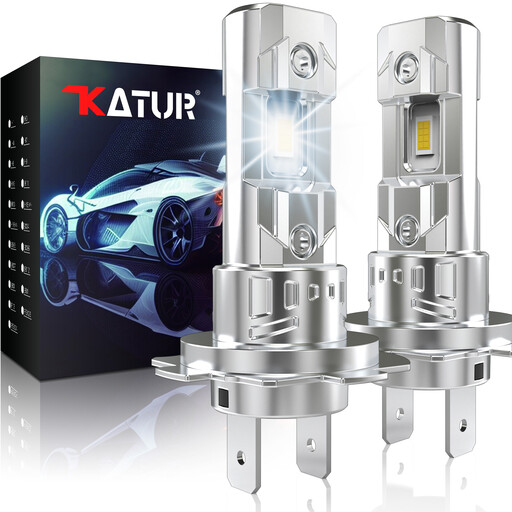
- Why we recommend this product: The KATUR model stands out with its fanless design. Heat is dissipated passively through the bulb's body, which is made of 6063 aviation-grade aluminium. This eliminates operating noise and the potential failure point of a mechanical fan. The 1:1 mini design allows for a straightforward plug-and-play installation.
- Advantages:
- Silent operation thanks to the passive cooling system.
- Compact design that matches a standard halogen bulb.
- 360-degree illumination due to the GC LED chip arrangement.
- Best suited for: Vehicle owners who prefer a completely silent solution and value a simple installation process without any structural modifications.
OUSHI H7 LED Headlight Bulbs, Upgraded
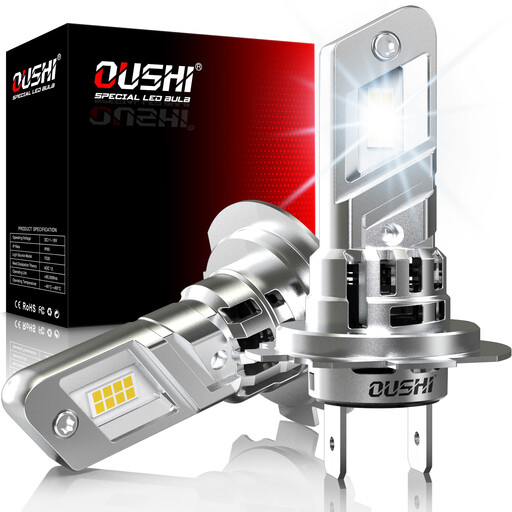
- Why we recommend this product: This model from OUSHI focuses on high light output. According to the manufacturer, it reaches up to 30,000 lumens per pair. To manage the resulting heat, it incorporates an active cooling system with a high-speed turbofan. The manufacturer states that the integrated CAN bus electronics are designed for 98% of vehicle systems, making it an excellent choice for European vehicles with sensitive on-board electronics.
- Advantages:
- Very high light output, according to the manufacturer.
- Active cooling system for consistent performance under heavy load.
- Enhanced CAN bus compatibility to prevent error messages.
- Best suited for: Drivers who seek maximum illumination and own a vehicle with a complex electrical system that requires high CAN bus compatibility.
Bullvision H7 LED Light Bulbs, 6000K
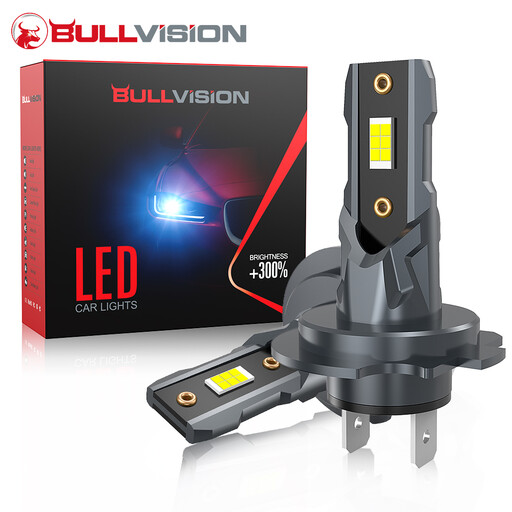
- Why we recommend this product: Bullvision offers a balanced solution, combining a 1:1 design for easy installation with an active cooling system. The manufacturer highlights the precise beam pattern, achieved through close chip spacing, which is designed to reduce glare. An important note from the manufacturer is that an additional CAN bus decoder may be required for certain brands like Volkswagen, Mercedes-Benz, or BMW.
- Advantages:
- Good balance between brightness and a compact design.
- Active fan (10,000 RPM) to ensure longevity.
- Focus on a beam pattern that mimics the original halogen.
- Best suited for: Users looking for a plug-and-play solution with the reassurance of active cooling, who will take note of the specific compatibility information for their vehicle model.
More Options for Automotive LED Bulbs
If the H7 socket type isn't right for your vehicle, or if you're looking for other lighting solutions like fog lights or interior lighting, you can find a wider selection in our White Bulb category.
Frequently Asked Questions (FAQ)
1. Are H7 LED bulbs street legal in Germany? The legal situation is complex. For legal use on public roads in Germany, an LED retrofit bulb must have a specific General Operating Permit (Allgemeine Betriebserlaubnis - ABE) for the exact vehicle model in which it is installed. Many H7 LED bulbs available on the market do not have this approval for every vehicle. Before purchasing and installing, you must verify that a valid ABE exists for the chosen product and your specific vehicle model to ensure compliance with German road traffic regulations (StVZO).
2. What does H7 LED 6000K mean? The designation H7 LED 6000K describes two technical properties. "H7" is the name for the bulb's socket type and design. "6000K" stands for the colour temperature of 6000 Kelvin. This corresponds to a cool, daylight-like white tone that many drivers perceive as high-contrast and modern.
3. Do I need a CAN bus adapter for my H7 LED headlights? Whether an external CAN bus adapter (decoder) is necessary depends on your vehicle model and the chosen LED bulb. Many newer H7 headlight bulbs with LED technology already have a CAN bus function integrated ("CAN bus ready"). However, with particularly sensitive vehicle systems, especially from European manufacturers, error messages can still occur. In this case, installing an additional decoder is required. Some manufacturers, like Bullvision, explicitly point this out.