
Patio Umbrella Buying Guide 2026: Models and Selection Criteria
Choosing a patio umbrella is a decision that should be based on technical specifications and your specific use case. The right model not only protects against direct sunlight but also enhances the functional usability of your garden, terrace, or balcony. The key differentiators lie in the construction, material, size, and operation.
Buying Guide: Technical Selection Criteria
The decision for a patio umbrella depends on objective factors. An analysis of the following points will help you identify the right model for your requirements.
Umbrella Type: Cantilever, Center-Pole, or Half-Balcony Umbrella?
- Center-Pole Umbrella: The classic umbrella type, where the pole is positioned centrally under the canopy. It is suitable for placement in a table with a corresponding opening or in combination with a mobile umbrella stand.
- Cantilever Umbrella: With this model, the pole is located to the side, and the canopy hovers freely over the area to be shaded. This allows for flexible use of the space directly under the umbrella without a pole getting in the way. A cantilever umbrella with a 3m diameter provides generous shade coverage for seating areas.
- Half-Balcony Umbrella: This design is specifically conceived for small balconies or narrow terraces. The umbrella has a straight side, allowing it to be placed directly against a house wall for maximum space efficiency.
Material and Construction: Stability and Durability
- Frame: Aluminum frames are lightweight and corrosion-resistant. Powder-coated steel offers high stability but can be more susceptible to rust if the coating is damaged. The material thickness of the pole and ribs is an indicator of wind stability.
- Canopy: Most umbrella canopies are made of polyester with a fabric weight between 160 and 250 g/m². A higher grammage indicates more robust quality. A water-repellent coating provides short-term protection against light rain showers. The crucial factor is the UV protection, often specified as UPF (Ultraviolet Protection Factor). A UPF of 50+ means that less than 1/50th of UV radiation penetrates the fabric.
Operating Mechanism and Features
- Crank Mechanism: A patio umbrella with a crank can be opened and closed with minimal effort. This is a key comfort feature, especially for large-diameter umbrellas.
- Tilt Function: A balcony umbrella that is tiltable allows the canopy to be angled against the low-lying sun in the morning or evening. This maximizes shade coverage throughout the day.
- Additional Features: Some models offer integrated lighting, such as a patio umbrella with LED, powered by a solar panel. This creates a pleasant atmosphere in the evening hours.
Our Selection of Patio Umbrellas for 2026
The following models are distinguished by specific technical features that qualify them for different applications.
1. Schneider Umbrella Rhodos Blacklight 300/8
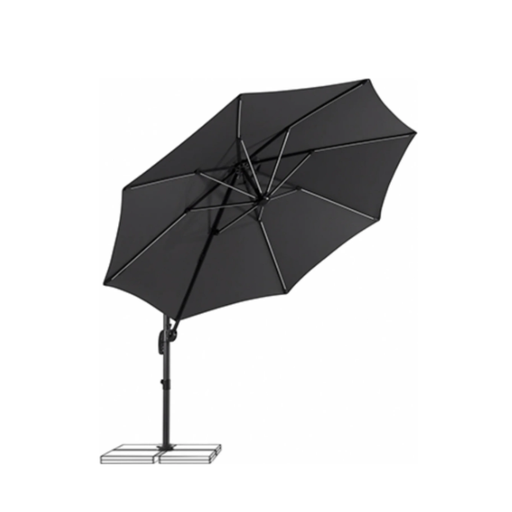
Analysis & Recommendation: The Schneider Rhodos Blacklight is a classic cantilever umbrella with a diameter of 300 cm. Its design allows for unobstructed placement of furniture underneath. The powder-coated aluminum frame in anthracite is robust and weather-resistant. A particularly functional feature is the 360° rotation via a foot pedal, which allows for easy alignment with the sun's position. According to the manufacturer, the 100% polyester canopy is rot-proof and has a water-repellent coating. The UV protection has been tested according to the AS/NZS4399 standard.
Pros:
- Large shade area due to 3 m diameter
- Flexible positioning thanks to 360° rotation and tilt adjustment
- Sturdy aluminum frame
- Includes a protective cover and a cross base (slabs not included)
Best suited for: Users with large terraces or garden areas who are looking for a flexible and extensive shading solution for seating groups or loungers.
2. Schneider Schirme Salerno mezza 150x150cm
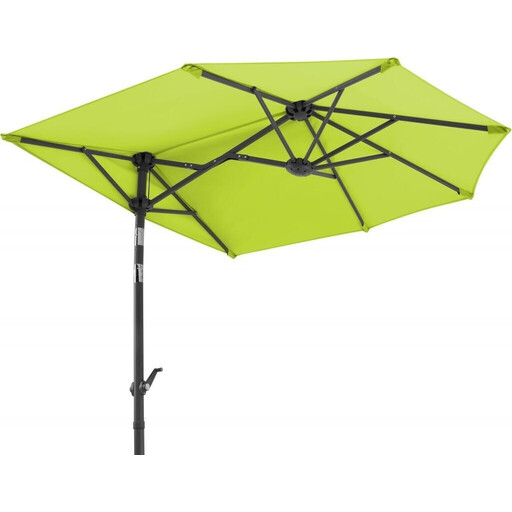
Analysis & Recommendation: The Salerno mezza is designed as a half-balcony umbrella and represents a space-saving solution for balconies and narrow terraces. With its dimensions of 150x150 cm, it can be placed directly against a wall. It is operated via a smooth-running patio umbrella with a crank. A metal tilt joint allows the canopy to be angled in two directions, making it a functional tiltable balcony umbrella. According to the manufacturer, the polyester canopy (approx. 180 g/m²) offers UV protection of 50+ in accordance with the AS/NZS4399 standard.
Pros:
- Space-saving design for balconies and alcoves
- Easy operation via crank mechanism
- Bi-directional tilt function to adapt to the sun's position
- High UV protection factor (UPF 50+)
Best suited for: Apartment dwellers with small to medium-sized balconies or narrow terraces who need efficient, flush-to-wall shading.
3. OUTFIT Patio Umbrella with Solar LED Ø3m
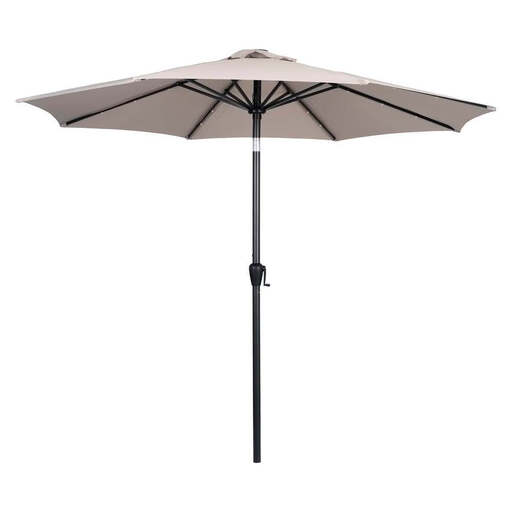
Analysis & Recommendation: This model from OUTFIT is a center-pole umbrella with a 3 m diameter that serves a dual function: sun protection by day and lighting by night. Solar-powered LEDs are integrated into the eight steel ribs, supplied with energy from a panel at the top of the umbrella. The umbrella features a crank function for opening and a side tilt function. The 180 g/m² polyester canopy offers a UV protection of 30, according to the manufacturer. The pole is made of aluminum with a diameter of 48 mm.
Pros:
- Integrated patio umbrella with LED lighting for evening use
- Convenient handling with crank and tilt function
- Large diameter for comprehensive shade
- LEDs powered by a solar panel
Best suited for: Users who want to enjoy their terrace or garden area after sunset and appreciate atmospheric, integrated lighting without an additional power source.
Discover More Models
The products presented here represent a selection tailored to specific requirements. For a broader overview of models, sizes, and designs, you can browse our entire range of Patio Furniture Umbrellas.
Frequently Asked Questions (FAQ)
1. What UV protection factor is recommended for a patio umbrella? A high UV Protection Factor (UPF) is an important quality indicator. A UPF of 50+ means the fabric blocks more than 98% of UV radiation. This is often tested according to standards like the Australian/New Zealand standard AS/NZS4399. Models with a UPF of 30 to 50 already offer good protection.
2. How do I secure a patio umbrella safely? Stability is fundamental. The minimum recommended weight for the umbrella base is specified by the manufacturer and must be adhered to. For an umbrella with a 3 m diameter, base weights of 40 kg or more are often required. Cantilever umbrellas frequently use cross bases that must be weighted down with four concrete or granite slabs (e.g., 50x50 cm). The umbrella must always be closed during strong winds or storms.
3. What does "water-repellent" mean for a patio umbrella? A water-repellent coating causes water to bead off the fabric during light rain, preventing it from soaking through immediately. However, it does not offer complete protection during prolonged or heavy rainfall. A patio umbrella is primarily for sun protection, not a rain umbrella. To prevent mildew and material damage, the umbrella should only be closed and stored when completely dry.