
Gaming TVs 2026: A Technical Guide for Your Purchasing Decision
Selecting a TV for gaming applications in 2026 requires an analysis of specific technical parameters that extend beyond the criteria for a conventional television. Factors such as refresh rate, latency, connectivity standards, and panel technology are crucial for a responsive and visually immersive gaming experience. This guide focuses on the objective specifications relevant to discerning users of consoles like the PlayStation 5 and Xbox Series X, as well as PC gamers.
Buyer's Guide: What to Look for in a Gaming TV
The choice of a model should be based on a consideration of the following technical features.
Refresh Rate (Hz) and Variable Refresh Rate (VRR)
The refresh rate, measured in Hertz (Hz), indicates how many times the image is updated per second. While 60 Hz was the standard for a long time, 120Hz TVs or even 144Hz TVs are now the norm for smooth gaming. A higher frequency allows for sharper depiction of fast motion and reduces motion blur.
Closely related is VRR (Variable Refresh Rate). This technology dynamically synchronises the TV's refresh rate with the frame rate output by the console or PC. The result is the elimination of screen tearing and stuttering, leading to consistently smooth gameplay. Standards such as AMD FreeSync Premium Pro and NVIDIA G-Sync are relevant certifications in this regard.
Connectivity: The HDMI 2.1 Standard
An HDMI 2.1 TV is a fundamental requirement for modern gaming setups. Only this standard provides the necessary bandwidth (up to 48 Gbps) to transmit 4K signals at 120 Hz. Furthermore, HDMI 2.1 supports other features crucial for gamers:
- Auto Low Latency Mode (ALLM): The TV automatically switches to the lowest latency mode as soon as a console is detected.
- Variable Refresh Rate (VRR): As described above, for smooth image rendering.
- Enhanced Audio Return Channel (eARC): Enables the transmission of uncompressed audio formats like Dolby Atmos to a compatible soundbar or AV receiver.
Therefore, a TV for PS5 or Xbox Series X must have at least one HDMI 2.1 port.
Panel Technology: OLED vs. QLED with Mini-LED
The choice of display technology directly impacts contrast, brightness, and colour reproduction.
- OLED TVs: Organic Light-Emitting Diodes generate their own light. Each pixel can be turned on and off individually. This results in perfect black levels and a theoretically infinite contrast ratio. Response times are extremely fast, which is advantageous for gaming.
- QLED TV with Mini-LED: This technology uses a backlight composed of thousands of tiny Mini-LEDs grouped into zones (Local Dimming). A QLED filter with Quantum Dots ensures a very wide and precise colour gamut. These models often achieve higher peak brightness than OLEDs, which is particularly beneficial in bright rooms and for HDR content.
Sound Technology and Smart Features
While many gamers use external sound systems or headsets, high-quality integrated speakers are gaining importance. Formats like Dolby Atmos create a three-dimensional soundscape that enhances immersion. A modern Smart TV with a responsive operating system (e.g., Google TV or webOS) and access to all relevant streaming apps completes the package.
Our Top Picks for 2026
Based on the technical criteria mentioned above, here is a selection of models that are particularly well-suited for gaming applications.
TCL 65Q6C QLED Mini LED TV, 65-inch
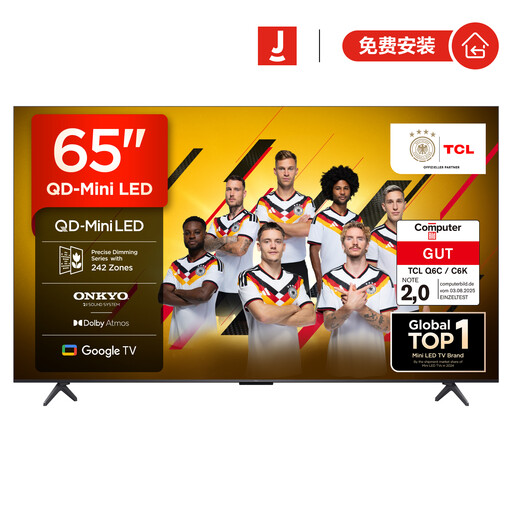
Why we recommend this product The TCL 65Q6C combines QD-Mini LED technology with a native 144 Hz refresh rate. Support for AMD FreeSync Premium Pro and the comprehensive gaming features of its "Game Master" mode make it a powerful device for PC and console gamers. The integrated 2.1-channel Onkyo sound system with Dolby Atmos delivers solid audio performance without requiring additional hardware.
Pros:
- 144Hz Motion Clarity Pro and VRR for extremely smooth motion.
- QD-Mini LED technology for high contrast and a peak brightness of 1000 nits.
- Comprehensive gaming features: HDMI 2.1, ALLM, AMD FreeSync Premium Pro.
- Integrated Onkyo 2.1 sound system with Dolby Atmos.
- Smart TV with Google TV, Google Assistant, and Alexa compatibility.
Who it's for: This model is aimed at gamers looking for a high refresh rate and modern gaming features in a 4K TV, who also value a balanced price-to-performance ratio.
TCL 65Q7C QLED Mini LED TV, 65-inch
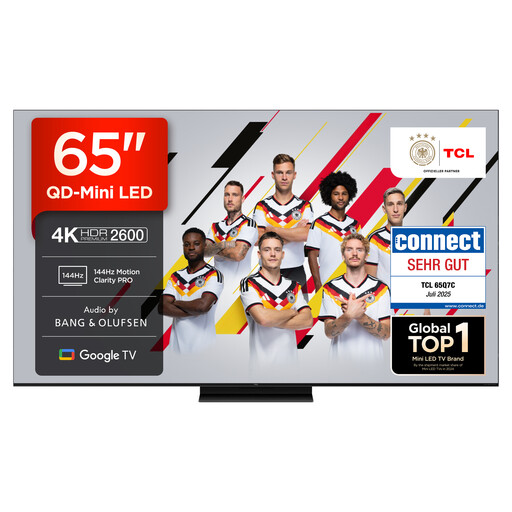
Why we recommend this product The TCL 65Q7C elevates performance with a higher peak brightness of up to 2600 nits and an integrated 6.2.2 sound system by Bang & Olufsen. This combination of visual brilliance and high-fidelity audio reproduction positions the device in the premium segment. The gaming specifications, with 144Hz VRR and HDMI 2.1, are identical to the Q6C but offer a more intense HDR experience thanks to the increased brightness.
Pros:
- Very high peak brightness (up to 2600 nits) for impressive HDR gaming.
- Integrated 6.2.2 sound system by Bang & Olufsen for immersive audio.
- 144Hz VRR, HDMI 2.1, and AMD FreeSync Premium Pro.
- IMAX Enhanced certification for cinematic image quality.
- Ultra-slim, bezel-less design.
Who it's for: Users who want to make no compromises on picture and sound quality and are looking for an all-in-one device for high-end gaming and home cinema will find a fitting solution here.
LG 77” OLED evo 4K Smart TV (OLED77C67LA)
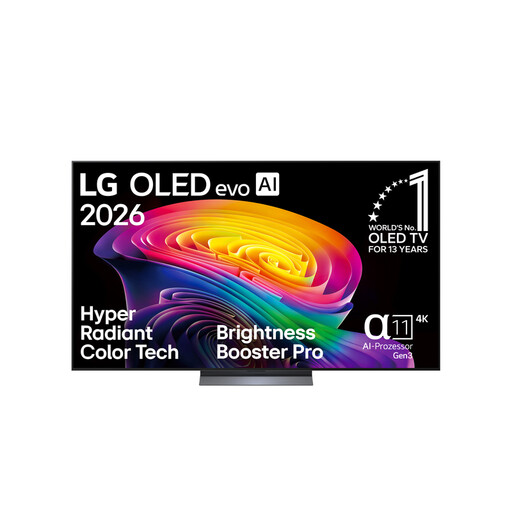
Why we recommend this product This OLED TV from LG leverages the strengths of its self-emissive pixels for perfect contrast and colour accuracy. A standout feature is its support for VRR up to 165 Hz, making it particularly appealing for PC gamers. Compatibility with NVIDIA G-Sync and AMD FreeSync Premium, along with four HDMI 2.1 ports, underscores its dedicated focus on gaming. The α11 AI Processor optimises picture and sound in real-time.
Pros:
- OLED panel for perfect black levels and infinite contrast.
- Support for VRR up to 165 Hz, ideal for high-end PC gaming.
- Compatible with NVIDIA G-Sync and AMD FreeSync Premium.
- Four HDMI 2.1 ports for maximum connectivity.
- webOS Smart TV platform with personalised recommendations.
Who it's for: This model is designed for image quality purists. Gamers and home cinema enthusiasts who appreciate the best possible contrast and the extremely fast response times of OLED technology will find what they are looking for here.
Other Options with an Audio Focus
If your main focus is on outstanding integrated audio performance that goes beyond the models featured here, you can find more specialised devices in our TVs with Premium Sound category.
Frequently Asked Questions (FAQ)
1. What is more important for a gaming TV: 4K or 144Hz? Both address different aspects of the gaming experience. 4K (resolution) provides a sharp and detailed picture. 144Hz (refresh rate) ensures smooth and responsive motion handling. For competitive and fast-paced games (e.g., first-person shooters), a high refresh rate often takes higher priority. For graphically rich single-player titles, 4K resolution can be more important. Ideally, modern gaming TVs offer both.
2. Do I really need HDMI 2.1 for the PS5? Yes, to unlock the full potential of the PlayStation 5, an HDMI 2.1 TV is required. Only this standard enables games to be displayed in 4K resolution at 120 frames per second (fps). Features like VRR and ALLM, which further enhance the gaming experience, are also tied to the HDMI 2.1 standard.
3. What is the difference between OLED and QLED for gaming? An OLED TV, with its self-emissive pixels, offers unparalleled contrast and extremely fast pixel response times, which minimises motion blur. A QLED TV, especially one with a Mini-LED backlight, can achieve significantly higher peak brightness, which makes HDR content look more impressive and is advantageous in bright rooms. Furthermore, with QLED panels, there is no risk of burn-in from static image elements. The choice depends on personal priorities and the viewing environment.