
Folding Table Buying Guide: How to Choose the Right Space-Saving Table
By Joybuy Product Recommendation Officer, July 29, 2026
Living space is a valuable commodity, especially in urban areas. A folding table seems like the ideal solution for adding functionality without permanently sacrificing space. However, the market is flooded with models whose practical utility often falls short of their marketing promises. Many buyers quickly discover that their new table wobbles, the surface wears out quickly, or it's unwieldy when folded.
This guide focuses on the critical features that distinguish a good folding table from a useless one. We'll highlight the most common design flaws and show you what to look for to make an informed decision for your home, office, or recreational activities.
The 3 Most Common Flaws in Folding Tables
Before choosing a model, it's important to know the typical weak points that often only become apparent with everyday use.
- Unstable Folding Mechanisms: A common problem is low-quality hinges and locks. After just a few weeks of use, they lose their rigidity, causing the table to wobble and providing an unsafe surface for working or dining. A robust mechanism is crucial, especially for tables that are set up and taken down daily.
- Inferior Surface Materials: Many budget-friendly tables use thinly coated particleboard, which is extremely susceptible to scratches, dents, and moisture. A single spilled glass of water can cause the top to swell, rendering the table unusable. For use as a folding dining table or folding desk, a resilient surface is essential.
- Misleading Space-Saving Claims: A table that folds is not automatically space-saving. Some models are still bulky and heavy when folded, making them difficult to store. A well-thought-out design also considers storage and transport.
Crucial Parameters for Making the Right Choice
To avoid a bad buy, you should carefully examine three core aspects. These determine the longevity and functionality of your folding table.
1. Mechanism and Load Capacity
The folding mechanism is the heart of the table. Look for solid metal hinges and a clearly defined locking mechanism that audibly clicks into place.
- Freestanding Tables: Models with folding legs should have safety rings or clips to prevent accidental collapse.
- Wall-Mounted Tables: For a wall-mounted folding table, the quality of the wall bracket and hinges is critical. Stability here depends directly on correct installation and the condition of the wall.
- Load Capacity: The maximum load capacity specified by the manufacturer is a key indicator of stability. For a workstation holding a monitor and other devices, the load capacity should be at least 30 kg. A sturdy camping table or multi-purpose table can handle significantly more.
2. Material and Dimensions
The material of the tabletop and frame determines its durability and intended use.
- Tabletop: High-Pressure Laminate (HPL) or melamine-coated boards (often classified as PB or MDF with an E1 standard for low emissions) offer good resistance to scratches and moisture. For outdoor use, tops made of UV-protected high-density polyethylene (HDPE) are a great choice.
- Frame: Powder-coated steel frames provide high stability and are protected against rust. Aluminium is lighter and therefore advantageous for portable tables like a camping table.
- Dimensions: Measure not only the available space for the unfolded table but also the storage space for its folded state. A small desk for small rooms should have the slimmest possible depth when folded.
3. Additional Features for More Flexibility
Modern folding tables often offer more than just a flat surface.
- Height Adjustability: A height-adjustable table can adapt to various uses—from a child's table to a standing workstation.
- Integrated Storage: A wall-mounted folding table with a shelf provides extra space for books, office supplies, or decor, thus maximising space efficiency.
- Extendibility: Some models designed as a folding dining table can extend from a small console to a large table, offering maximum flexibility.
Recommended Options for Every Need
Here are some models tailored to specific user profiles that meet the criteria mentioned above.
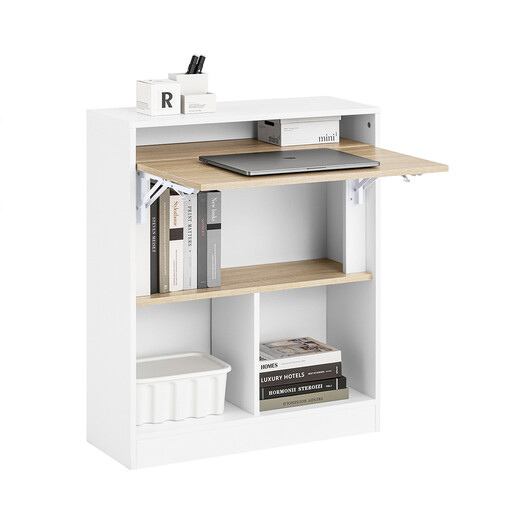
SoBuy Wall-Mounted Folding Desk with 5 Shelves
Why it's a good fit: Ideal for those who need a fully functional workspace in a small apartment that completely disappears after hours. The combination of a desk and shelf makes optimal use of wall space.
The secure wall mounting eliminates the problem of wobbly legs (Flaw 1). By integrating storage, it's a true space-saving solution, not just a foldable board (Flaw 3).
Combines a work surface and storage in one unit. According to the manufacturer, the construction offers a high load capacity of up to 81 kg.
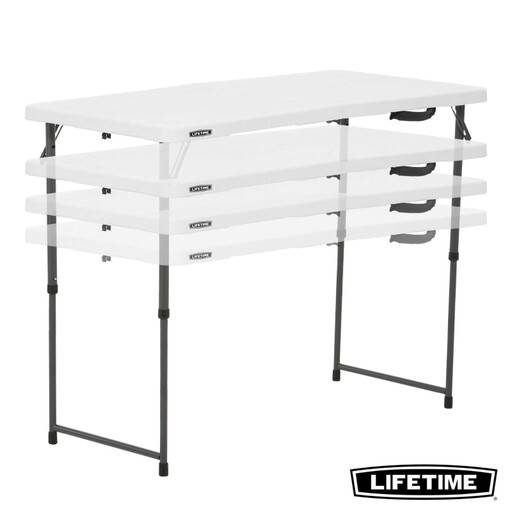
Lifetime 122x60 cm Height-Adjustable Folding Table
Why it's a good fit: Perfect for flexible use in the garden, for camping, at parties, or as a temporary work table. Its robust, weather-resistant construction and height adjustment make it extremely versatile.
The HDPE tabletop is stain and weather-resistant, countering the problem of inferior surfaces (Flaw 2). The design, which folds in the middle and includes a carrying handle, is truly portable (Flaw 3).
Adjustable to four height levels (56 cm to 91 cm). The UV-protected top and rust-resistant steel frame allow for both indoor and outdoor use.
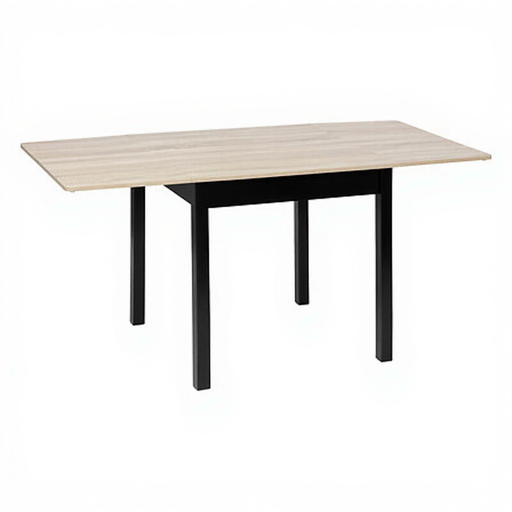
5five Extendable Folding Table
Why it's a good fit: Transforms from a compact console into a dining table for up to six people. A practical solution for apartments where a large dining table is only needed occasionally.
The integrated extension mechanism is designed for stability when extended, avoiding the wobbling issues of simple folding tables (Flaw 1). The design is built for dual functionality, not compromise.
Serves as both a space-saving console and a full-fledged dining table. Its minimalist design complements many modern interior styles.
Looking for More Options?
We have compiled a complete, up-to-date list of products that meet these strict selection criteria and relevant standards.
Frequently Asked Questions (FAQ)
1. How do you securely mount a wall-mounted folding table?
Secure mounting is crucial. Always use the appropriate wall plugs and screws for your wall type (e.g., concrete, drywall, brick). Check the wall's load-bearing capacity beforehand. A spirit level is essential to align the table perfectly horizontally and prevent an uneven load on the hinges. If in doubt, the installation should be carried out by a professional.
2. What is the average load capacity of a folding table?
The load capacity varies widely depending on the model and construction. Simple, lightweight camping tables often only support 15–30 kg. In contrast, a solid folding desk or a wall-mounted folding table made of robust materials can be designed for 35 kg to over 80 kg. Always check the manufacturer's specifications to ensure the table is suitable for its intended purpose.
3. Can a folding table be used as a permanent dining table?
Yes, as long as the model is designed for it. Look for tables with a stable, securely locking frame and a durable, easy-to-clean surface (e.g., HPL coating). Freestanding, extendable models are often better suited for this purpose than simple folding-leg tables, as they typically offer greater stability and a larger tabletop area.