
Fast-Charging Power Banks: Top Picks for 2026
The need to keep mobile devices powered on the go is a technical reality. An external battery with fast charging is an effective solution for this. Choosing the right model depends on specific, measurable parameters tailored to your individual use case. This article analyses the technical criteria relevant for selecting a power bank with fast-charging capabilities and presents a selection of models with varying specifications.
Buying Guide: Technical Selection Criteria
The performance of a portable charger is determined by a combination of its capacity, charging speed, ports, and form factor.
Capacity (mAh): The Energy Reserve
Capacity, measured in milliampere-hours (mAh), indicates how much electrical charge a power bank can store. The choice of capacity should be based on the energy requirements of the devices you need to charge.
- Up to 5,000 mAh: These models are typically very compact and lightweight. They are suitable for an emergency top-up or a single full charge of a modern smartphone. Such a small power bank is ideal for daily commutes or short trips.
- 10,000 mAh: A 10,000mAh power bank represents a balance between portability and performance. It can charge most smartphones approximately 1.5 to 2.5 times, making it suitable for day trips or short business travels.
- 20,000 mAh and above: Models with this capacity are designed for extended travel or for charging more power-hungry devices like tablets or laptops. A laptop power bank typically requires at least this capacity to provide a significant charge.
Charging Power (Watts) and Protocols (PD, QC)
The fast-charging capability is defined by the output power in watts (W) and the supported charging protocols.
- Power Delivery (PD): This is a universal fast-charging standard that operates via the USB-C port. It enables high power outputs of up to 100W or more, which is necessary for rapidly charging smartphones, tablets, and laptops (e.g., MacBooks).
- Quick Charge (QC): A standard developed by Qualcomm, predominantly found in Android smartphones. Many modern power banks support both protocols for maximum compatibility.
A power output of 20W or more is required for fast-charging current iPhones. For laptops, 65W to 100W is a common requirement.
Ports and Additional Features
The type and number of ports determine the power bank's versatility.
- Power Bank with USB-C: A USB-C port that functions as both an input and an output (bidirectional) is now standard. It typically supports Power Delivery.
- Wireless Power Bank: Models with Qi charging capability allow for the wireless charging of compatible devices. A MagSafe power bank also uses magnets for precise and secure alignment with compatible iPhones.
- Power Bank with Integrated Cable: A built-in cable increases convenience, as there is no need to carry a separate one. This is often a USB-C or Lightning cable.
Our Top Picks for 2026
Based on the technical criteria mentioned above, we present three models with different specialisations.
1. BASEUS 10000mAh Magnetic Mini Wireless Fast Charge Power Bank 30W
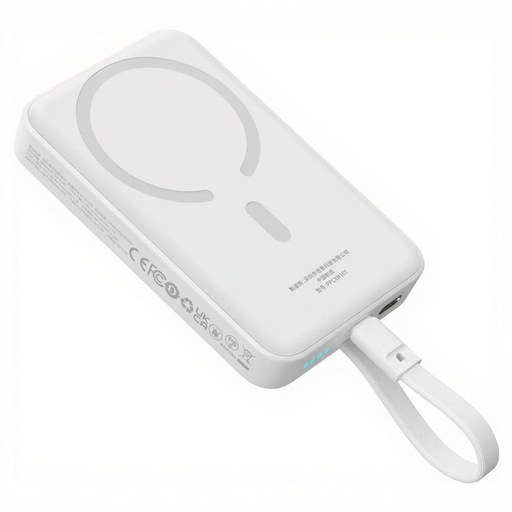
Why We Recommend It This model combines a moderate 10,000 mAh capacity with versatile charging options. Wired charging via USB-C reaches up to 30W, while the wireless charging function with MagSafe compatibility delivers up to 15W. The integrated USB-C cable enhances its practicality.
- Key Specs:
- Capacity: 10,000 mAh (Rated Capacity 5,800 mAh)
- Charging Power: Up to 30W via USB-C (PD), up to 15W wireless
- Features: MagSafe power bank, power bank with integrated cable (USB-C)
- Ports: 1x USB-C (In/Out), 1x integrated USB-C cable (In/Out)
- Best For:
- Users of iPhone 12 series and newer, and other MagSafe-compatible devices.
- Individuals seeking a balanced solution of capacity, speed, and convenience for daily use.
2. ASPERX Laptop Power Bank 20000mAh
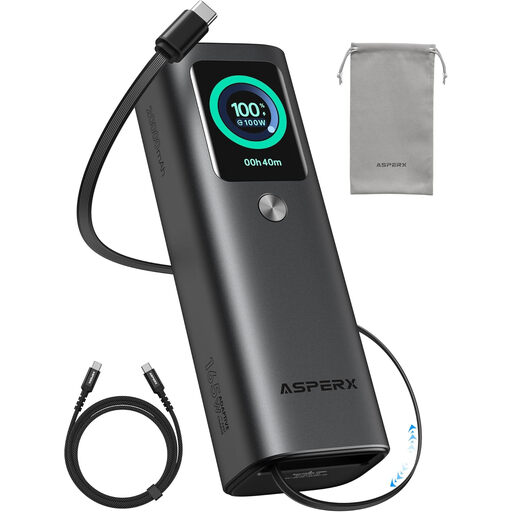
Why We Recommend It With a total output of 165W and two PD-capable USB-C ports (100W + 65W), this model is explicitly designed as a laptop power bank. Its 20,000 mAh capacity and integrated, retractable USB-C cable make it a powerful tool for professionals and travellers. The TFT display for showing charging data is a functional detail.
- Key Specs:
- Capacity: 20,000 mAh / 74 Wh (airline-approved)
- Charging Power: 165W total output, up to 100W on a single USB-C port
- Features: Simultaneous charging for two laptops, TFT display, integrated 60 cm USB-C cable
- Ports: 2x USB-C (bidirectional), 1x USB-A
- Best For:
- Users who need to charge laptops like MacBook Pro, Dell, or HP on the go.
- Tech-savvy users who want to power multiple devices simultaneously at high speed.
3. DigiEra Magnetic Wireless Power Bank 5000mAh
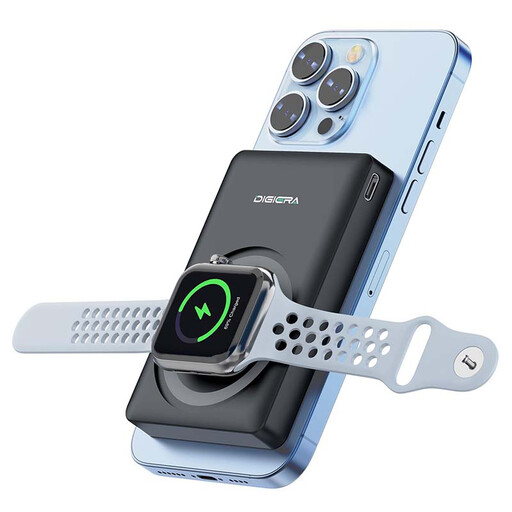
Why We Recommend It This model focuses on maximum portability. With a 5,000 mAh capacity and a weight of just 123 grams, it is an extremely small power bank. It supports 20W wired charging via USB-C and 15W magnetic wireless charging. A unique feature is its mode for use as a magnetic SSD enclosure.
- Key Specs:
- Capacity: 5,000 mAh (Rated Capacity 3,000 mAh)
- Charging Power: Up to 20W via USB-C (PD), up to 15W wireless
- Features: Compact design, MagSafe compatibility, SSD enclosure mode
- Dimensions: 99 × 66 × 13 mm, 123 g
- Best For:
- Minimalists and iPhone users looking for a lightweight, pocket-sized backup solution.
- Users who need a discreet power bank for iPhone that attaches magnetically during use.
Other Options and Accessories
The full performance of a power bank can only be realised with the right cables. To make optimal use of the fast-charging capabilities of both devices and power banks, a high-quality cable is essential. You can find a selection of certified cables in our fast charging USB C cable category.
Frequently Asked Questions (FAQ)
1. What does "fast charging" mean for a power bank? A fast-charging feature means the power bank can deliver a high power output (measured in watts) via specific protocols like USB Power Delivery (PD) or Quick Charge (QC). This allows compatible devices, such as smartphones or laptops, to be charged in significantly less time than with a standard charger (typically 5W).
2. How many mAh should a power bank have? The required capacity depends on your intended use. For an emergency smartphone top-up, 5,000 mAh is sufficient. For daily use and multiple smartphone charges, 10,000 mAh is a good benchmark. For charging laptops or for multi-day trips without access to a power outlet, 20,000 mAh or more is recommended.