
Wallbox Buyer's Guide 2026: Finding the Right Charging Station for Your EV
Purchasing a private EV charging station is a decision driven by technical parameters and individual needs. Choosing the right system depends on your existing electrical setup, vehicle type, and desired convenience features. This article breaks down the key criteria to consider when selecting a wallbox or a mobile charging solution.
Technical Criteria for Your Charging Solution
The choice of a charging solution is based on an analysis of your technical environment and usage profile. The following factors are of central importance.
Charging Power: 11 kW vs. 22 kW Wallbox
Charging power, measured in kilowatts (kW), determines the speed at which the vehicle's battery is charged.
- 11 kW Wallbox: This is the common standard for residential use. An 11 kW wallbox can fully charge most electric cars overnight. In many regions, installing an 11 kW wallbox simply requires notifying the local grid operator.
- 22 kW Wallbox: A 22 kW wallbox offers double the charging power and can cut charging time in half. This is beneficial for vehicles with large batteries or for users with short dwell times. Installation of a 22 kW wallbox often requires a permit from the grid operator. Furthermore, the vehicle's on-board charger must support this power level to take full advantage of it.
Connection Type: Single-Phase vs. 3-Phase
The number of phases in your electrical connection influences the maximum possible charging power.
- Single-phase: Single-phase chargers use one phase of the home's electrical supply. In some regions, regulations on unbalanced loads may limit single-phase charging power (e.g., to 4.6 kW or 20 A), even if the charger is technically capable of more.
- 3-Phase Wallbox: Three-phase chargers use all three phases of a three-phase connection. This enables higher charging capacities of 11 kW (16 A per phase) or 22 kW (32 A per phase) and ensures a balanced load on the power grid.
Control and Connectivity: Smart Wallbox with App
Modern charging solutions often offer smart features controlled via a network connection (Wi-Fi or LAN). A smart wallbox with app integration allows for:
- Remote Control and Monitoring: Start, stop, and monitor charging sessions remotely.
- Charge Scheduling: Set charging windows to take advantage of off-peak electricity rates.
- Power Adjustment: Adjust the charging current to match your home's electrical capacity or to prioritise other appliances.
- Consumption Analysis: Track and analyse the amount of energy consumed, often with a cost overview.
Mobile Charging Solutions: Portable Chargers and Cables
As an alternative to a permanently installed wallbox, there are mobile chargers, often referred to as portable EV chargers or mobile charging cables. These devices plug directly into a standard household socket (Schuko) or a CEE industrial socket. They offer flexibility for users who cannot perform a permanent installation or need a charging solution on the go. Charging power is typically limited to 2.3 kW (from a household socket) up to 11 kW (from a CEE socket).
Our Top Charging Solutions for 2026
Based on technical specifications and practical utility, we present three distinct charging concepts.
1. feyree EV Charger 7.6KW – Smart Wallbox for Single-Phase Connections
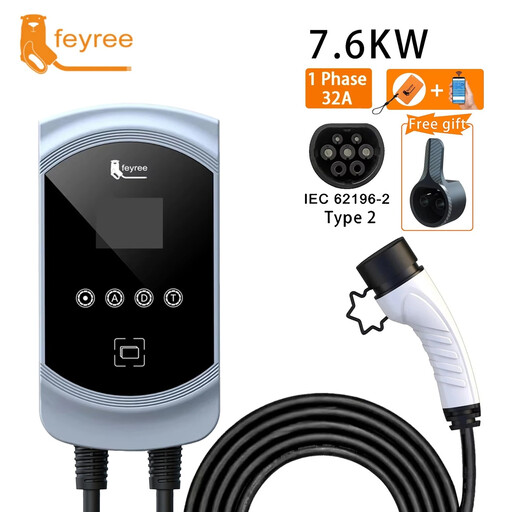
Why we recommend this product This EV Charger from feyree combines solid charging power for single-phase connections with extensive smart features. Control via the Tuya Smart App provides detailed management of the charging process, including scheduling and current adjustment. Its integrated protection mechanisms cover all relevant safety scenarios.
Advantages
- Adjustable Charging Current: The current can be flexibly adjusted between 8A and 32A to match the capacity of your home's electrical system.
- Comprehensive App Control: Remote control, charge scheduling, and monitoring via Wi-Fi and the Tuya Smart App.
- High Safety Standards: Integrated protection against leakage current, overvoltage, overheating, and more.
- Weather Resistance: The IP65 protection rating ensures reliable operation outdoors.
- Access Control: An RFID card function allows for authorised charging sessions.
Who it's for This model is designed for homeowners with a single-phase connection who are looking for a permanently installed, intelligent, and secure wallbox with app functionality. It is ideal for users who want to precisely control the charging process and integrate it into their smart home ecosystem.
2. dé Type 2 Schuko EV Charger – Mobile Charging Cable for Maximum Flexibility
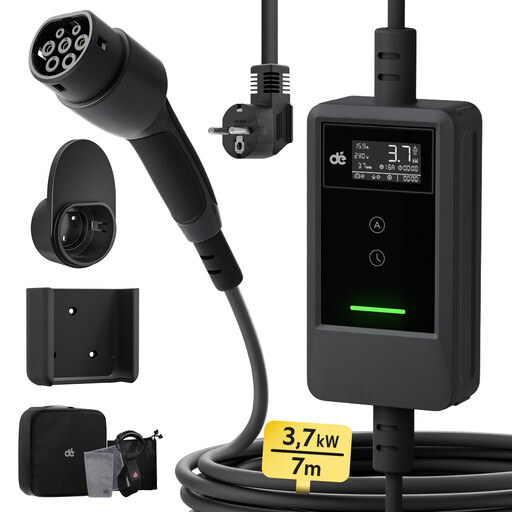
Why we recommend this product This mobile charger from dé offers a straightforward plug-and-play solution for charging at any standard Schuko socket. It requires no permanent installation, making it a highly flexible option. The ability to adjust the charging current via the app or directly on the device protects the home's electrical system from overload.
Advantages
- Universal Compatibility: Connects to any 230V household socket and is compatible with all vehicles featuring a Type 2 charging cable connector.
- No Installation Required: Ready to use immediately without needing an electrician.
- Adjustable Charging Current: The current can be selected between 6A and 16A to adapt the charging power to the specific socket.
- Smart Features: App control for monitoring and scheduling charging sessions.
- Portability: Its compact design and 7-metre cable length make it ideal for travel or as a secondary charger.
Who it's for This portable EV charging cable is the perfect solution for renters who cannot make structural modifications, as well as for EV owners who need a reliable charging option for travel or when visiting friends and family.
3. dé Wallbox 22kW – High-Performance 3-Phase Charging Station
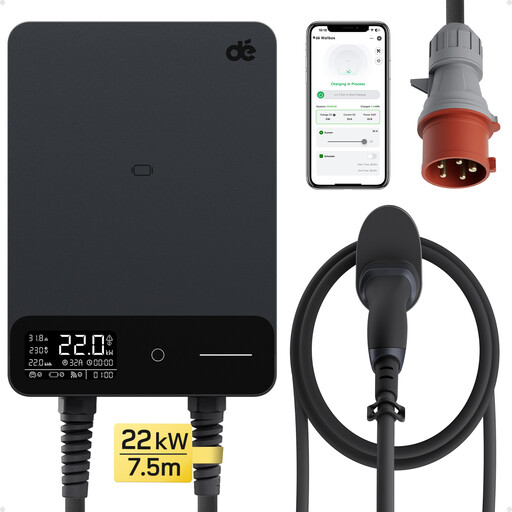
Why we recommend this product The dé 22kW Wallbox is designed for maximum charging performance in private and semi-public settings. With its 3-phase connection and integrated energy meter, it offers a future-proof solution for fast charging and precise cost control. The built-in Type B RCD simplifies installation and reduces additional costs.
Advantages
- High Charging Power: Up to 22 kW of power for extremely short charging times (vehicle-dependent).
- Integrated Energy Meter: Enables accurate tracking of consumption, useful for billing a company car.
- App Control: Full control over charge scheduling, power adjustment (6A-32A), and consumption data.
- Integrated Type B RCD: A built-in AC/DC sensitive fault current protection device increases installation safety and saves costs.
- Long Cable: The 7.5-metre Type 2 charging cable offers great flexibility in positioning the vehicle.
Who it's for This 3-phase wallbox is aimed at homeowners with a three-phase connection and an electric vehicle that supports high AC charging speeds. It is ideal for users who value maximum charging speed, detailed consumption monitoring, and high safety standards.
Alternatives and Additional Accessories
In addition to the charging electronics, the quality of the connecting cable is crucial for a safe and efficient charging process. A standard-compliant cable ensures correct communication between the vehicle and the charging point. You can find a selection of certified cables for various needs in our Type 2 Charging Cables category.
Frequently Asked Questions (FAQ)
1. Do I need a permit to install a wallbox? Regulations vary by region. In many places, wallboxes up to 11 kW only need to be registered with the local grid operator. Wallboxes with a power output greater than 11 kW (e.g., 22 kW) often require a permit before installation. The registration or permit application is typically handled by the certified electrician performing the installation.
2. Can I install a wallbox myself? No. Connecting a wallbox to the electrical grid is a high-voltage installation that, for safety and legal reasons, must be performed exclusively by a qualified electrical professional. Improper installation can lead to severe damage to your property, your vehicle, and pose a risk of fatal injury.
3. What is the difference between an 11 kW and a 22 kW wallbox? The primary difference is the maximum charging power. A 22 kW wallbox can theoretically charge a compatible EV twice as fast as an 11 kW version. In practice, the actual charging time depends on the vehicle's on-board charger, as many EVs are limited to 11 kW for AC charging. Additionally, the administrative and often financial overhead for installing a 22 kW wallbox is higher (permit requirements, potential need for a more powerful home electrical connection).