
Energy-Efficient Fan Heaters: Our Top Picks for 2026
With energy costs on the rise, the efficiency of heating solutions is a growing priority. An electric fan heater offers a way to quickly heat individual rooms on demand, without needing to power up the entire central heating system. Modern devices, particularly ceramic fan heaters, are engineered with technical features that optimise both energy consumption and operational safety. Selecting the right model depends on objective criteria such as the heating technology, power management, and integrated safety mechanisms.
Buyer's Guide: What to Look for in an Energy-Efficient Fan Heater
A fan heater should be evaluated based on its technical specifications. The following parameters are crucial for making an informed decision.
1. Heating Technology: PTC Ceramic as the Standard
Modern fan heaters typically use PTC (Positive Temperature Coefficient) heating elements. These ceramic semiconductors have self-regulating properties: as the temperature rises, their electrical resistance increases, which automatically reduces current draw and, consequently, heat output. This prevents overheating and contributes to energy efficiency. Compared to devices with traditional heating coils, PTC heaters provide more even heat distribution and do not burn dust, which minimises odours.
2. Energy Efficiency and Power Management
Energy efficiency is largely determined by a precise fan heater with a thermostat. Such a device automatically shuts off once the set room temperature is reached and turns back on when the temperature drops. This avoids unnecessary continuous operation and lowers electricity costs. Look for models that allow for precise temperature adjustments (e.g., in 1°C increments). Multiple power levels (e.g., 900W, 1500W, 2000W) also allow you to adapt the heating output to the room size and current heating needs.
3. Noise Level (Decibels)
For use in noise-sensitive environments like a bedroom fan heater or a home office, quiet operation is crucial. The noise level is measured in decibels (dB). Models with an operating noise level below 45 dB are considered quiet. Particularly quiet devices can reach levels as low as 25 dB in their lowest mode, which is equivalent to a whisper. This is often achieved with brushless DC motors, which operate with less vibration and noise than conventional AC motors.
4. Safety Features
A safe fan heater is characterised by multiple protective mechanisms. Essential standards include:
- Overheat Protection: A sensor automatically shuts the device off if internal temperatures become too high.
- Tip-Over Protection: A switch on the base of the unit immediately cuts power if the fan heater is knocked over.
- Flame-Retardant Material: The housing should be made of V-0 certified, flame-retardant plastic to minimise fire risk.
- Certifications: Certifications like CE and CB confirm compliance with European safety standards.
5. Ease of Use
Additional features enhance its practical utility. A fan heater with a remote control allows you to manage all functions from a distance. A programmable timer (e.g., 1–12 hours) enables automatic shut-off after a predefined period. An optional oscillation (swivel function) ensures better distribution of warm air throughout the room.
Our Product Selection for 2026
Based on the technical criteria mentioned above, we present two models that stand out for their specifications and feature sets.
DREO Energy Saving Fan Heater - 1500W Atom 318
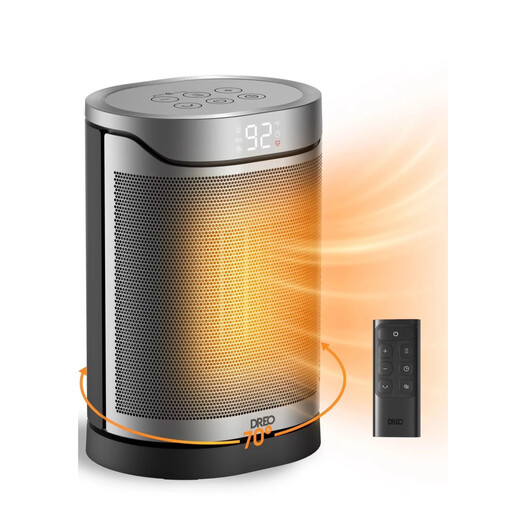
Product Specification Analysis: The Dreo Atom 318 is a compact ceramic fan heater designed for rapid, targeted heating of small to medium-sized rooms up to 20 m². Its core component is a PTC heating element, which, according to the manufacturer, enables a 2-second heat-up time. The brushless DC motor ensures quiet operation with a noise level between 25 and 42 dB. The integrated thermostat is adjustable from 5°C to 35°C in 1°C increments and manages the three power levels (900W / 1300W / 1500W) as needed. The 8-stage safety system includes tip-over and overheat protection, as well as a flame-retardant housing.
Pros:
- Rapid heat output from the 1500W PTC heating element
- Very quiet operation (from 25 dB), suitable for bedrooms and offices
- Precise digital thermostat for enhanced efficiency
- Comprehensive safety features (Shield360˚)
- Compact design and low weight (1.67 kg)
Who It's For: This model is designed for individuals seeking an efficient and quiet supplemental heater for single rooms such as a home office, bedroom, or small living area. Its compact size makes it easily portable.
View the Dreo Atom 318 on Joybuy.de
DREO Energy Saving Fan Heater - 2000W Solaris 628
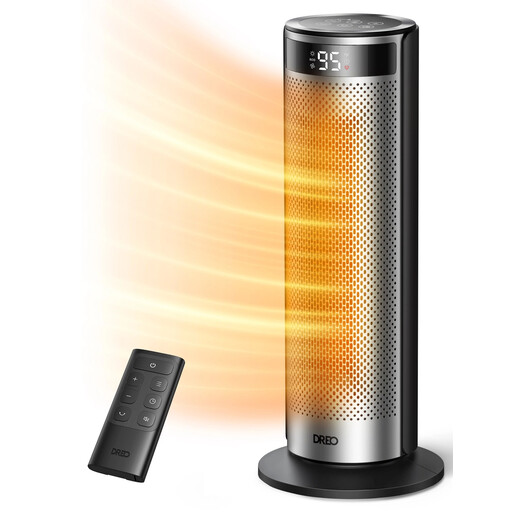
Product Specification Analysis: The Dreo Solaris 628 is a more powerful tower fan heater designed for rooms ranging from 15 to 25 m². With a maximum output of 2000W and an enlarged PTC heating element (250x44 mm), it generates a powerful 3.1 m/s airflow for fast and wide-reaching heat distribution. Despite its high power, the noise level remains low at 25 to 42 dB, thanks to its dual DC motor. The device features the same precise control and safety functions as the smaller model, including a digital thermostat (5–35°C), a 12-hour timer, a remote control, and the 8-stage Shield360˚ safety system.
Pros:
- High heating output of 2000W for larger rooms
- Fast and even heat distribution with 70° oscillation
- Quiet operation despite high power (from 25 dB)
- Comprehensive safety features, including a child lock
- Remote control for enhanced convenience
Who It's For: This model is ideal for users who want to heat larger living rooms, open-plan offices, or poorly insulated spaces quickly and efficiently, without compromising on noise or safety.
View the Dreo Solaris 628 on Joybuy.de
Other Options and Alternatives
The selection of heating devices is diverse, covering various technologies and power classes. If you wish to compare more models or explore other product categories, you can find a broader overview in our section for energy-efficient home appliances.
Frequently Asked Questions (FAQ)
1. How much electricity does an energy-saving fan heater use? Power consumption depends on the wattage and duration of use. A 1500W fan heater running continuously for one hour at its highest setting will consume 1.5 kilowatt-hours (kWh). However, a fan heater with a thermostat does not run continuously. It shuts off once the target temperature is reached, which significantly reduces overall consumption. The actual cost will depend on your electricity tariff.
2. Are ceramic fan heaters safer than models with heating coils? Yes, PTC ceramic fan heaters offer a higher level of safety by design. The material self-regulates its temperature and does not get as hot as glowing coils. Additionally, they burn fewer dust particles, which improves indoor air quality. Combined with modern safety mechanisms like tip-over and overheat protection, they are considered a safe choice for home use.
3. Can you leave a fan heater running overnight in a bedroom? Models with comprehensive safety features are designed for unattended operation, such as overnight use. A precise thermostat maintains a constant temperature, overheat protection prevents critical temperatures, and tip-over protection shuts the unit off if it is accidentally knocked over. A programmable timer offers additional control by automatically turning the device off after a set period.